

Bus Integration Dedicated to Improving Resilience, Eliminating Congestion, and Triggering Innovation Over Numerous Applications and Localities Act or the BIDIRECTIONAL Act This bill establishes requirements to encourage the deployment of vehicle-to-grid and vehicle-to-everything technologies and applications that enable bidirectional charging, such as technologies that enable electric vehicles to use their batteries to power the energy grid or homes when they are not being driven. Specifically, the bill requires states to consider measures to promote vehicle-to-grid integration under the Public Utility Regulatory Policies Act. The bill also directs the Department of Energy to establish a grant program for projects that use at least one electric school bus with such technology. Grants may be awarded to electric energy suppliers, state public utility commissions, school bus manufacturers, school districts, suppliers of charging infrastructure, renewable energy developers, and other eligible entities.
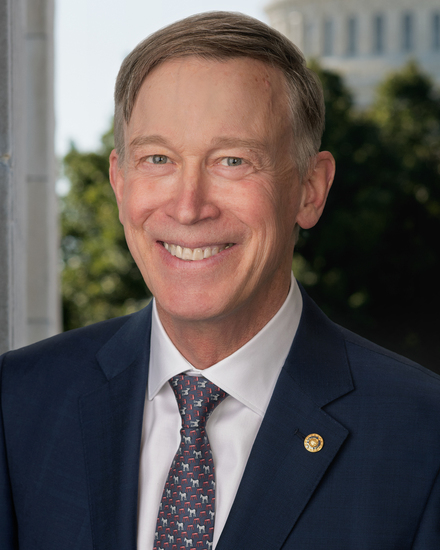
Sen. John W. Hickenlooper
Sponsored bills
Maddy summarySRES 799 is a non-binding Senate resolution designating October 5, 2022, as "Energy Efficiency Day." It commemorates the economic and environmental benefits of energy efficiency, citing historical achievements like $800 billion in annual energy cost savings and 2 million jobs in the sector. The resolution does not create new policies or affect any group; it solely encourages public recognition through events and awareness activities. It references past bipartisan energy efficiency legislation but does not alter existing laws. This is a symbolic gesture celebrating existing progress, not a policy change.
Maddy summaryThis Senate resolution (SRES 794) officially designates the week of September 26-30, 2022, as "National Clean Energy Week." It does not create new laws or affect specific people or groups; instead, it symbolically recognizes the importance of clean energy. The resolution encourages Americans, businesses, and governments to support clean energy solutions and invest in affordable, low-emission technologies. It highlights clean energy’s role in job creation and economic growth but contains no binding requirements or policy changes.
Election Worker Protection Act of 2022 This bill addresses certain protections for election workers. Among other provisions, the bill (1) establishes grants for the recruitment, training, and safety of election workers; and (2) makes it a crime to intimidate, threaten, coerce, or harass an election worker with the intent to interfere with the official duties of, or retaliate against, the worker.
Non-Recognition of Russian Annexation of Ukrainian Territory Act This bill prohibits any federal agency from taking any action or extending any assistance that recognizes or implies recognition of Russia's sovereignty over any internationally recognized territory of Ukraine, including its airspace and territorial waters.
Democracy Is Strengthened by Casting Light On Spending in Elections Act of 2022 or the DISCLOSE Act of 2022 This bill addresses campaign finance, including by expanding the prohibition on campaign spending by foreign nationals, requiring additional disclosures of campaign expenditures, and requiring additional disclosures regarding certain political advertisements. Specifically, the bill expands existing foreign money prohibitions to include disbursements for paid web-based or digital communications and federal judicial nomination communications. It also prohibits foreign nationals from contributing to campaigns related to ballot initiatives and referenda. The Government Accountability Office must, for each four-year election cycle, study and report on the incidence of illicit foreign money in federal elections. Next, the bill makes it unlawful to establish or use a corporation, company, or other entity with the intent to conceal an election contribution or donation by a foreign national. A violator is subject to criminal penalties—a fine, a prison term of up to five years, or both. Covered organizations (e.g., corporations, labor organizations, and political organizations) must, within 24 hours, file reports with the Federal Election Commission to disclose campaign expenditures of more than $10,000 during an election cycle. The bill also requires organizations to provide additional disclosures regarding political advertisements, including the donors who contributed the most money to that organization in the last year.
This resolution recognizes (1) the celebration of Hispanic Heritage Month from September 15-October 15, 2022; and (2) the integral role of Latinos and their manifold heritage in the economy, culture, and identity of the United States.
Maddy summarySRES 780 is a Senate resolution designating September 2022 as "National Workforce Development Month." It does not create new laws or funding but formally acknowledges the importance of workforce development programs. The resolution supports existing federal initiatives like the Workforce Innovation and Opportunity Act, which helps workers gain skills through training, career pathways, and job placement services. It recognizes that these programs assist millions of people, including those with low incomes, veterans, and individuals with disabilities, by connecting them to employment opportunities.
This resolution remembers Her Majesty Queen Elizabeth II and her more than 70 years of service in support of the British people and the Commonwealth of Nations. The resolution also expresses gratitude to Queen Elizabeth II for her efforts to maintain strong bilateral relations between the United Kingdom and the United States. Finally, the resolution extends condolences to the family of Queen Elizabeth II, to the people of the United Kingdom of Great Britain and Northern Ireland, and to the peoples of the Commonwealth of Nations.
Secure and Fair Enforcement Banking Act of 2021 or the SAFE Banking Act of 2021 This bill generally prohibits a federal banking regulator from penalizing a depository institution for providing banking services to a legitimate cannabis-related business. Prohibited penalties include terminating or limiting the deposit insurance or share insurance of a depository institution solely because the institution provides financial services to a legitimate cannabis-related business and prohibiting or otherwise discouraging a depository institution from offering financial services to such a business. Additionally, proceeds from a transaction involving activities of a legitimate cannabis-related business are not considered proceeds from unlawful activity. Proceeds from unlawful activity are subject to anti-money laundering laws. Furthermore, a depository institution is not, under federal law, liable or subject to asset forfeiture for providing a loan or other financial services to a legitimate cannabis-related business. The bill also provides that a federal banking agency may not request or order a depository institution to terminate a customer account unless (1) the agency has a valid reason for doing so, and (2) that reason is not based solely on reputation risk. Valid reasons for terminating an account include threats to national security and involvement in terrorist financing, including state sponsorship of terrorism.