

Maddy summaryThis bill funds research at land-grant universities to study how grazing by hoofed animals (like cattle or deer) can reduce wildfire risks on public and private lands. It directs grants for developing grazing techniques that lower fire fuels, aid post-fire recovery, and protect soil, water, and native plants - while avoiding invasive species spread or erosion. Key research areas include rotational grazing, managed stocking rates, and water point management. The findings will be shared through educational materials and outreach to help landowners and managers adopt these practices. The bill focuses on research, not direct land management changes.
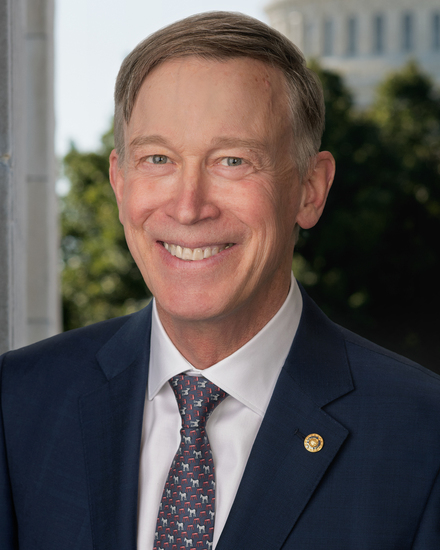
Sen. John W. Hickenlooper
Sponsored bills
Credit Union Board Modernization Act This bill revises the required frequency of meetings held by a credit union's board of directors. Specifically, new credit unions and credit unions with a low soundness rating must meet monthly. All other credit unions must hold at least six meetings annually, with at least one meeting held during each fiscal quarter. Currently, all credit union boards must meet at least once a month.
This resolution supports the designation of Career and Technical Education Month to celebrate career and technical education across the United States.
Maddy summaryThis bill establishes the Wildfire Intelligence Center within the Departments of Agriculture, Commerce, and Interior to centralize wildfire data and coordination. The Center will provide real-time risk assessments, fire behavior modeling, and tools for evacuation planning to help communities, firefighters, and emergency responders. It aims to improve data sharing across federal, state, tribal, and local agencies managing wildfire response by creating standardized tools and a unified information platform. The Center will focus on pre-fire planning, active response, and post-fire recovery using aggregated scientific data and predictive services.
Protecting Sensitive Locations Act This bill prohibits immigration enforcement actions within 1,000 feet of a sensitive location except in exigent circumstances, such as the imminent risk of death, violence, or physical harm to any person. Sensitive locations include health care facilities; schools and school bus stops; places that provide assistance for people such as children, pregnant women, and abuse victims; child care facilities; places that provide disaster or emergency services; places of worship; courthouses and lawyers’ offices; facilities used as polling places; certain labor union facilities; and public assistance offices. The prohibition shall apply to Department of Homeland Security officers and agents, as well as state employees pursuing immigration enforcement actions. If an enforcement action is carried out in violation of this prohibition (1) no information resulting from the action may be entered into the record in a resulting removal proceeding, and (2) the affected individual may move to immediately terminate such a proceeding. U.S. Immigration and Customs Enforcement and U.S. Customs and Border Protection shall annually report to Congress about enforcement actions taken at sensitive locations in the preceding year.
Maddy summaryThis bill permanently extends the New Markets Tax Credit (NMTC) program, which incentivizes private investment in low-income communities. It modifies the tax code to keep the credit available beyond 2025 (replacing "2020 through 2025" with "2020 and each calendar year thereafter") and adds automatic annual inflation adjustments to the credit amount starting in 2026. The bill also provides tax relief by allowing NMTC credits to offset the alternative minimum tax, specifically for investments made after December 2024. This directly affects community development financial institutions (CDFIs) and investors who fund projects in designated low-income areas.
Maddy summaryThis bill creates a new "Director of Foreign Assistance" position within the U.S. Department of State, requiring Senate confirmation and mandating that the Director report directly to the Deputy Secretary of State. The Director's duties include coordinating all U.S. foreign aid programs across agencies (like USAID and the Treasury), aligning aid with national security goals, tracking results through data analysis, and improving transparency in spending. The bill also requires all foreign aid funds to be obligated (committed for spending) within 90 days of congressional appropriations. This position directly affects how the State Department and other federal agencies manage and report on foreign assistance programs.
This resolution condemns Russia's nuclear escalatory rhetoric and implied threats on the potential use of nuclear weapons in the context of its invasion of Ukraine. The resolution also (1) condemns Russia's purported suspension of participation in the New START Treaty, (2) emphasizes the value of arms control agreements between the United States and Russia, and (3) calls on the administration to continue pursuing nuclear arms control and risk reduction with Russia and China.
Maddy summaryS 422, the Right to Contraception Act, establishes a federal statutory right for individuals to access contraceptives and for healthcare providers to offer contraceptive services, free from state restrictions. It directly affects all Americans seeking or providing contraception, particularly protecting historically marginalized groups like people of color, immigrants, LGBTQ+ individuals, and low-income or rural residents who face barriers to care. The bill overrides state laws that restrict access - such as bans on specific contraceptives, provider refusal policies based on personal beliefs, or Medicaid restrictions - and prohibits government actions that impede this right. Enforcement allows the Attorney General or affected individuals to challenge violations in court, with courts required to strike down restrictive laws.
Maddy summaryThis bill amends federal securities laws to expand regulatory exemptions for retirement plans used by charities and educational institutions. It specifically updates definitions to include 403(b) plans (common for nonprofit employees) under exemptions from certain registration and oversight rules, provided they meet three conditions: (1) they follow federal retirement law (ERISA), (2) the employer acts as a fiduciary for investment choices, or (3) they are governmental plans. This change directly affects employees of qualifying charities and educational institutions who participate in these 403(b) plans, reducing compliance burdens for their retirement plans. The policy change streamlines regulatory requirements without altering retirement benefits or funding.