

Maddy summaryHR 5581, the Uniform Standards Protection Act of 2025, prevents states from requiring federal law enforcement officers to wear specific uniforms. It directly affects federal officers, including those enforcing immigration laws, by overriding state laws that impose uniform requirements. The bill prohibits any state law mandating uniforms for these officers and stops ongoing state court cases against them for violating such laws. This creates a federal standard, ensuring uniform requirements for federal officers are set solely at the national level.
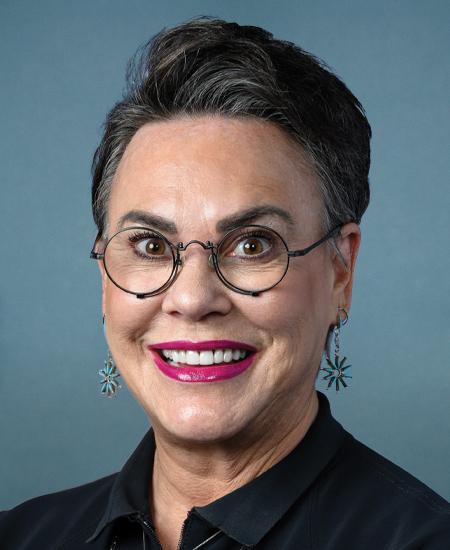
Rep. Harriet M. Hageman
Sponsored bills
Maddy summaryHRES 719 is a House resolution honoring Charles "Charlie" James Kirk, the founder of Turning Point USA who was assassinated on September 10, 2025. The resolution condemns his assassination and all political violence, extends condolences to his family, and calls on Americans to reject violence while promoting civil discourse. It specifically recognizes Kirk's legacy as a defender of constitutional principles and his role in inspiring youth through free speech and faith-based civic engagement. As a commemorative resolution, it does not enact policy changes but formally expresses the House's stance on honoring his life and legacy.
Maddy summaryHR 5483, the Chloe Cole Act, prohibits health care professionals, hospitals, or clinics from providing certain gender-affirming treatments to minors under 18 that aim to alter their body to align with a gender identity different from their sex assigned at birth. This includes puberty blockers, sex hormones, and specific surgeries, unless the treatment falls under narrow exceptions like medically necessary care for disorders of sexual development, injuries, or detransition. The bill creates a private right for affected minors or their guardians to sue providers for damages in federal court, with strict liability for violations. It applies when interstate commerce is involved (e.g., payments, travel, communications) and sets a 25-year statute of limitations from the minor’s 18th birthday.
Maddy summaryThis bill (HR 5431) prohibits the use of federal taxpayer money to pay reparations ordered by international courts or bodies for violations of international law. It directly affects the U.S. federal government, blocking any payment from existing federal funds for such reparations. The key mechanism requires Congress to pass a new law approving any specific reparations payment after this bill takes effect. The bill does not block existing international agreements but prevents automatic federal funding for new reparations awards.
Maddy summaryHR 5401, the Pay Our Troops Act of 2026, ensures military personnel, civilian Defense workers, and supporting contractors receive pay during government funding gaps in fiscal year 2026. It appropriates emergency funds for active-duty service members, reserves, and their supporting personnel (including Coast Guard staff under DHS) if regular appropriations aren't enacted by the end of the fiscal year. The bill provides necessary pay and allowances during any period when full-year funding is unavailable, covering both active service and support roles. Funding expires when regular appropriations are passed, a funding resolution is enacted, or January 1, 2027, whichever comes first. This is a procedural measure to prevent pay delays for military and support staff during fiscal year 2026 funding lapses.
Maddy summaryHR 5392, the Northern Arizona Protection Act, nullifies President Biden's August 2023 proclamation creating the Baaj Nwaavjo I'tah Kukveni-Ancestral Footprints of the Grand Canyon National Monument in Arizona. It prohibits the future designation or extension of national monuments within the specific area shown on the August 2023 map without explicit congressional approval. This bill directly affects federal land management in that region by blocking monument designations under the Antiquities Act without Congress authorizing them.
Maddy summaryThis bill would withhold 50% of federal highway funding from states that issue driver's licenses to people without proof of U.S. citizenship or legal residency status, starting in 2027. To comply, states must ban such licenses and allow local/state officials to share immigration status information with U.S. Customs and Border Protection. The Transportation Secretary would maintain a public database tracking each state's compliance with these requirements. The law directly affects state governments and their access to federal transportation funds, not individual drivers.
Maddy summaryThis symbolic resolution (HRES 700) condemns the assassination of Charlie Kirk, a conservative campus advocate and founder of Turning Point USA, who was killed on September 10, 2025, at Utah Valley University. It expresses the House's deepest condolences to Kirk’s family, including his wife and children, and honors his work promoting civil discourse among college students. The resolution does not create new laws or policies but serves as a formal expression of the House’s stance on the incident. It directly affects no individuals or groups through legislative action, as it is purely a ceremonial statement.
Maddy summaryThis bill prohibits U.S. federal agencies from purchasing large language models (LLMs) that do not meet specific standards for truthfulness, neutrality, and accuracy. It requires all federal LLM procurement after enactment to prioritize factual responses, historical/scientific accuracy, and nonpartisan outputs - explicitly banning models that encode partisan views or favor concepts like diversity, equity, and inclusion unless prompted by users. The rule applies to all federal agencies (excluding the Government Accountability Office) and directly affects LLM developers seeking government contracts. Key provisions mandate that LLMs must acknowledge uncertainty, avoid ideological manipulation, and remain neutral in responses. The law creates a concrete procurement standard for federal AI tools, not a broader regulation.
Maddy summaryThis bill requires pension plan administrators to locate and notify beneficiaries of unclaimed retirement funds ($50 or more) before transferring them to state unclaimed property programs. Administrators must first attempt to update contact information through databases and send a clear notice explaining the transfer process, unless no updated contact can be found. It establishes a national clearinghouse for states to manage these transfers and mandates regular reports to the Labor Secretary about unclaimed funds, including beneficiary details. The law protects administrators from liability if they follow these procedures, ensuring forgotten retirement savings can be recovered by rightful owners through state programs.