

Having Employees Return to Duty Act or the HERD Act This bill addresses federal employees who comply with Executive Order 14043 (requiring COVID-19 vaccination for federal employees). Specifically, the bill requires each federal agency to require employees who comply with the order to work from their duty station and to work the hours required as of February 15, 2020. The bill's requirement does not apply to immunocompromised employees. Additionally, the bill does not prohibit an agency from implementing different policies at a particular work site if the agency finds that (1) there is substantial transmission of COVID-19 within a community in which such requirements would otherwise be carried out; and (2) implementing those different policies will not degrade the level of service that the agency provides to the public.
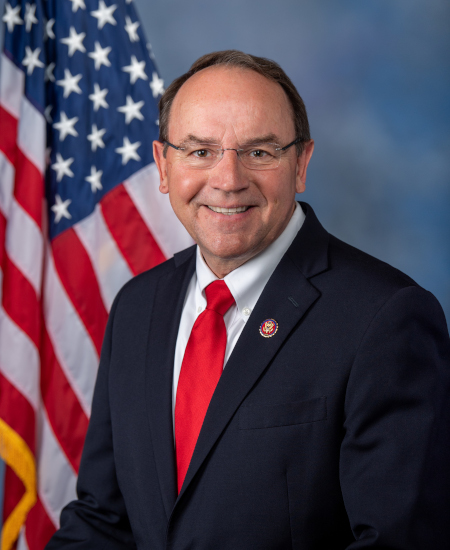
Rep. Thomas P. Tiffany
Sponsored bills
Keeping Our COVID-19 Heroes Employed Act This bill exempts essential workers from COVID-19 vaccination requirements imposed by the federal government and contractors, public entities that received federal COVID-19 relief funds, and private entities that received any federal funds. An essential worker is an individual who was deemed to be essential or exempted from response measures during the COVID-19 pandemic by a state, tribe, or territory.
Fiscal State of the Nation Resolution This concurrent resolution requires the congressional budget committees to conduct an annual joint hearing to receive a presentation from the Comptroller General regarding (1) the Government Accountability Office's audit of the financial statement of the executive branch, and (2) the financial position and condition of the federal government.
Supplying America Needs Truckers Aged 18 Act or the SANTA 18 Act This bill exempts drivers who transport goods from a port of entry and another place within the same state from age restrictions and other requirements that apply to federal commercial driver's licenses.
Saving Workers by Eliminating Economic Tampering and Ensuring Reliability Act or the SWEETER Act This bill eliminates certain Department of Agriculture (USDA) sugar subsidy programs. Specifically, the bill eliminates (1) the price support loan program available to processors of domestically grown sugarcane and sugar beets; (2) the sugar marketing allotments and tariff-rate quotas that limit the quantities of domestically produced sugar that processors may sell and the sugar that may be imported under lower tariff rates; and (3) the feedstock flexibility program for bioenergy producers, which operates to avoid loan forfeitures to the USDA's Commodity Credit Corporation by requiring USDA to purchase surplus sugar from domestic processors for resale to bioenergy producers.
Maddy summaryHRES 754 is a non-binding resolution expressing the House of Representatives' opposition to proposed "punitive natural gas taxes" on U.S. businesses, families, and workers. It cites claims that such taxes would raise average energy bills by 17%, reduce GDP by $9 billion, and eliminate 90,000 jobs, while disproportionately harming low-income households. The resolution argues that opposing these taxes supports U.S. energy security, national security, and continued leadership in reducing emissions through domestic natural gas production. As a procedural resolution, it does not create law but formally states the House's position against this policy approach.
This bill prohibits the use of federal funds to require a member of the Armed Forces to receive a COVID-19 vaccination. The bill also prohibits adverse action (e.g., punishment) being taken against a member of the Armed Forces because the member refuses to receive a COVID-19 vaccination.
Defund the People's Liberation Army Act This bill prohibits the purchasing or selling of publicly traded securities issued by certain listed Chinese military companies or contributors. The bill provides an exception for divestment in such securities. Decisions made by the Department of Defense to include a company on such a list or regulations created by the Department of the Treasury to carry out this bill are not subject to further review, including judicial review.
Safeguarding Educational Institutions, Colleges, Universities, and Research Entities from China's Attempts to Misappropriate Property of the United States Act of 2021 or the SECURE CAMPUS Act of 2021 This bill prohibits certain Chinese citizens from receiving visas to participate in graduate or post-graduate studies in science, technology, engineering, or math (STEM) and contains other related provisions. This prohibition applies to F (academic student) and J (exchange visitor) visas and does not apply to citizens or permanent residents of Taiwan or Hong Kong. (China considers Taiwan a Chinese province. Hong Kong is a special administrative region within China, and most of its permanent inhabitants are Chinese citizens.) The Department of State may waive this prohibition on a case-by-case basis for national security purposes or if the applicant is a member of a religious or ethnic group that is systematically oppressed by the Chinese Communist Party. Institutions of higher education in the federal Student and Exchange Visitor Program must annually certify that no prohibited Chinese citizens are permitted to participate in the institution's graduate or post-graduate STEM programs. A recipient of a federal STEM research grant must certify that the recipient (1) is not a Chinese citizen or a participant in a Chinese government foreign researcher recruitment program (a program that compensates individuals to conduct STEM-related research and development), and (2) will not knowingly use grant funds to employ such an individual. Entities that receive certain federal research or education assistance shall not knowingly employ any individual participating in a Chinese government foreign researcher recruitment program. An individual who recruits or performs research for such a program must register as an agent of a foreign principal.
Lower Costs, More Cures Act of 2021 This bill establishes and modifies several programs and requirements to address prescription drug prices. The bill modifies provisions under Medicare and Medicaid relating to prescription drug coverage and price transparency. Among other changes, the bill requires the Centers for Medicare & Medicaid Services to publish certain information, as reported by pharmacy benefit managers (PBMs), relating to generic dispensing rates, drug discounts and rebates, and payments between PBMs, health plans, and pharmacies; caps annual out-of-pocket spending under the Medicare prescription drug benefit; allows prescription drug plan sponsors under the Medicare prescription drug benefit to offer additional plans in a region; requires pass-through pricing models, and prohibits spread-pricing, for payment arrangements with PBMs under Medicaid; and allows states to include in the Medicaid Drug Rebate Program covered outpatient drugs that are provided as part of physician or outpatient hospital services. The bill also generally modifies other provisions relating to the regulation and costs of generic and brand-name drugs. Among other changes, the bill prohibits the manufacturer of a brand-name, generic, or biosimilar drug from entering into certain agreements to resolve or settle a patent infringement claim in connection with the sale of a drug or biological product; permanently allows high deductible health plans to waive deductibles for insulin and associated products; and establishes the position of Chief Pharmaceutical Negotiator in the Office of the U.S. Trade Representative.