This joint resolution nullifies a Bureau of Alcohol, Tobacco, Firearms and Explosives rule published on April 26, 2022, concerning regulatory definitions and identification of firearms.
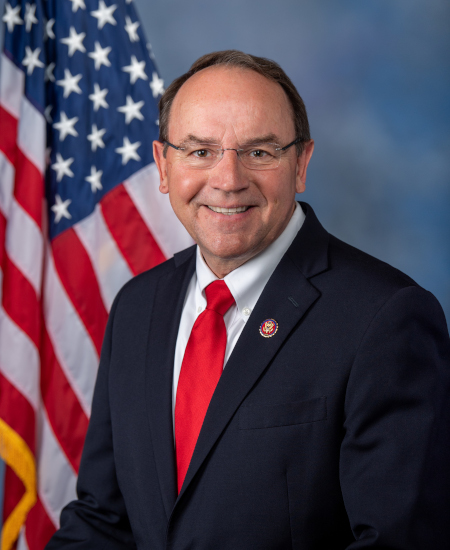
Rep. Thomas P. Tiffany
Sponsored bills
This joint resolution nullifies the interim final rule submitted by the Department of Justice and the Department of Homeland Security and published on March 29, 2022, concerning procedures for the consideration of asylum claims and other related issues. (Among other changes, the interim final rule requires an asylum seeker subject to expedited removal to be screened by an asylum officer for a credible fear of persecution or torture, rather than a credible fear of persecution, reasonable possibility of persecution, or reasonable possibility of torture.)
This resolution condemns recent attacks on pro-life facilities, groups, and churches and calls on the current presidential administration to use appropriate law enforcement authorities to support their safety.
This resolution expresses the sense of the House of Representatives that the President should work with Congress to develop and execute a strategy to counter the rise in violent crime across the country by reinforcing strong criminal justice policies, by laying blame on the perpetrators of violent acts, and by securing the southern border.
Ending Catch and Release Act of 2022 This bill changes the treatment of certain non-U.S. nationals ( aliens under federal law) without lawful immigration status, including by prohibiting the release of asylum seekers into the United States while their cases are pending. The Department of Homeland Security (DHS) may not (with some exceptions) release an individual who is not clearly entitled to admission into the United States while the individual's case is pending, even if the individual is an asylum seeker. DHS may instead detain the individual or return the individual to a neighboring country in certain situations. The bill also expands expedited removal from the United States (i.e., removal without further hearing or review) to include individuals present in the United States without being admitted, with certain exceptions. Under current law, individuals are subject to expedited removal if they lack proper documentation or obtained an immigration benefit through fraud; such individuals are still subject to expedited removal under the bill. The bill also modifies the standard for establishing a credible fear of persecution to avoid expedited removal. Generally, an asylum seeker may avoid expedited removal if an asylum officer finds such a credible fear. Under this bill, an officer may find credible fear if it is more likely than not the individual can establish their eligibility for asylum, whereas under current law, the officer may find credible fear if there is a significant possibility that the individual can establish their eligibility.

Keeping Violent Offenders Off Our Streets Act This bill conditions receipt of Edward Byrne Memorial Justice Assistance Grant program funding on certain minimum bail standards and public safety reporting. It also expands the definition of business of insurance (as it relates to crimes by or affecting persons engaged in the business of insurance whose activities affect interstate commerce) to include the posting of monetary bail, criminal bail bonds, and federal immigration bail bonds.
Protecting Kids from Candy-Flavored Drugs Act This bill establishes enhanced criminal penalties for certain federal drug offenses involving the manufacture or distribution of candy-flavored controlled substances or similar products for minors. Specifically, the bill imposes enhanced criminal penalties for a federal drug offense that involves manufacturing, creating, distributing, dispensing, or possessing with intent to distribute a controlled substance listed in schedule I or II that is combined with a candy or drink, marketed to appear similar to a candy or drink, or modified by flavoring or coloring to appear similar to a candy or drink. To be subject to an enhanced penalty, the individual must have knowledge or reasonable cause to believe that the controlled substance will be distributed, dispensed, or sold to an individual who is under 18 years of age.
Combating Violent and Dangerous Crime Act This bill revises various statutes with respect to violent crimes and establishes new criminal offenses. For example, the bill (1) increases the statutory maximum penalty for carjacking, and (2) establishes enhanced criminal penalties for certain federal drug offenses involving the manufacture or distribution of candy-flavored controlled substances or similar products for minors.
Protecting Pain-Capable Unborn Children from Late-Term Abortions Act This bill establishes a new criminal offense for performing or attempting to perform an abortion if the probable gestational age of the fetus is 15 weeks or more. A violator is subject to criminal penalties—a fine, a prison term of up to five years, or both. The bill provides exceptions for an abortion (1) that is necessary to save the life of the pregnant woman, or (2) when the pregnancy is the result of rape or incest. A physician who performs or attempts to perform an abortion under an exception must comply with specified requirements. A woman who undergoes a prohibited abortion may not be prosecuted for violating or conspiring to violate the provisions of this bill.
Alien Criminal Expulsion Act or the ACE Act This bill modifies the actions that the Department of State must take with regards to a foreign country that refuses to accept a citizen or national of that country who is subject to a final order of removal from the United States. Currently, the State Department must discontinue granting immigration visas, nonimmigrant visas, or both, to citizens or nationals of that country until the country has accepted the individual subject to removal. Under this bill, the State Department must discontinue granting both types of visas until the country accepts the individual.