

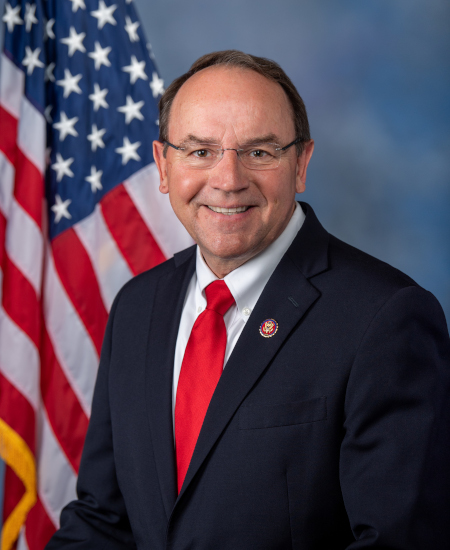
Photo of Thomas P. Tiffany
R United States House · District 7 · Wisconsin

Rep. Thomas P. Tiffany

Compare
Total votes
2,837
all sessions
Attendance
95%
137 missed
Lower than 93% of chamber peers
With party
90%
of cast votes
Lower than 86% of chamber peers
Bipartisan score
5%
crosses aisle rarely
Higher than 85% of chamber peers
Sponsored
912
bills & resolutions
Lower than 77% of chamber peers
Committees
6
assignments
912 bills and resolutions

Sponsored bills

Total
912
Primary
58
Co-sponsor
854
This page
912
matching current filters
Primary HCONRES 5
In committee · Indiana House · Lead sponsor
Expressing support for the Nation's law enforcement agencies and condemning any efforts to defund or dismantle law enforcement agencies.

Maddy summaryHCONRES 5 is a symbolic Congressional resolution expressing support for law enforcement officers and condemning calls to defund or dismantle local police departments. It highlights officer safety concerns, references rising fatalities in 2021, and argues that reduced funding would harm community safety. The resolution does not alter funding, create new laws, or change policy - it solely states Congress's position through non-binding language. It was introduced in January 2023 by a bipartisan group of House members.

In committee Jan 9, 2023 0 co-sponsors
Co-sponsor HJRES 12
In committee · Indiana House · Co-sponsor
Proposing a balanced budget amendment to the Constitution of the United States.

Maddy summaryH.J.Res. 12 proposes a constitutional amendment requiring the federal government to balance its budget annually, meaning spending cannot exceed revenue except under specific circumstances. It would directly affect Congress and the President by mandating that annual budgets must not exceed revenue, with exceptions requiring a 3/5 vote in both chambers of Congress or a military conflict waiver approved by a joint resolution. Key provisions include prohibiting increases to the national debt without a 3/5 congressional vote, requiring the President to submit a balanced budget proposal each year, and defining "receipts" to exclude borrowing. The amendment would take effect five years after ratification by 38 states (three-fourths of states) and includes limited waivers for declared wars or imminent national security threats. This is a procedural constitutional change, not a spending bill, and would fundamentally alter federal budgeting processes.

In committee Jan 9, 2023 1 co-sponsor
Co-sponsor HJRES 8
In committee · Indiana House · Co-sponsor
Proposing an amendment to the Constitution of the United States to require that the Supreme Court of the United States be composed of nine justices.

Maddy summaryHJRES 8 proposes a constitutional amendment to permanently set the Supreme Court's size at nine justices. The bill would require any future changes to the Court's composition to follow this specific number, locking in the current structure. It does not alter the existing Court size (which has been nine since 1869) but aims to prevent future adjustments through legislative action. The amendment must be ratified by three-fourths of state legislatures within seven years to take effect. This is a procedural proposal focused on constitutional structure, not a direct policy affecting citizens or programs.

In committee Jan 9, 2023 1 co-sponsor
Co-sponsor HR 86
In committee · Indiana House · Co-sponsor
Ending Catch and Release Act of 2023

Ending Catch and Release Act of 2023 This bill changes the treatment of certain non-U.S. nationals ( aliens under federal law) without lawful immigration status, including by prohibiting the release of asylum seekers into the United States while their cases are pending. The Department of Homeland Security (DHS) may not (with some exceptions) release an individual who is not clearly entitled to admission into the United States while the individual's case is pending, even if the individual is an asylum seeker. DHS may instead detain the individual or return the individual to a neighboring country in certain situations. The bill also expands expedited removal from the United States (i.e., removal without further hearing or review) to include individuals present in the United States without being admitted, with certain exceptions. Under current law, individuals are subject to expedited removal if they lack proper documentation or obtained an immigration benefit through fraud; such individuals are still subject to expedited removal under the bill. The bill also modifies the standard for establishing a credible fear of persecution to avoid expedited removal. Generally, an asylum seeker may avoid expedited removal if an asylum officer finds such a credible fear. Under this bill, an officer may find credible fear if it is more likely than not the individual can establish their eligibility for asylum, whereas under current law, the officer may find credible fear if there is a significant possibility that the individual can establish their eligibility.

In committee Jan 9, 2023 1 co-sponsor
Co-sponsor HR 117
In committee · Indiana House · Co-sponsor
To prohibit any entity that receives Federal funds from the COVID relief packages from mandating employees receive a COVID-19 vaccine, and for other purposes.

Maddy summaryHR 117 prohibits any organization receiving federal funds from pandemic relief packages from requiring employees to get a COVID-19 vaccine. It specifically applies to entities funded by the CARES Act, Families First Act, Paycheck Protection Program, Consolidated Appropriations Act 2021, or American Rescue Plan Act. Entities violating this rule must return all received funds to the federal government. The bill directly affects employers receiving these specific relief funds, not all employers or the general public.

In committee Jan 9, 2023 1 co-sponsor
Co-sponsor HR 100
In committee · Indiana House · Co-sponsor
No SmartPay for Anti-2A Companies Act

Maddy summaryHR 100, the No SmartPay for Anti-2A Companies Act, prohibits the federal government from awarding new contracts under the SmartPay Program for payment systems that use payment processors with a merchant category code designated for gun retailers. This means government agencies cannot contract with payment processors that categorize gun stores as a business type for processing transactions. The bill only applies to new contracts; existing agreements remain unaffected. It directly impacts payment processing companies that use such codes and federal agencies utilizing the SmartPay Program for future procurement.

In committee Jan 9, 2023 1 co-sponsor
Co-sponsor HR 79
In committee · Indiana House · Co-sponsor
WHO Withdrawal Act

WHO Withdrawal Act This bill requires the President to immediately withdraw the United States from the World Health Organization (WHO) and prohibits using any federal funds to provide for U.S. participation in the WHO. The bill also repeals the 1948 act authorizing the United States to join the WHO.

In committee Jan 9, 2023 1 co-sponsor
Co-sponsor HR 214
In committee · Indiana House · Co-sponsor
Veterans’ True Choice Act of 2023

Maddy summaryHR 214, the Veterans’ True Choice Act of 2023, allows veterans with service-connected disabilities to choose TRICARE Select over VA health care. It creates a new category of "covered veteran beneficiaries" who can enroll in TRICARE Select during the annual open enrollment period, with cost-sharing based on their disability status - not their military service date. The bill requires the VA and Defense Departments to establish a reimbursement agreement for these enrollments and mandates quarterly reports to Congress on implementation. This change directly affects veterans who qualify for TRICARE only through this new provision, giving them a formal choice between VA care and TRICARE Select.

In committee Jan 9, 2023 1 co-sponsor
Co-sponsor HR 38
In committee · Indiana House · Co-sponsor
Concealed Carry Reciprocity Act

Maddy summaryThis bill establishes nationwide recognition for valid concealed carry permits. It allows permit holders from any state to carry concealed handguns in states that either issue such permits or don't ban concealed carry, provided they carry a photo ID and their valid permit. Key provisions include making presentation of a valid permit and ID prima facie evidence of compliance, shifting the burden of proof to prosecutors if challenged, and requiring courts to award attorney fees to successful defendants. It does not override state laws prohibiting concealed carry on private property or government lands, nor does it affect restrictions on federal lands like national parks.

In committee Jan 9, 2023 1 co-sponsor
Co-sponsor HR 164
In committee · Indiana House · Co-sponsor
Close Biden’s Open Border Act

Close Biden's Open Border Act This bill provides $15 billion for the Department of Homeland Security to construct a border wall along the southern border of the United States. It also imposes a two-year moratorium on funding for U.S. contributions to the United Nations (U.N.). During the two-year period, funds may not be authorized or otherwise made available for contributions to the U.N.

In committee Jan 9, 2023 1 co-sponsor
Showing 511 to 520 of 912 bills
Previous 1 … 51 52 53 … 92 Next