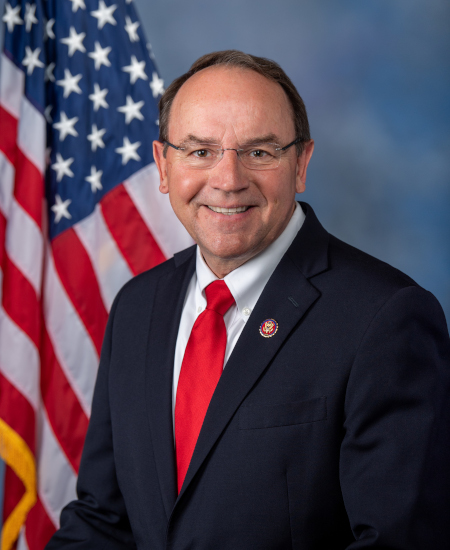
Photo of Thomas P. Tiffany
R United States House · District 7 · Wisconsin

Rep. Thomas P. Tiffany

Compare
Total votes
2,837
all sessions
Attendance
95%
137 missed
Lower than 93% of chamber peers
With party
90%
of cast votes
Lower than 86% of chamber peers
Bipartisan score
5%
crosses aisle rarely
Higher than 85% of chamber peers
Sponsored
912
bills & resolutions
Lower than 77% of chamber peers
Committees
6
assignments
912 bills and resolutions

Sponsored bills

Total
912
Primary
58
Co-sponsor
854
This page
912
matching current filters
Co-sponsor HR 377
In committee · Indiana House · Co-sponsor
Regulation Reduction Act of 2025

Maddy summaryHR 377, the Regulation Reduction Act of 2025, requires federal agencies to repeal three existing rules before issuing new ones that impose costs or responsibilities on businesses, state/local governments, or individuals. For major new rules, agencies must also certify that the new rule’s cost does not exceed the cost of the repealed rules. Agencies must publish all repealed rules in the Federal Register and submit a 90-day review to Congress identifying costly, ineffective, duplicative, or outdated regulations. This bill directly affects how federal agencies develop new rules, aiming to reduce regulatory burden by mandating rule removal before new rule creation.

In committee Jan 14, 2025 1 co-sponsor
Co-sponsor HR 274
In committee · Indiana House · Co-sponsor
Sunset Chevron Act

Maddy summaryHR 274, the Sunset Chevron Act, requires the Government Accountability Office (GAO) to compile a list of federal court decisions that upheld agency rules using Chevron deference (a judicial practice deferring to agency interpretations of laws) and are still in effect. The bill mandates that the GAO publish this list within 180 days of enactment, organizing it by agency and assigning each rule a sunset date. The most recent rule from each agency expires 30 days after the list's publication, with earlier rules expiring 30 days after the prior rule’s sunset date. This creates an automatic expiration process for specific agency rules upheld under Chevron deference, directly affecting federal agencies whose rules are included in the GAO's list.

In committee Jan 9, 2025 1 co-sponsor
Co-sponsor HJRES 12
In committee · Indiana House · Co-sponsor
Proposing an amendment to the Constitution of the United States to limit the number of terms that a Member of Congress may serve.

Maddy summaryThis proposed constitutional amendment would limit Members of Congress to serving a maximum of three terms in the House of Representatives or two terms in the Senate. It directly affects current and future members by preventing those who have already served the maximum terms from seeking re-election. Key provisions include counting vacancies filled for more than a year (House) or three years (Senate) as a full term toward the limit, while excluding terms served before ratification from the count. As a constitutional amendment proposal, it requires approval by three-fourths of state legislatures to become law.

In committee Jan 6, 2025 1 co-sponsor
Co-sponsor HR 6492
Signed into law · Indiana House · Co-sponsor
EXPLORE Act

Maddy summary# Summary of the EXPLORE Act Legislative Text This is a comprehensive legislative text (likely the "EXPLORE Act" - Enhancing Recreation Opportunities for People of All Abilities, and Veterans) that establishes several key initiatives to improve outdoor recreation access across Federal lands. ## Key Focus Areas: ### 1. Accessibility for People with Disabilities (Title II - Access America) - Requires comprehensive assessments of outdoor recreation facilities on Federal lands within 5 years - Mandates development of 3 new accessible trails per region for each agency (Forest Service, National Park Service, BLM, USFWS) within 1 year - Requires development of 2 new accessible recreation opportunities per region within 1 year - Requires making accessibility information available on public websites within 7 years - Requires development of accessible features including trail bridges, parking, and restrooms ### 2. Military and Veterans Programs - Requires educational materials for military members/veterans on accessing Federal lands free of charge within 2 years - Establishes Military Veterans Outdoor Recreation Liaisons within relevant agencies within 1 year - Requires a National Strategy for Military and Veteran Recreation within 1 year - Creates a pilot program for veteran employment in conservation positions - Promotes partnerships with organizations providing outdoor recreation for veterans ### 3. Youth Access - Requires a strategy to increase youth recreation visits to Federal lands within 2 years - Extends the "Every Kid Outdoors" program until September 30, 2031 - Focuses on increasing opportunities for underserved youth ### 4. Recreation Permitting Modernization (Title III) - Defines special recreation permits and establishes fee structures - Creates categories for different types of recreation permits - Establishes a process for application and review of permits - Includes provisions for multijurisdictional trips across different Federal lands The legislation aims to improve access to outdoor recreation for people with disabilities, veterans, and youth while modernizing the permitting process for recreational activities on Federal lands. It requires specific timelines for implementation and includes detailed definitions and requirements for each component of the bill.

Signed into law Jan 4, 2025 1 co-sponsor
Co-sponsor HR 4563
In committee · Indiana House · Co-sponsor
ACE Act

Maddy summary# Summary of Proposed Legislation This comprehensive legislative proposal contains multiple sections addressing election integrity, campaign finance reform, cybersecurity, census operations, and related government functions. Key provisions include: 1. **Campaign Finance Reforms**: - Increased thresholds for political committee reporting requirements - Repeal of requirements for political committees to report donor identification - Exemption of uncompensated internet communications from contribution/expenditure treatment - Protection of donor privacy for tax-exempt organizations through the "Speech Privacy Act of 2023" 2. **Election Security**: - Establishment of a process for testing and monitoring cybersecurity vulnerabilities in election equipment - Requirements for the Secretary of Homeland Security to notify state officials about election cybersecurity incidents - Exclusive authority for the Election Assistance Commission regarding guidelines for voting system certification 3. **Census and Redistricting**: - Establishment of a permanent Census Monitoring Board with bipartisan composition to review census operations - Clarification of state authority over congressional redistricting maps - Provisions regarding the Speaker of the House's authority to join civil actions related to apportionment 4. **Other Key Provisions**: - Termination of the Disinformation Governance Board and prohibition on funding similar entities - Amendments to the Federal Election Campaign Act to increase reporting thresholds and exempt certain communications - Various technical corrections to existing campaign finance law The legislation appears to focus on enhancing election security, reducing regulatory burdens on political organizations, protecting donor privacy, and strengthening oversight of census operations while maintaining constitutional boundaries between federal and state authority.


In committee Jan 3, 2025 1 co-sponsor
Co-sponsor HR 162
In committee · Indiana House · Co-sponsor
First Amendment Accountability Act

Maddy summaryHR 162, the First Amendment Accountability Act, creates a legal right for individuals to sue federal employees who violate their First Amendment rights (such as free speech or assembly) while acting under government authority. It directly affects citizens whose rights are infringed and federal employees (excluding the President/Vice President) who may face lawsuits. The bill allows victims to seek redress through court action, with courts having discretion to award attorney fees to the winning party. It explicitly excludes lawsuits against the federal government or employer for conduct within the scope of employment.

In committee Jan 3, 2025 1 co-sponsor
Co-sponsor HR 191
In committee · Indiana House · Co-sponsor
Inflation Reduction Act of 2025

Maddy summaryHR 191, titled "Inflation Reduction Act of 2025," is a procedural bill that repeals the Inflation Reduction Act of 2022 (Public Law 117-169) and rescinds its unobligated funds. It directly affects the implementation of the 2022 law by nullifying its provisions and redirecting any remaining unspent budget authority. The bill contains no new policy mechanisms or direct impacts on citizens or programs; its sole action is to undo the previous legislation. This is a straightforward repeal measure with no new funding or regulatory changes. The title is misleading, as the bill does not create a new inflation reduction policy but instead reverses the prior law.

In committee Jan 3, 2025 1 co-sponsor
Co-sponsor HR 45
In committee · Indiana House · Co-sponsor
FIND Act

Maddy summaryHR 45 (FIND Act) requires federal government contractors to certify they do not discriminate against firearm businesses (including manufacturers, dealers, and trade associations) in their policies or practices. The bill mandates that contractors and subcontractors (for contracts over 10% of the prime contract value) certify they have no discriminatory policies and will not adopt them during the contract term. Violations could lead to contract termination and potential debarment. This applies to all federal procurement contracts awarded after the bill's enactment, excluding sole-source contracts. The law aims to ensure firearm businesses are treated equally in government contracting without restricting legitimate business criteria like creditworthiness or legal compliance.

In committee Jan 3, 2025 1 co-sponsor
Co-sponsor HR 10516
In committee · Indiana House · Co-sponsor
ELITE Vehicles Act

Maddy summaryThe ELITE Vehicles Act (HR 10516) repeals three federal tax credits for electric vehicles: one for new clean vehicles (Section 30D), one for previously-owned clean vehicles (Section 25E), and one for commercial clean vehicles (Section 45W). It also removes tax credit eligibility for electric vehicle recharging infrastructure under Section 30C. These changes take effect 30 days after the bill’s enactment, eliminating tax benefits for individuals and businesses purchasing or contracting for eligible electric vehicles or charging equipment after that date. The bill directly affects consumers, dealers, and manufacturers who previously claimed these credits.

In committee Dec 19, 2024 1 co-sponsor
Co-sponsor HR 7513
In committee · Indiana House · Co-sponsor
Protecting American Seniors’ Access to Care Act

Maddy summaryHR 7513, the Protecting America’s Seniors’ Access to Care Act, prohibits the Department of Health and Human Services from implementing or enforcing a proposed rule that would have set minimum staffing requirements for nursing homes and other long-term care facilities receiving Medicare or Medicaid funding. The bill specifically blocks the September 2023 proposed rule (88 Fed. Reg. 61352-61429) and any substantially similar rule. This directly affects long-term care facilities that rely on federal healthcare program payments. The key mechanism is a clear statutory prohibition preventing the rule from taking effect, without altering existing staffing standards or requirements.

In committee Dec 19, 2024 1 co-sponsor
Showing 201 to 210 of 912 bills
Previous 1 … 20 21 22 … 92 Next