

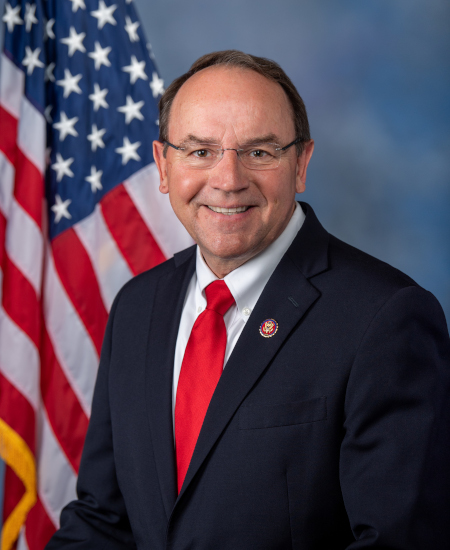
Photo of Thomas P. Tiffany
R United States House · District 7 · Wisconsin

Rep. Thomas P. Tiffany

Compare
Total votes
2,837
all sessions
Attendance
95%
137 missed
Lower than 93% of chamber peers
With party
90%
of cast votes
Lower than 86% of chamber peers
Bipartisan score
5%
crosses aisle rarely
Higher than 85% of chamber peers
Sponsored
912
bills & resolutions
Lower than 77% of chamber peers
Committees
6
assignments
912 bills and resolutions

Sponsored bills

Total
912
Primary
58
Co-sponsor
854
This page
912
matching current filters
Co-sponsor HR 810
In committee · Indiana House · Co-sponsor
Personalized Care Act of 2025

Maddy summaryHR 810, the Personalized Care Act of 2025, expands Health Savings Account (HSA) eligibility and benefits. It broadens who qualifies for HSAs to include individuals covered by more health plans (like Medicaid, Medicare, TRICARE) and health care sharing ministries (section 2). The bill also increases annual HSA contribution limits (to $10,800 for individuals and $29,500 for families) and reduces penalties for non-qualified distributions (section 3, section 7). Additionally, it allows periodic fees paid to physicians for defined medical services and health care sharing ministry fees to be treated as deductible medical expenses (sections 5, 8-9). These changes apply to taxable years beginning after December 31, 2024.

In committee Jan 28, 2025 1 co-sponsor
Co-sponsor HR 778
In committee · Indiana House · Co-sponsor
Safeguarding American Workers’ Benefits Act

Maddy summaryHR 778, the Safeguarding American Workers’ Benefits Act, modifies Social Security Number (SSN) requirements for claiming the Child Tax Credit (CTC) and Earned Income Tax Credit (EITC). It requires taxpayers to provide SSNs issued to U.S. citizens or under specific legal provisions (as defined in the bill) before the tax return deadline, replacing previous allowances for certain alternative numbers. This directly affects individuals filing taxes who seek these credits, as they must now use only eligible SSNs to qualify. The changes apply to taxable years beginning after December 31, 2025. The bill does not alter the credit amounts but tightens verification rules for eligibility.

In committee Jan 28, 2025 1 co-sponsor
Co-sponsor HR 21
Passed · Indiana House · Co-sponsor
Born-Alive Abortion Survivors Protection Act

Maddy summaryHR 21, the Born-Alive Abortion Survivors Protection Act, requires medical staff at abortion facilities to provide the same immediate care and hospital admission to any infant born alive during an abortion as they would for any newborn. It mandates reporting failures to provide this care to law enforcement and imposes penalties of up to 5 years in prison for violations, with harsher penalties for intentional killing. The bill also allows women who undergo abortions to sue for civil damages, including triple the abortion cost, and provides for attorney fees. It defines "abortion" to exclude procedures performed after viability to preserve a live birth. This law directly affects healthcare providers at abortion facilities and creates new federal legal obligations for them.

Passed Jan 24, 2025 1 co-sponsor
Co-sponsor HR 643
In committee · Indiana House · Co-sponsor
Federal Insurance Office Elimination Act

Maddy summaryHR 643, the Federal Insurance Office Elimination Act, eliminates the Federal Insurance Office within the Treasury Department and removes the position of its Director. The bill updates federal law by deleting references to the office from the Dodd-Frank Act and other legislation, while clarifying that Treasury retains all existing authority over insurance matters. This change directly affects the structure of federal financial regulation by removing a specific oversight role and modifying related statutory language. The bill does not alter insurance policy or create new regulatory requirements, only removing an existing office and its associated references.

In committee Jan 23, 2025 1 co-sponsor
Co-sponsor HR 710
In committee · Indiana House · Co-sponsor
Regulation Decimation Act

Maddy summaryThe Regulation Decimation Act requires federal agencies to repeal at least ten existing regulations before issuing a new rule that affects businesses, states, or local governments. For major rules (those with significant economic impact), agencies must repeal ten related rules and ensure the new rule's cost does not exceed the cost of the repealed rules, with Office of Management and Budget certification. The law excludes internal agency policies and rules revised to reduce burdens, and mandates agencies to review all costly or outdated rules within 90 days of enactment, reporting on rule reductions to Congress every five years. This bill directly affects federal agencies creating new regulations, aiming to reduce regulatory burden through mandatory rule repeal.

In committee Jan 23, 2025 1 co-sponsor
Co-sponsor HR 645
In committee · Indiana House · Co-sponsor
National Constitutional Carry Act

Maddy summaryHR 645, the National Constitutional Carry Act, would prevent all U.S. states and localities from requiring permits or imposing penalties for carrying firearms in public. It directly affects eligible U.S. citizens (including non-residents) who legally possess firearms under state and federal law, removing current permit requirements for public carry. The bill’s key provision amends federal law to invalidate any state or local law that criminalizes or discourages public firearm carry, except where private property owners clearly prohibit firearms or security screening occurs. This would override existing state permit laws, making permitless carry legal across all states and territories for qualified individuals.

In committee Jan 23, 2025 1 co-sponsor
Co-sponsor HR 703
In committee · Indiana House · Co-sponsor
Main Street Tax Certainty Act

Maddy summaryHR 703, the Main Street Tax Certainty Act, makes a key tax deduction permanent for small business owners. It removes the temporary sunset provision (subsection (i)) from Section 199A of the tax code, ensuring the qualified business income deduction remains available for eligible small businesses. This change directly affects pass-through business owners (like S-corps, partnerships, and sole proprietorships) who currently qualify for this deduction. The permanent change takes effect for tax years starting after December 31, 2025.

In committee Jan 23, 2025 1 co-sponsor
Co-sponsor HR 696
In committee · Indiana House · Co-sponsor
End Unaccountable Amnesty Act

Maddy summaryHR 696, the "End Unaccountable Amnesty Act," restricts immigration benefits by making Temporary Protected Status (TPS) more difficult to obtain. The bill requires new legislation for each country's TPS designation, mandates specific findings about armed conflict or disasters, and limits TPS to 12-month periods with possible 12-month extensions. It also limits immigration parole to 1,000 people annually for specific urgent humanitarian reasons or public benefits, and repeals "cancellation of removal" provisions that allowed some individuals to adjust their immigration status. These changes primarily affect immigrants seeking temporary protections or parole in the United States.

In committee Jan 23, 2025 1 co-sponsor
Primary HR 711
In committee · Indiana House · Lead sponsor
FAIR Act of 2025

Maddy summaryHR 711 (FAIR Act of 2025) prohibits federal agencies, contractors, and entities receiving federal funds from discriminating based on race, color, or national origin in federal contracts, employment, or federally funded programs. It specifically bans policies like racial quotas, set-asides, or numerical goals that grant preferences to any group. The law applies to all federal departments, contractors, and state/private recipients of federal aid, requiring them to eliminate such practices within six months of enactment. It does not affect immigration laws or existing contracts or ongoing legal cases.

In committee Jan 23, 2025 0 co-sponsors
Co-sponsor HJRES 28
In committee · Indiana House · Co-sponsor
Proposing an amendment to the Constitution of the United States to require that the Supreme Court of the United States be composed of nine justices.

Maddy summaryHJRES 28 proposes a constitutional amendment to permanently fix the number of justices on the U.S. Supreme Court at nine. This would require ratification by 38 state legislatures (three-fourths of states) within seven years to become part of the Constitution. The amendment directly affects the structure of the Supreme Court, which has had nine justices since 1869 but could otherwise be altered by future congressional action. It does not change current court operations or create new laws, but instead seeks to make the nine-justice composition a permanent constitutional requirement.

In committee Jan 22, 2025 1 co-sponsor
Showing 181 to 190 of 912 bills
Previous 1 … 18 19 20 … 92 Next