

Equality Act This bill prohibits discrimination based on sex, sexual orientation, and gender identity in areas including public accommodations and facilities, education, federal funding, employment, housing, credit, and the jury system. Specifically, the bill defines and includes sex, sexual orientation, and gender identity among the prohibited categories of discrimination or segregation. The bill expands the definition of public accommodations to include places or establishments that provide (1) exhibitions, recreation, exercise, amusement, gatherings, or displays; (2) goods, services, or programs; and (3) transportation services. The bill allows the Department of Justice to intervene in equal protection actions in federal court on account of sexual orientation or gender identity. The bill prohibits an individual from being denied access to a shared facility, including a restroom, a locker room, and a dressing room, that is in accordance with the individual's gender identity.
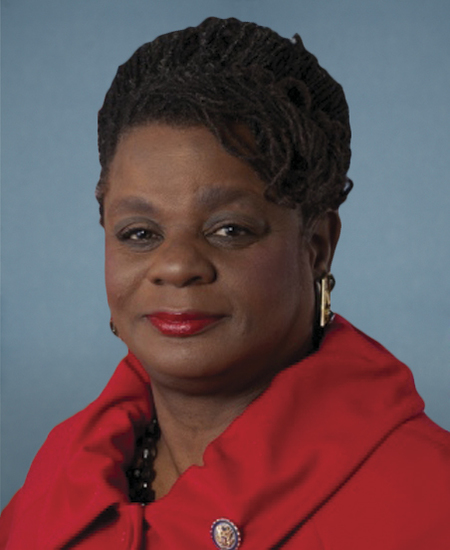
Rep. Gwen Moore
Sponsored bills
This resolution expresses support for the goals and ideals of Social Work Month and World Social Work Day.
This resolution acknowledges the impact of redlining (i.e., geographic discrimination) and states that the federal government has a responsibility to ameliorate its effects, including through the creation, preservation, and maintenance of equitable economic opportunities and recovery efforts in response to the COVID-19 (i.e., coronavirus disease 2019) pandemic.
State Health Care Premium Reduction Act of 2021 This bill establishes and provides funding for the Improve Health Insurance Affordability Fund. States must use allocated funds to (1) issue reinsurance payments to health insurers (i.e., reimbursements to protect insurers against exceedingly high claims) for individual health insurance coverage, or (2) provide other assistance to reduce out-of-pocket costs (e.g., copayments, coinsurance, and deductibles) for qualified health plans offered in the individual market through an exchange. Reinsurance payments using such funds may not be applied to (1) grandfathered health plans in place on March 23, 2010, (2) non-grandfathered transitional plans meeting specified requirements identified by the Centers for Medicare & Medicaid Services (CMS), or (3) student health insurance plans provided by institutions of higher education. The bill appropriates $10 billion per year for the fund, which the CMS must distribute to states in accordance with a specified methodology based on the estimated amount of reinsurance payments for individuals in a state during the given year, subject to specified deductions. Additionally, states must submit applications explaining how they will use such funds. In the event that a state does not submit an application, the bill directs the CMS to allocate the calculated funding amount to reinsurance programs in that state.
Medicaid Report on Expansion of Access to Coverage for Health Act or the Medicaid REACH Act This bill reduces federal payment for Medicaid administrative expenses incurred by states that have not elected to participate in Medicaid expansion under the Patient Protection and Affordable Care Act (i.e., nonexpansion states) if the state does not comply with specified reporting requirements. The bill requires nonexpansion states to report, among other information, the number of uninsured individuals under the age of 65 and the estimated percentage of such individuals who would be eligible to receive coverage if the state expanded Medicaid.
Supporting Veteran Families in Need Act This bill permanently extends the authorization for the Department of Veterans Affairs to provide financial assistance for supportive services for very low-income veteran families in permanent housing.
Immediate Coverage for Former Foster Youth Act This bill accelerates the application of certain changes that are scheduled to take effect under the Substance Use-Disorder Prevention that Promotes Opioid Recovery and Treatment (SUPPORT) for Patients and Communities Act relating to the coverage of former foster youth under Medicaid. Under current law, a state Medicaid program must cover former foster youth until the age of 26 if the youth were in the state's foster care system at the age of 18 and were enrolled in the state's Medicaid program while in foster care; a state may choose to also cover former foster youth from other states. The SUPPORT for Patients and Communities Act altered these provisions to require a state Medicaid program to cover former foster youth from other states until the age of 26; such changes apply to former foster youth who reach the age of 18 on or after January 1, 2023. The bill instead applies these changes to former foster youth who reach the age of 18 on or after the date of enactment of this bill. States must also establish Medicaid outreach and enrollment programs for former foster youth.
This bill designates the portion of U.S. Route 80 from Selma, Alabama, to Montgomery, Alabama, as the John R. Lewis Voting Rights Highway.
Dependent Income Exclusion Act of 2021 This bill excludes certain wages or self-employment earnings of a dependent of a taxpayer for purposes of determining the taxpayer's eligibility for premium tax credits used to purchase insurance on Patient Protection and Affordable Care Act exchanges. To qualify for the exclusion, the dependent must be under 18 years of age or have not attained age 24 during a specified five-year period, and be a full- or part-time student or apprentice or participant in a job training program.
Protecting the Right to Organize Act of 20 21 This bill expands various labor protections related to employees' rights to organize and collectively bargain in the workplace. Among other things, it (1) revises the definitions of employee , supervisor , and employer to broaden the scope of individuals covered by the fair labor standards; (2) permits labor organizations to encourage participation of union members in strikes initiated by employees represented by a different labor organization (i.e., secondary strikes); and (3) prohibits employers from bringing claims against unions that conduct such secondary strikes. The bill also allows collective bargaining agreements to require all employees represented by the bargaining unit to contribute fees to the labor organization for the cost of such representation, notwithstanding a state law to the contrary; and expands unfair labor practices to include prohibitions against replacement of, or discrimination against, workers who participate in strikes. The bill makes it an unfair labor practice to require or coerce employees to attend employer meetings designed to discourage union membership and prohibits employers from entering into agreements with employees under which employees waive the right to pursue or a join collective or class-action litigation. The bill further prohibits employers from taking adverse actions against an employee, including employees with management responsibilities, in response to that employee participating in protected activities related to the enforcement of the prohibitions against unfair labor practices (i.e., whistleblower protections). Such protected activities include providing information about a potential violation to an enforcement agency, participating in an enforcement proceeding, initiating a proceeding concerning an alleged violation or assisting in such a proceeding, or refusing to participate in an activity the employee reasonably believes is a violation of labor laws. Finally, the bill addresses the procedures for union representation elections, provides employees with the ability to vote in such elections remotely by telephone or the internet, modifies the protections against unfair labor practices that result in serious economic harm, and establishes penalties and permits injunctive relief against entities that fail to comply with National Labor Relations Board orders.