

Federal Jobs Act This bill requires federal agencies to develop plans to increase diversity in the workforce. Specifically, the Office of Personnel Management (OPM) and the Office of Management and Budget (OMB) must develop a plan to increase diversity in the executive branch of government that includes specified information, including strategies for agencies to remove barriers to equal employment opportunities. Each executive agency must develop an agency-specific plan to increase diversity, pursuant to OPM and OMB guidance, and periodically publish specified data. The legislative and judicial branches of government must also implement these requirements to the greatest extent possible. Additionally, each executive agency, and each prime contractor that is under contract with an executive agency, must periodically report information relating to economically and socially disadvantaged businesses.
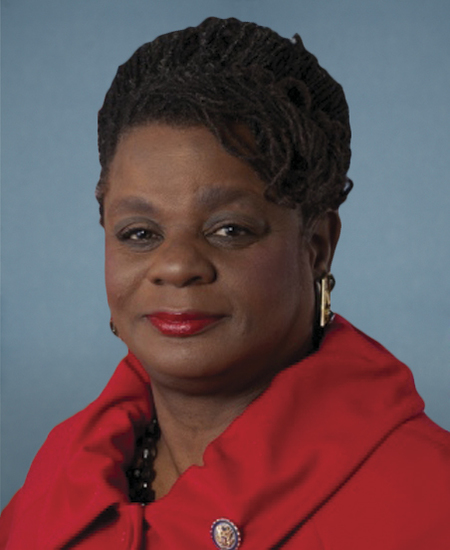
Rep. Gwen Moore
Sponsored bills
Domestic Violence Public Health Emergency Guidance Act This bill requires the Department of Justice to issue guidance to law enforcement agencies on model practices for addressing domestic violence and protecting the safety of law enforcement officers during the COVID-19 (i.e., coronavirus disease 2019) public health emergency.
Restoring Neighborhoods and Strengthening Communities Act This bill directs the Department of Transportation (DOT) to establish a grant program to identify infrastructural barriers posed by transportation facilities within certain communities (e.g., communities of color, low-income communities, or tribal or indigenous populations) and study the feasibility of improving, and developing plans to improve, connectivity within these communities by redesigning or removing such barriers. DOT may award grants to states, tribal and local governments, nonprofit organizations, and other entities for (1) community engagement, education, and capacity building, including to educate community members about opportunities to affect transportation and economic development planning and investment decisions; and (2) planning and feasibility studies, including development of designs and artistic renderings to facilitate community engagement. It may also award capital construction grants to the owner of an infrastructural barrier to carry out projects for which all necessary feasibility studies and other planning activities have been completed, including the replacement of an infrastructural barrier with a new use or facility that has been identified by members of the community.
Elijah E. Cummings Lower Drug Costs Now Act This bill establishes several programs and requirements relating to the prices of prescription drugs. In particular, the bill requires the Department of Health and Human Services (HHS) to negotiate prices for certain drugs (current law prohibits HHS from doing so). Specifically, HHS must negotiate maximum prices for single-source, brand-name drugs that lack certain generics and that are among either the 125 drugs that account for the greatest national spending or the 125 drugs that account for the greatest Medicare spending. HHS must negotiate the prices of at least 25 such drugs for 2024 and of at least 50 such drugs thereafter and must also negotiate prices for certain newly approved drugs and for insulin products. The negotiated prices must be offered under Medicare and may also be offered under private health insurance unless the insurer opts out. The negotiated maximum price may not exceed (1) 120% of the average price in Australia, Canada, France, Germany, Japan, and the United Kingdom; or (2) if such information is not available, 85% of the U.S. average manufacturer price. Drug manufacturers that fail to comply with the bill's negotiation requirements are subject to civil and tax penalties. The bill also makes a series of additional changes to Medicare prescription drug coverage and pricing, including by (1) requiring drug manufacturers to issue rebates to the Centers for Medicare & Medicaid Services for covered drugs that cost $100 or more and for which the average manufacturer price increases faster than inflation, and (2) capping annual out-of-pocket spending under the Medicare prescription drug benefit. The bill also requires drug manufacturers to report specified information for certain high-cost drugs, and it provides funds for opioid epidemic initiatives and biomedical research.
This bill restores the limitation on downward attribution rules to 50% of stock ownership in applying constructive ownership rules to controlled foreign corporations.
This resolution urges (1) the President to issue a proclamation recognizing Earth Day; and (2) governments and people to continue building upon the Paris Agreement and other efforts to ensure that future generations inherit a livable, sustainable, and ecologically rich planet. The resolution reaffirms that immediate action is needed to reduce greenhouse gas emissions and ameliorate environmental injustices in order to protect our planet, public health, and overall well-being of all people and wildlife. In addition, it encourages the American people to mark Earth Day by working to address environmental challenges, educate others about the need for year-round action, and honor the stewardship ethic for which Senator Gaylord Nelson stood.
Promoting Effective and Empowering Recovery Services in Medicare Act of 2021 or the PEERS Act of 2021 This bill specifies that peer support specialists may participate in the provision of behavioral health integration services with the supervision of a physician or other entity under Medicare. The bill defines peer support specialists as individuals who are recovering from a mental health or substance-use condition and have certain national or state credentials, as specified, to provide peer support services.
Pharmacy and Medically Underserved Areas Enhancement Act This bill provides for Medicare coverage and payment with respect to certain pharmacist services that (1) are furnished by a pharmacist in a health-professional shortage area, and (2) would otherwise be covered under Medicare if furnished by a physician.
Lady Liberty Act of 2021 This bill sets a floor of 125,000 for the maximum number of refugees who may be admitted into the United States each fiscal year. Under current law, the President sets the annual cap on refugee admissions at the beginning of each fiscal year. (The cap for FY2021 is 15,000, and the cap for FY2020 was 18,000.)
Black Maternal Health Momnibus Act of 2021 This bill directs multi-agency efforts to improve maternal health, particularly among racial and ethnic minority groups, veterans, and other vulnerable populations. It also addresses maternal health issues related to COVID-19 (i.e., coronavirus disease 2019). The Department of Health and Human Services (HHS) and other specified departments must address the social determinants of maternal health, which include child care, housing, food security, transportation, and environmental conditions. The bill also extends to 24 months postpartum eligibility for the Special Supplemental Nutrition Program for Woman, Infants, and Children. Additionally, HHS and other agencies must take actions to grow and diversify the maternal health workforce. To increase access to maternity care, HHS and other agencies must (1) award specified grants; (2) test an alternative payment model for perinatal care under Medicaid and the Children's Health Insurance Program (CHIP); and (3) support training, technology, and telehealth initiatives. The bill also increases research and data collection on maternal morbidity and mortality, particularly among tribal populations and minority groups. The Bureau of Prisons and the Department of Justice must establish programs to improve maternity care for incarcerated populations. The Medicaid and CHIP Payment and Access Commission must also report on the impact of Medicaid ineligibility for pregnant and postpartum prisoners. Additionally, as a condition for certain grants, states and territories must have laws limiting the use of restraints on pregnant individuals in prisons. The bill also directs activities to mitigate adverse maternal health outcomes associated with climate change and to improve maternal vaccination rates.