

Maddy summaryThe Beverage Regulatory Parity Act establishes a federal framework for regulating hemp-derived non-alcoholic beverages containing naturally occurring cannabinoids, such as delta-9 THC and CBD. The bill assigns primary regulatory authority to the Tax and Trade Bureau, which will enforce a three-tiered distribution system requiring separate permits for manufacturers, wholesalers, and retailers, while also setting strict labeling, advertising, and age-restriction requirements modeled after alcohol regulations. Additionally, the Food and Drug Administration will oversee product safety by defining standards for adulteration and misbranding, ensuring that beverages do not contain synthetic cannabinoids or harmful additives like alcohol or nicotine. The legislation imposes a federal excise tax of 8 cents per milligram of intoxicating THC content on these products and explicitly preserves state and local authority to enact more stringent laws or prohibit the sale of such beverages within their jurisdictions.
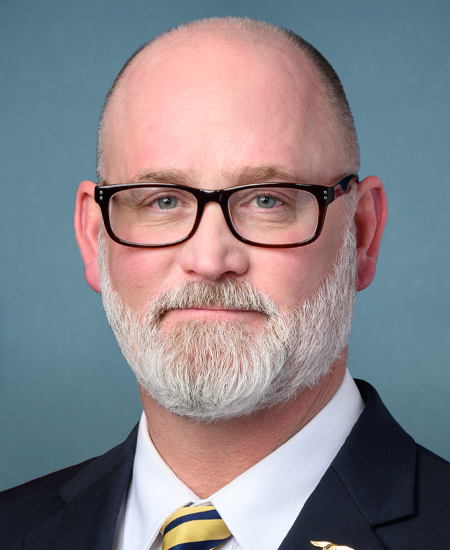
Rep. Derrick Van Orden
Sponsored bills
Maddy summaryThe Ride in Freedom Act prohibits the District of Columbia from requiring individuals to wear protective helmets while operating or riding on motorcycles and motor-driven cycles. The bill directly repeals the existing local regulation that mandates helmet use for these vehicles. Additionally, it amends the District of Columbia Home Rule Act to explicitly prevent the local Council and Mayor from enacting any future laws or resolutions that would impose such a requirement.
Maddy summaryThe Right to Worship Act makes it unlawful for individuals to knowingly disrupt religious services or prevent people from entering houses of worship within 100 feet of an entryway during the hour before and after a scheduled service. The bill applies to conduct that meaningfully interferes with a service's normal operation or unreasonably hinders participation, while explicitly allowing free speech as long as it adheres to these specific time, place, and manner restrictions. Violators face escalating civil fines ranging from $2,500 for a first offense to $10,000 for subsequent offenses, assessed by the Attorney General. Additionally, the act permits aggrieved individuals, the U.S. Attorney General, or state attorneys general to file civil lawsuits seeking injunctive relief, compensatory damages, and attorney fees.
Maddy summaryHR 7008, the Stop Insider Trading Act, restricts Members of Congress, their spouses, and dependent children from purchasing certain investments like stocks in publicly traded companies. It requires 7-14 days' advance public notice before selling any such investment, including the sale date, description, and number of shares. Exceptions apply for work-related transactions (e.g., employer compensation) and reinvesting dividends. Violations trigger a fee of $2,000 or 10% of the investment’s value (whichever is greater), plus any net gain, paid from personal funds - not congressional allowances or campaign donations. The bill aims to prevent conflicts of interest by increasing transparency around congressional financial dealings.
Maddy summaryThis resolution expresses support for designating the first week of August as National Community Health Center Week to honor the contributions of these facilities. It encourages all Americans to visit their local health centers during this time to celebrate the partnership between these organizations and the communities they serve. The bill highlights how community health centers provide affordable, comprehensive care to millions of people, particularly in rural and underserved areas, while integrating services like dental care, behavioral health, and pharmacy support. By recognizing these centers, the resolution aims to raise awareness of their role in improving public health outcomes and supporting local economies.
Maddy summaryThis bill, titled the Permanent CBDC Ban Act, aims to permanently prohibit the Federal Reserve from issuing a central bank digital currency. It achieves this by amending the Federal Reserve Act to remove the specific legal authority that allows the Reserve to create such a digital currency. The legislation directly affects the Federal Reserve by stripping away its power to launch a digital version of the dollar. By deleting the relevant subsection of the law, the bill ensures that the Reserve cannot issue a CBDC in the future.
Maddy summaryThe House Our Heroes Act expands support for veterans struggling with guaranteed housing loans by allowing the Department of Veterans Affairs to offer educational courses on credit improvement, financial management, and loss mitigation options. Additionally, the bill permits the agency to make partial claims and modify loan terms, such as interest rates and payment schedules, for specific loans that go into default between May 1, 2025, and November 28, 2026. These measures aim to provide more flexible assistance tools to help veterans avoid foreclosure or manage their debts without strictly following previous mandatory procedures.
Maddy summaryThe Responsible Artificial Intelligence for Veterans Act of 2026 requires the Department of Veterans Affairs to hire an independent research center to evaluate artificial intelligence tools currently used or being developed for patient care within the Veterans Health Administration. This evaluation will focus on five specific high-risk systems to assess their safety, accuracy, fairness, and how well they integrate with existing medical workflows. The law mandates that the findings be reported to Congress within a year, followed by a detailed plan from the VA to address any identified risks or gaps in oversight. Additionally, a government auditor will review both the evaluation and the VA's response plan to ensure accountability, all without requesting new funding for the initiative.
Maddy summaryThe Wildfire Reduction Market Expansion Act of 2026 updates the Clean Air Act to broaden the definition of renewable biomass eligible for carbon credits. It specifically allows materials from forest management, such as slash, storm debris, and wood residuals, to be counted as renewable fuel if they come from sustainably managed lands or public forests designated for fuel reduction. The bill also includes vegetation cleared from defensible space around buildings and from wildfire risk reduction projects in the wildland-urban interface. By clarifying these categories and establishing certification requirements, the legislation aims to increase the supply of biomass available for generating renewable energy credits.
Maddy summaryThe VA Police Security Enhancement Act expands the authority of Department of Veterans Affairs police officers to include protection of property and ensuring facility security, while also defining the specific areas where they have jurisdiction. To support these expanded duties, the bill requires the VA to create memoranda of understanding with local, state, and federal law enforcement agencies to facilitate coordination and allows officers to operate off VA property only in specific circumstances like hot pursuit or under a written agreement. The legislation mandates modernization of security measures, including access controls and surveillance systems, and establishes a dedicated funding account for officer employment, training, and security infrastructure that expires after three years. Additionally, the bill strengthens oversight by requiring the VA Secretary to provide Congress with regular reports on staffing, training, and enforcement activities, as well as data on arrests and use of force.