

Maddy summaryThis resolution establishes a House select committee to investigate claims about President Biden's cognitive and physical health decline and whether information was concealed from the public. The committee will specifically examine his cancer diagnosis, roles of administration figures (including Vice President Harris and Jill Biden), media coverage of his health, and classified document handling. It cannot pass laws but must issue a final report by December 31, 2025, detailing findings and recommendations. The committee's work is limited to fact-finding through hearings and evidence gathering, not policy-making.
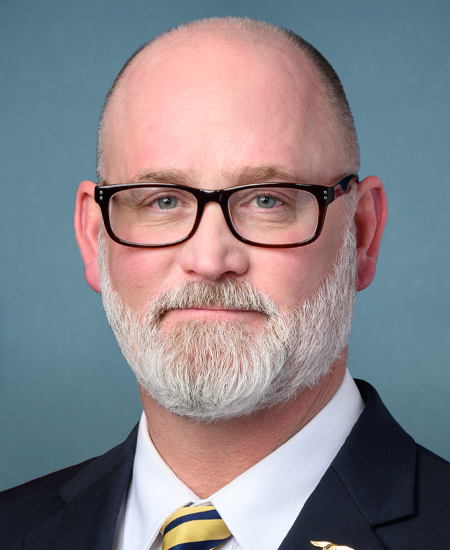
Rep. Derrick Van Orden
Sponsored bills
Maddy summaryHR 3598, the Deescalation Drone Pilot Program Act of 2025, establishes a federal pilot program to test nonlethal drones for law enforcement during active shooter events. The program, managed by the FAA, will review nonlethal devices (like sound emitters or cameras) for drones, develop training and safety protocols, and assess effectiveness in indoor scenarios to increase officer safety. It requires drones to be manufactured in the U.S. and mandates a report to Congress within 3 months of the pilot's conclusion, followed by rulemaking to create a formal approval process for law enforcement use. The bill directly affects Federal, State, local, and Tribal law enforcement agencies responding to active shooter events as defined by the legislation.
Maddy summaryHR 3608, "Connor’s Law," requires commercial motor vehicle operators (like truck and bus drivers) to read and speak English well enough to converse with the public, understand English traffic signs, respond to officials, and complete reports. The bill adds this language requirement to existing federal safety rules for commercial drivers. Drivers found noncompliant with this rule would face an "out of service" order, meaning they cannot operate their vehicle until they meet the requirement. This directly affects commercial drivers operating in the U.S. under federal safety regulations.
Maddy summaryHR 3597, the Protecting Circuit Boards and Substrates Act, creates two main incentives to boost domestic production of printed circuit boards and integrated circuit substrates. It provides a 25% tax credit for businesses purchasing US-manufactured circuit boards and substrates, and establishes a federal financial assistance program offering up to $300 million per project (with larger amounts possible with presidential approval) for manufacturing or research and development facilities in the United States. The program prioritizes small businesses, minority-owned businesses, veteran-owned businesses, and projects that expand domestic production capacity or relocate manufacturing from foreign-controlled areas. Recipients must use funds for specific covered incentives like facility construction, equipment, or workforce training programs, with strict clawback provisions for delays or inappropriate technology sharing with foreign entities of concern. The program requires coordination with multiple federal agencies and includes annual reviews by the Government Accountability Office to track outcomes.
Maddy summaryHR 3512, the Tackling Predatory Litigation Funding Act, imposes a new annual tax on funds received by third-party investors who finance lawsuits through litigation financing agreements. It directly affects investors (including foreign entities) who provide funding to plaintiffs or law firms in exchange for a share of settlement or judgment proceeds, excluding small agreements under $10,000 or standard loans. The tax equals the top individual income tax rate plus 3.8 percentage points, with 50% withheld from settlement payments by parties involved in the lawsuit. The law also clarifies that such funds cannot offset losses and excludes certain typical legal fee reimbursements from taxation. The provisions take effect for taxable years beginning after December 31, 2025.
Maddy summaryHR 3463 (COUNTER Act) expands the U.S. military's authority to counter drone threats by allowing the Department of Defense and Coast Guard to neutralize unmanned aircraft systems without being restricted by certain federal laws. It exempts related technology, procedures, and protocols from public disclosure requirements under federal and state laws, and permits military commanders to delegate these actions. The bill applies to both domestic and overseas operations, clarifying that other federal laws do not apply to U.S. military or Coast Guard activities mitigating drone threats abroad. Key changes include broadening legal authority beyond previous restrictions and extending reporting deadlines for related activities.
Maddy summaryThis bill changes the training requirements for certified nursing assistants (CNAs) in nursing and skilled nursing facilities. It requires the Health and Human Services Secretary to revise federal regulations so that registered nurses supervising CNA training need only 2 years of general nursing experience - not specifically in long-term care facilities. This change directly affects nursing facilities that train CNAs and the registered nurses who supervise that training. The key provision broadens the pool of eligible supervisors by removing the prior requirement for long-term care experience, making it easier for facilities to meet training needs.
Maddy summaryThis bill requires the Department of Veterans Affairs (VA) to establish clear standards for evaluating all VA suicide prevention and mental health grant or pilot programs. It mandates that these programs set measurable goals, develop detailed evaluation plans (including data collection methods and analysis), and share results with relevant stakeholders before, during, and after implementation. The VA must also conduct post-program evaluations to assess effectiveness and share "best practices" across programs. These standards apply to all existing and future VA programs focused on veteran mental health, ensuring consistent evaluation and transparency. The bill directly affects how the VA administers suicide prevention initiatives for veterans.
Maddy summaryHR 3283, the FARMER Act, directly affects farmers who purchase crop insurance under enterprise or whole farm units by increasing federal premium subsidies. It raises the government subsidy rate to 77% for higher coverage levels and 68% for lower coverage levels under specific revenue or yield protection plans. The bill also lowers the required coverage level from 14% to 10% and increases the premium subsidy rate from 65% to 80% for supplemental coverage. Additionally, it mandates a study on expanding supplemental coverage to larger counties, requiring a report to Congress within one year.
Maddy summaryHR 3277, the Ensuring Lasting Smiles Act, requires group health plans and health insurance issuers to cover medically necessary outpatient and inpatient treatments for congenital anomalies or birth defects primarily affecting the eyes, ears, teeth, mouth, or jaw. This includes reconstructive procedures, dental/orthodontic support during treatment, and follow-up care, but excludes purely cosmetic surgery not tied to a medical diagnosis. Cost-sharing (like copays) for these services must not be stricter than for other medical benefits. The law takes effect for plan years beginning January 1, 2026, and mandates insurers to provide notice about this coverage to beneficiaries.