

Ensuring Patient Access to Critical Breakthrough Products Act of 2021 This bill provides for Medicare coverage of medical devices that are approved under the Food and Drug Administration (FDA) Breakthrough Devices Program. (Under the program, manufacturers work with the FDA to expedite the review and approval of certain medical devices that provide for more effective treatment or diagnosis of life-threatening or irreversibly debilitating human diseases or conditions.) The bill allows designated medical breakthrough devices to be temporarily covered under Medicare during a four-year transitional period. The Centers for Medicare & Medicaid Services (CMS) must assign payment codes for such devices within three months of FDA approval. The CMS must also establish a process to allow for continued coverage after the transitional period has expired, taking into account any additional evidence or data the CMS deems necessary. The CMS must also provide for temporary and, where appropriate, permanent Medicare coverage of breakthrough devices for which there is no existing benefit category (i.e., classification).
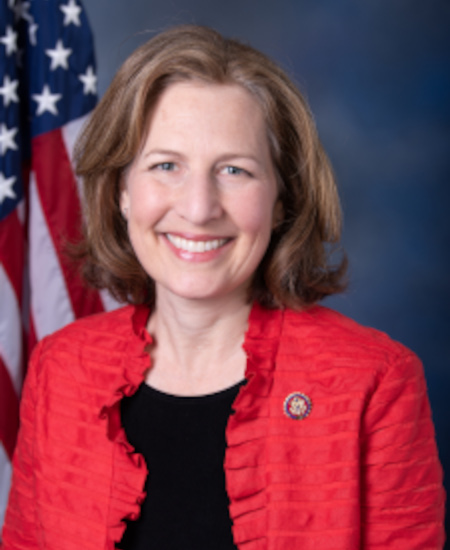
Rep. Kim Schrier
Sponsored bills
Continuous Improvement and Accountability in Organic Standards Act This bill requires the Department of Agriculture (USDA) to undertake rulemaking and other activities to implement certain recommendations of the National Organic Standards Board (a federal advisory board that considers and makes recommendations concerning the production, handling, and processing of organic products). Specifically, USDA must issue within a specified time line final rules for implementing recommendations approved (1) by the board between December 31, 2000, and the date of the bill's enactment; and (2) with at least two-thirds of the votes cast at a meeting where a quorum was present. If USDA determines issuing rules for such recommendations is not practicable, it must identify and report to Congress about the specific constraints that preclude rulemaking. In addition, the bill sets out a process and time line for USDA to implement through rulemaking future recommendations of the board that are approved by at least two-thirds of the votes cast at a meeting where a quorum was present. The bill also requires state officials or entities that certify organic farms or handling operations to report annually concerning the implementation of and compliance with any new rule or guidance.
Metropolitan Statistical Area Preservation Act This bill prohibits the Office of Management and Budget (OMB) from establishing, for purposes of designating areas as metropolitan statistical areas (MSAs), a minimum population for the urban area of such MSA that is more than 50,000. The OMB may, for statistical purposes only, establish other statistical area designations with higher minimum population requirements for such urban areas.
Expanding Access to Graduate Education Act of 2021 This bill allows income-eligible graduate students who received Pell Grants during their undergraduate education to utilize their remaining Pell Grant eligibility toward their first graduate degree, subject to the existing 12-semester duration limit. Currently, Pell Grants are available only to undergraduate students.
Local Journalism Sustainability Act This bill allows individual and business taxpayers tax credits for the support of local newspapers and media. Specifically, individual taxpayers may claim an income tax credit up to $250 for a local newspaper subscription. The bill also allows local newspaper employers a payroll tax credit for wages paid to an employee for service as a local news journalist and certain small businesses a tax credit for local newspaper and media advertising expenses.
Support UNFPA Funding Act This bill authorizes annual contributions to support the core functions and programs of the United Nations Population Fund for the five fiscal years following the bill's enactment.
Sustainable Skies Act This bill allows a business-related tax credit through 2031 for each gallon of sustainable aviation fuel used by a taxpayer in the production of a qualified mixture (i.e., a mixture of sustainable aviation fuel and kerosene that is sold for use in certain U.S. aircraft). The bill generally defines sustainable aviation fuel as liquid fuel that consists of synthesized hydrocarbons, meets certain recognized international standards, is derived from biomass, waste streams, renewable energy sources, or gaseous carbon oxides, is not derived from palm fatty acid distillates, and achieves at least a 50% life cycle greenhouse gas emissions reduction in comparison with petroleum-based jet fuel. To be eligible for such credit, a taxpayer must meet certification requirements showing that the sustainable aviation fuel conforms with one of the life cycle greenhouse gas emissions reduction tests set forth in this bill.
Shark Fin Sales Elimination Act of 20 21 This bill addresses the sale of shark fins and the inclusion of rays and skates in the Seafood Traceability Program. The Seafood Traceability Program has data reporting and recordkeeping requirements at the time of entry for imported fish or fish products entered into U.S. commerce. The bill makes it illegal to possess, buy, or sell shark fins or any product containing shark fins, except for certain dogfish fins. A person may possess a shark fin that was lawfully taken consistent with a license or permit under certain circumstances. Penalties are imposed for violations under the Magnuson-Stevens Fishery Conservation and Management Act. The Department of Commerce must revise its regulations to include rays and skates as species that are subject to the Seafood Traceability Program.
Michael Lecik Military Firefighters Protection Act This bill establishes a presumption of service-connection for specified diseases becoming manifest in certain veterans to a degree of disability of 10% or more within 15 years of the veteran's separation from active military, naval, or air service. Under a presumption of service-connection, specific diseases or disabilities diagnosed in certain veterans are presumed to have been caused by the circumstances of their military service. Health care benefits and disability compensation may then be awarded. Veterans addressed by this bill are those who (1) are trained in fire suppression, and (2) served on active duty in a military occupational specialty or career field with a primary responsibility of firefighting or damage control for at least five years in the aggregate.
Outdoor Restoration Partnership Act of 2021 This bill establishes and provides funding for the Restoration and Resilience Grant Program and the Restoration and Resilience Partnership Program. The bill establishes a Restoration Fund Advisory Council to provide advice to the Department of Agriculture (USDA) respecting the grant program. The grant program shall provide grants to eligible entities (e.g., a state agency, a unit of local government, or a tribal government) for purposes such as (1) increasing the capacity for planning, coordinating, and monitoring restoration and resilience projects on federal land and nonfederal land; or (2) restoration and resilience projects on nonfederal land. Under the Restoration and Resilience Partnership Program, USDA shall carry out restoration and resilience projects that reduce wildfire potential, improve community resilience in the wildland-urban interface, or restore wildlife habitat.