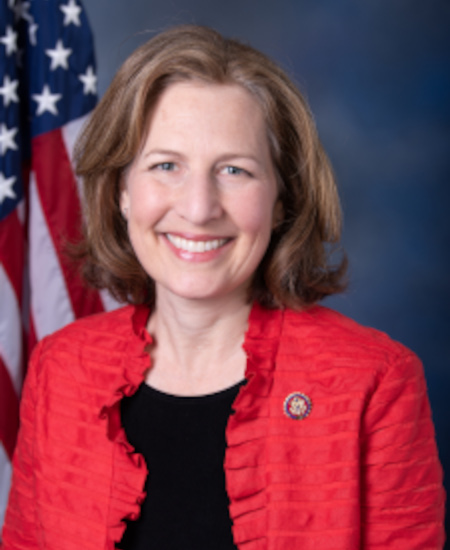
Photo of Kim Schrier
D United States House · District 8 · Washington On the 2026 ballot

Rep. Kim Schrier

Compare
Total votes
2,837
all sessions
Attendance
99%
24 missed
Near the chamber average
With party
94%
of cast votes
Lower than 83% of chamber peers
Bipartisan score
3%
crosses aisle rarely
Higher than 82% of chamber peers
Sponsored
1,071
bills & resolutions
Near the chamber average
Committees
4
assignments
1,071 bills and resolutions

Sponsored bills

Total
1,071
Primary
73
Co-sponsor
998
This page
1,071
matching current filters
Co-sponsor HR 4786
In committee · Indiana House · Co-sponsor
RISE Act of 2021

Respond, Innovate, Succeed, and Empower Act of 2021 or the RISE Act of 2021 This bill establishes requirements for institutions of higher education (IHEs) concerning students with disabilities. Specifically, the bill requires IHEs to allow students to use certain documents, such as individualized education programs, to establish their disabilities. In addition, IHEs must make the process for determining the eligibility for accommodations transparent. Finally, IHEs must submit key data related to their undergraduate students with disabilities for inclusion in federal postsecondary institution data collection efforts.

In committee Jul 29, 2021 1 co-sponsor
Co-sponsor HR 4829
In committee · Indiana House · Co-sponsor
Distillery Revitalization Act

Distillery Revitalization Act This bill requires the Small Business Administration to modify the Restaurant Revitalization Program, established to support food and beverage purveyors in response to COVID-19, to allow certain distilleries to participate in the program. To be program-eligible, a distillery must have at least 33% of revenue from on-site sales. However, certain states limit the percentage of revenue that a distillery may have from on-site sales to less than 33%. For a distillery located in such a state, the bill allows the distillery to use its combined revenue from on-site sales and sales to retailers for on-site sales to reach the 33% threshold.

In committee Jul 29, 2021 1 co-sponsor
Co-sponsor HR 4769
In committee · Indiana House · Co-sponsor
Onward to Opportunity Act

Onward to Opportunity Act This bill requires the Department of Defense to implement a pilot grant program at five military installations to provide enhanced support and funding to eligible entities to supplement the Transition Assistance Program (TAP) in providing job opportunities for industry-recognized certifications, job placement assistance, and related employment services to service members participating in TAP and their spouses.

In committee Jul 28, 2021 1 co-sponsor
Primary HR 4669
In committee · Indiana House · Lead sponsor
Capping Costs for Consumers Act of 2021

Capping Costs for Consumers Act of 2021 This bill expands and provides funding for assistance to certain individuals who enroll in plans through health insurance exchanges. Specifically, it increases the premium assistance tax credit by revising, from the second-lowest cost silver plan to the second-lowest cost gold plan, the benchmark plan on which the credit amount is based. The bill also requires individuals to enroll in a gold plan to be eligible for cost-sharing reductions and it extends the reductions to individuals with a higher maximum household income. These changes apply to plan and tax years beginning on or after January 1, 2023.

In committee Jul 23, 2021 0 co-sponsors
Co-sponsor HR 4651
In committee · Indiana House · Co-sponsor
RECOMPETE Act

Rebuilding Economies and Creating Opportunities for More People Everywhere To Excel Act or the RECOMPETE Act This bill establishes a grant program to assist economically distressed local communities and labor markets that meet specified economic criteria, including employment criteria. The Economic Development Administration (EDA) must award 10-year grants to a local government, tribal government, economic development district, or consortium of local government units located in such areas. Each grant recipient must develop and implement a comprehensive strategy to address the economic challenges specific to the area. The grants may be used to increase employment opportunities, increase local per capita income, support economic development, and develop infrastructure and housing. Additionally, the EDA must periodically evaluate each grant recipient based on certain benchmark criteria and annually report on the implementation of the program. The bill specifies formulas for determining the grant amount for each community or market and the federal share of the cost of each program or activity conducted under the program.

In committee Jul 23, 2021 1 co-sponsor
Co-sponsor HR 4649
In committee · Indiana House · Co-sponsor
To amend title VI of the Social Security Act to allow for the use of the Coronavirus State fiscal recovery fund to support mental and behavioral health programs, and for other purposes.

This bill permits state, tribal, and territorial governments to use designated COVID-19 relief funding to support mental and behavioral health programs. Currently, this funding is available to eligible governments through December 31, 2024, for responding to the COVID-19 public health emergency or its negative economic impacts; supporting essential workers and businesses; maintaining government services; and investing in water, sewer, or broadband infrastructure.

In committee Jul 22, 2021 1 co-sponsor
Co-sponsor HR 4635
In committee · Indiana House · Co-sponsor
School Milk Nutrition Act of 2021

School Milk Nutrition Act of 20 21 This bill revises requirements for milk provided by the National School Lunch Program of the Department of Agriculture. The bill permits schools participating in the program to offer students low-fat flavored milk.

In committee Jul 22, 2021 1 co-sponsor
Co-sponsor HR 3985
Passed · Indiana House · Co-sponsor
Averting Loss of Life and Injury by Expediting SIVs Act of 2021

Averting Loss of Life and Injury by Expediting SIVs Act of 2021 or the Allies Act of 2021 This bill increases the number of special immigrant visas available to qualified Afghan nationals who worked for the U.S. government or the North Atlantic Treaty Organization (NATO) missions in Afghanistan. The bill also relaxes certain qualifications for such visas. Specifically, this bill makes available an additional 8,000 visas for principal aliens under this special visa program, to be available until all such visas have been issued. (The numerical limitations in this program apply only to the principal alien who applies for the visa, not to any accompanying spouse or child.) Under this bill, an alien may qualify based on a credible basis for concern about the possibility of an ongoing serious threat in Afghanistan due to their work with the U.S. government or a NATO mission, where currently the alien must have experienced such a threat. The bill also eliminates a requirement for each applicant to submit a credible sworn statement describing that threat. Furthermore, for an applicant qualifying for a visa by performing duties for U.S. military personnel stationed with a NATO mission, this bill eliminates a requirement that the duties performed qualify as sensitive and trusted duties. If an alien submits a visa application that included an accompanying spouse or child but the alien passes away before the application is granted, the surviving spouse or child shall remain eligible to receive a visa under that application. Currently, a surviving spouse or child retains eligibility only if the application was approved before the alien passed away.

Passed Jul 22, 2021 1 co-sponsor
Co-sponsor HR 2467
Passed · Indiana House · Co-sponsor
PFAS Action Act of 2021

PFAS Action Act of 2021 This bill establishes requirements and incentives to limit the use of perfluoroalkyl and polyfluoroalkyl substances, commonly referred to as PFAS, and remediate PFAS in the environment. PFAS are man-made and may have adverse human health effects. A variety of products contain PFAS, such as nonstick cookware or weatherproof clothing. The bill directs the Environmental Protection Agency (EPA) to designate the PFAS perfluorooctanoic acid (PFOA) and perfluorooctanesulfonic acid (PFOS) as a hazardous substances under the Comprehensive Environmental Response, Compensation, and Liability Act of 1980, thereby requiring remediation of releases of those PFAS into the environment. Within five years, the EPA must determine whether the remaining PFAS should be designated as hazardous substances. The EPA must publish human health water quality criteria under the Clean Water Act for each measurable PFAS and class of such substances and establish standards to limit discharges of PFAS from industrial sources into waters of the United States. In addition, the EPA must issue a national primary drinking water regulation for PFAS that, at a minimum, includes standards for PFOA and PFOS. Among other requirements, the EPA must also issue a final rule adding PFOA and PFOS to the list of hazardous air pollutants, test all PFAS for toxicity to human health, and regulate the disposal of materials containing PFAS. The EPA must also require PFAS manufacturers to submit analytical reference standards for PFAS. The EPA and states may use those standards for (1) the development of information, protocols, and methodologies, and (2) activities relating to the implementation of enforcement of requirements. Finally, the bill provides incentives to address PFAS, such as grants to help community water systems treat water contaminated by PFAS and grants to schools for testing and filtrating PFAS from drinking water.


Passed Jul 22, 2021 1 co-sponsor
Co-sponsor HR 4587
In committee · Indiana House · Co-sponsor
Value in Health Care Act of 2021

Value in Health Care Act of 2021 This bill makes a series of changes to certain methodologies and components used in the Medicare Shared Savings Program. The program enables accountable care organizations (ACOs) to receive payments for savings stemming from care coordination and management. Among other changes, the bill requires the Centers for Medicare & Medicaid Services to increase the shared savings rate for participating ACOs, as specified, and to establish a program that assists ACOs with start-up and operational costs of participation. The bill also extends certain incentive payments for health professionals who participate in eligible alternative payment models. The Government Accountability Office must report on health outcomes and racial disparities among beneficiaries who receive care from providers under alternative payment models compared to beneficiaries who receive care from providers under the traditional fee-for-service system.

In committee Jul 21, 2021 1 co-sponsor
Showing 911 to 920 of 1,071 bills
Previous 1 … 91 92 93 … 108 Next