

Healthcare Workforce Resilience Act This bill makes previously unused immigrant visas available to nurses and physicians who petition for such a visa before the date that is 90 days after the end of the declared national emergency relating to the COVID-19 (i.e., coronavirus disease 2019) outbreak. The number of visas available shall be the total number of unused employment-based immigrant visas from FY1992-FY2020, up to 40,000. Of such visas, 25,000 shall be reserved for nurses and 15,000 for physicians. Certain family members may accompany the principal beneficiary of a visa provided under this bill, and visas for such family members shall (1) be made available from the unused visas from FY1992-FY2020, and (2) not be counted against the 40,000 cap. Visas provided under this bill shall be exempt from per-country limitations.
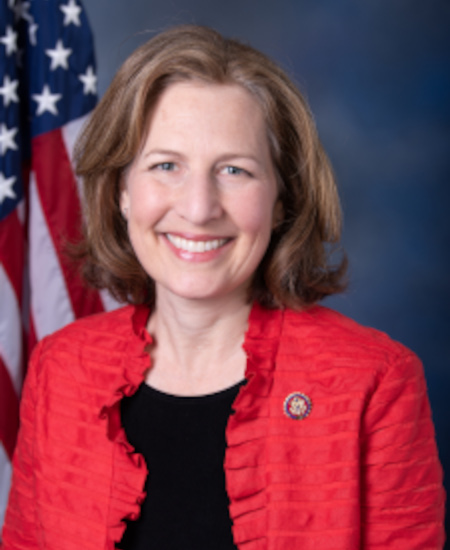
Rep. Kim Schrier
Sponsored bills
Equal Access to Abortion Coverage in Health Insurance Act of 2021 or the EACH Act of 2021 This bill requires federal health care programs to provide coverage for abortion services and requires federal facilities to provide access to those services. The bill also permits qualified health plans to use funds attributable to premium tax credits and reduced cost sharing assistance to pay for abortion services.
Medication Access and Training Expansion Act of 2021 or the MATE Act of 2021 This bill requires health care providers, as a condition of receiving or renewing a registration to prescribe potentially addictive drugs, to complete a one-time training on managing patients with substance use disorders. In addition, the Department of Health and Human Services must award grants to health professional associations and education programs for integrating substance use disorder training into relevant curricula.
Outdoors for All Act This bill directs the Department of the Interior to establish an outdoor recreation legacy partnership grant program under which Interior may award grants to states, certain political subdivisions of a state, special purpose districts, Indian tribes, or Alaska Native or Native Hawaiian communities or organizations. Funds must be used for projects to (1) acquire land and water for parks and other outdoor recreation purposes in qualifying areas, and (2) develop new or renovate existing outdoor recreation facilities that provide outdoor recreation opportunities to the public in qualifying areas. A qualifying area is an area that has a population of 30,000 or more in the most recent census, or that is administered by an Indian tribe or an Alaska Native or Native Hawaiian community organization. Interior shall give priority to projects that create or significantly enhance access to park and recreational opportunities in an urban neighborhood or community, engage and empower underserved communities and youth, provide opportunities for employment or job training for youth or underserved communities, establish or expand public-private partnerships, and take advantage of coordination among various levels of government.
Reducing Waste in National Parks Act This bill directs the National Park Service to establish a program for the National Park System to reduce disposable plastic products and, if applicable, eliminate the sale and distribution of disposable plastic products. Each regional office of the National Park Service must eliminate the sale of water in disposable plastic products and the sale and distribution of other disposable plastic products after consideration of several specified factors (e.g., the costs and benefits to overall operations). Each regional office must develop a proactive visitor education strategy to address visitor expectations of water availability and explain the rationale for the program and its implementation.
School Food Recovery Act of 2021 This bill directs the Department of Agriculture (USDA) to provide competitive grants and technical assistance for local educational agencies to implement food waste measurement and reporting, prevention, education, and reduction projects. In awarding grants, USDA must give priority to agencies that agree to use grant funds for carrying out specific projects, including (1) experiential education activities that encourage children enrolled in such agencies to participate in food waste measurement and education; and (2) the establishment of food waste measurement, prevention, and reduction projects with long-term sustainability. The federal share of project costs may not exceed 75% of the total cost of carrying out such projects. All projects must comply with the nutrition requirements of the National School Lunch Program or the School Breakfast Program, including by offering no less than the minimum quantities of required food components.
Growing Opportunities in Agriculture Act or the GO Ag Act This bill directs the Department of Education to award competitive grants to eligible entities (e.g., local educational agencies) to create new agricultural education programs in secondary schools. Agricultural education refers to career and technical education that is focused on agriculture, including classroom or laboratory instruction, work-based learning, and leadership education that is delivered through career and technical student organizations.
Israel Relations Normalization Act of 2021 This bill requires the Department of State to take certain actions promoting the normalization of relations between Israel, Arab states, and other relevant countries and regions. Specifically, the State Department must develop a strategy on expanding and strengthening the Abraham Accords (the term used to refer collectively to agreements between Israel and the United Arab Emirates and between Israel and Bahrain marking the public normalization of relations between the two Arab countries and Israel). The strategy must include a description of how the U.S. government will encourage further normalization of relations with Israel. In addition, the State Department must report on options for U.S. international efforts to promote the strengthening of ties between Israel, Arab states, and other relevant countries and regions. The State Department must also report on the status of the normalization of relations with Israel, including information on (1) laws that punish individuals for people-to-people relations with Israelis (i.e., anti-normalization laws), and (2) evidence of steps taken by Arab governments toward permitting or encouraging normalized relations between their citizens or residents and Israeli citizens.
Veteran Families Health Services Act of 2021 This bill addresses fertility treatments, counseling, and other health-related programs for veterans and members of the Armed Forces. Specifically, the bill requires the Department of Defense (DOD) and the Department of Veterans Affairs (VA) to provide fertility treatments and counseling to covered veterans and active duty service members or a spouse, partner, or gestational surrogate of such veteran or service member. A covered veteran or service member is a former or current member of the Armed Forces who has an infertility condition, unless it is demonstrable that the individual was completely infertile prior to serving in the Armed Forces. In the case of in vitro fertilization treatment, DOD and the VA may not furnish more than three completed cycles or six attempted cycles, whichever occurs first. DOD must establish procedures related to gamete retrieval and storage. Additionally, DOD must provide service members with the opportunity to cryopreserve and store their gametes prior to deployment to a combat zone or a hazardous duty assignment. DOD and the VA must share best practices and facilitate referrals for the furnishing of fertility treatment and counseling to eligible individuals. Fertility counseling and treatment are included within authorized VA medical services. The VA may pay the adoption expenses (for up to three adoptions) for a covered member who is enrolled in the VA health care system. The VA must facilitate specified reproduction and infertility research conducted collaboratively by DOD and the Department of Health and Human Services.
Meaningful Access to Federal Health Plan Claims Data Act of 2021 This bill requires the Centers for Medicare & Medicaid Services (CMS) to establish a program that allows clinician-led clinical data registries to access Medicare claims data for purposes of research, quality of care measurement, and reporting. (Clinician-led clinical data registries are data repositories operated by clinician organizations and that collect information about particular diseases and related medical procedures and therapies.) The new program must allow for various types of data queries, including provider, state, and nationwide claims data. Such data may be used for public reports about provider performance, specified nonpublic analyses (e.g., medical research), and fee-based data services. Registries must apply to the CMS for access. Additionally, registries and their authorized users must enter into data use agreements and are subject to monetary penalties for breaching such agreements. The bill also allows for Medicare coverage of new and emerging items and services for purposes of evidence collection in relation to such items and services.