

Maddy summaryHR 1591, the Security Clearance Review Act, requires the FBI Director to approve security clearances and access to classified information for political appointees and special government employees working in the Executive Office of the President. It prohibits these individuals from holding such clearances or accessing classified information without the FBI Director’s specific authorization. If the FBI denies or revokes clearance, the Director must immediately notify the President and Congress; if the President overrides this decision, they must provide written justification to Congress within 30 days. The bill directly affects high-level political appointees and special government employees in the White House and its immediate offices, altering the clearance process for this specific group.
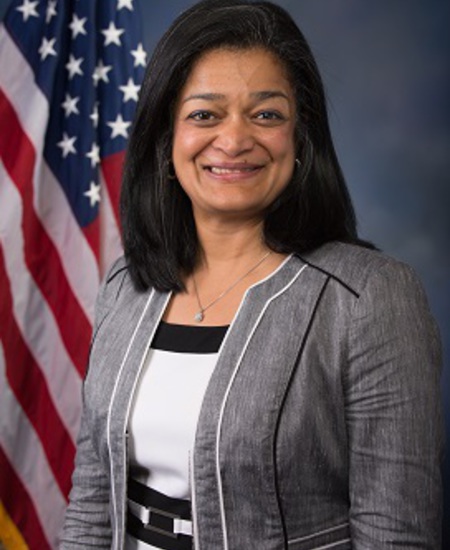
Rep. Pramila Jayapal
Sponsored bills
Maddy summaryHR 1638, the CROWN Act of 2025, prohibits discrimination based on hair texture or hairstyle that is commonly associated with race or national origin, particularly affecting Black individuals who wear natural or protective styles like braids, locs, cornrows, twists, or Afros. The bill explicitly expands protections under existing federal civil rights laws (including the Civil Rights Act of 1964 and the Fair Housing Act) to cover hair-based discrimination in federally funded programs, housing, public accommodations, employment, and equal rights. It requires schools, employers, and other entities receiving federal funds to eliminate grooming policies that disproportionately target these hairstyles. The law clarifies that such discrimination violates federal law and provides enforcement through existing civil rights mechanisms.
Maddy summaryThe Empowering and Enforcing Environmental Justice Act of 2025 establishes a new Office of Environmental Justice within the Department of Justice to address environmental health disparities. This Office will develop strategies, coordinate enforcement efforts, and administer a $50 million annual grant program for state, local, and Tribal governments to improve environmental enforcement in affected communities. The grants will fund staff training, hiring for investigations, and community engagement programs focused on low-income, Tribal, and Indigenous populations facing disproportionate environmental risks. The bill directly impacts the Department of Justice, state/local/tribal governments, and communities experiencing environmental justice challenges.
Maddy summaryEthan's Law requires gun owners to store firearms securely in homes where minors live or where residents are legally prohibited from owning guns. It makes it unlawful to leave firearms unsecured if a minor or ineligible person could access them, with fines of $500 per violation and harsher penalties if injury or death occurs. The bill creates a federal grant program to help states implement similar secure storage laws and treats unsafe storage as negligence in legal cases. It directly affects households with children or residents who cannot legally possess firearms, aiming to reduce accidental shootings and unauthorized access.
Maddy summaryHR 1449, the Energy Resilient Communities Act, creates a federal grant program to fund clean energy microgrids that support critical community infrastructure like hospitals, schools, and emergency facilities. Eligible entities - including states, local governments, nonprofits, and tribal agencies - can apply for grants covering up to 90% of costs for technical assistance, community outreach, or microgrid projects in environmental justice communities. Key provisions prioritize projects that reduce emissions, lower energy costs for low-income residents, minimize land use impacts, and ensure 40% of construction labor comes from local residents meeting specific criteria (e.g., displaced workers, environmental justice community members). The program authorizes $1.5 billion over 10 years, with at least 10% reserved for community-owned microgrid projects, and requires annual reporting on project outcomes and labor practices.
Maddy summaryThis bill would require states to create a simplified process for out-of-state healthcare providers to join Medicaid and CHIP programs. Qualified providers (those already enrolled in Medicare or another state's program with low fraud risk) could enroll without excessive screening and would be approved for five years. It directly affects children under 21 enrolled in Medicaid or CHIP by expanding access to providers outside their state, particularly in underserved areas. The change applies to all states' Medicaid programs but takes effect three years after enactment.
Maddy summaryHR 1484 requires the Federal Aviation Administration (FAA) to commission the National Academies of Sciences to convene experts and issue a report on the health impacts of air traffic noise and pollution within 30 days of the bill's enactment. The report will summarize current scientific knowledge on these health effects and must be submitted to the FAA, Health and Human Services, the Environmental Protection Agency, and specific congressional committees. This bill creates a new study requirement but does not change existing regulations or funding; it solely mandates the collection of expert consensus on the health impacts of aviation noise and emissions.
Maddy summaryThe Poverty Line Act of 2025 updates how the federal poverty line is calculated to better reflect current costs of basic needs. It requires annual revisions using a 5-year average of household spending on food, housing, childcare, and healthcare (adjusted for inflation), with regional variations based on state or county data. This change directly affects households applying for federal assistance programs like SNAP or Medicaid, as eligibility will now align with more accurate, location-specific costs. The bill also mandates a public online tool to help determine poverty line thresholds and includes safeguards to prevent sudden eligibility changes during relocations.
Goldie's Act This bill expands enforcement provisions under the Animal Welfare Act (AWA). Specifically, the bill directs the Department of Agriculture (USDA) to document and record detailed descriptions of violations of the act observed during inspections and investigations. USDA must provide a copy of all records documenting violations to state, local, and municipal animal control or law enforcement officials within 24 hours of such inspections or investigations. Inspections must be held at least once a year of each research facility, the premises of each animal dealer, and each exhibitor of animals. If violations are found during inspections, then USDA must conduct any necessary follow-up inspections until all the violations are corrected. Inspectors must confiscate or destroy in a humane manner animals found to be suffering physical or psychological harm as a result of failure to comply with the AWA. Violators are subject to civil penalties as outlined in the bill.
Maddy summaryHR 1330 establishes the Smithsonian National Museum of the American Latino, authorizing its location within the National Mall's "Reserve" area. The bill requires the Smithsonian Board to coordinate with federal agencies managing potential museum sites, including notifying relevant congressional committees before land transfers. It mandates that the museum's exhibits and programs accurately represent the diverse cultures, histories, and viewpoints of Hispanic and Latino communities in the U.S., seeking input from a broad range of community experts. The Smithsonian must also submit regular reports to Congress detailing compliance with these representation requirements.