

Scientific Integrity Act This bill revises provisions regarding the release of scientific research results by federal agencies. Each agency that funds, conducts, or oversees scientific research must (1) adopt and enforce a scientific integrity policy that includes requirements such as that scientific conclusions are not based on political considerations, and (2) submit such policy to the Office of Science and Technology Policy (OSTP) for approval. Each agency must make such policy available to the public and submit such policy to Congress. Agencies and the OSTP must periodically review the policies. The Government Accountability Office shall review implementation of the policies. Each agency shall (1) appoint a Scientific Integrity Officer, (2) establish a process for dispute resolution consistent with the scientific integrity policy, and (3) establish a specified training program for current and new employees.
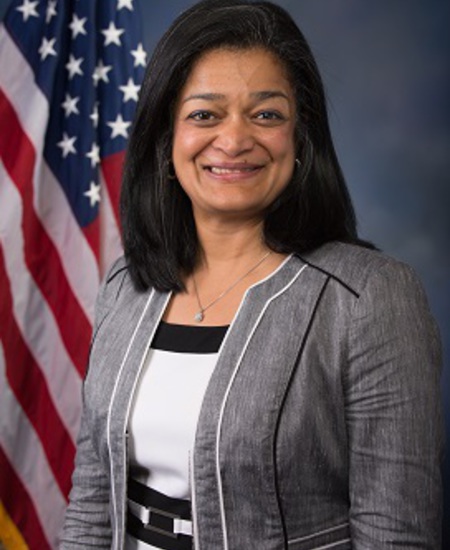
Rep. Pramila Jayapal
Sponsored bills
FEMA Climate Change Preparedness Act This bill requires the Federal Emergency Management Agency (FEMA) to (1) revise its 2018-2022 Strategic Plan to ensure that the plan explicitly mentions climate change and addresses the implications of climate change on homeland security and near- and long-term national disaster risk, and (2) ensure that future strategic plans do likewise. The Department of Homeland Security must establish, as a subcommittee of the National Advisory Council, the Climate Change Subcommittee, which shall advise FEMA on how to best incorporate climate change, including risk assessments and strategies for adaptation and mitigation, into and throughout FEMA's policies, plans, programs, and operations. FEMA must publish as a report, submit to specified congressional committees, and make available to Congress and the public, a comprehensive assessment of climate change risks and preparedness.
Air Traffic Noise and Pollution Expert Consensus Act of 20 21 This bill requires the Federal Aviation Administration to enter into an arrangement with the National Academies of Sciences, Engineering, and Medicine to examine and report on the various health impacts of air traffic noise and pollution.
FEMA Empowering Essential Deliveries Act or the FEED Act This bill authorizes the Federal Emergency Management Agency (FEMA) to approve state, local, and Indian tribal government plans to partner with small and mid-size restaurants and nonprofit organizations to provide nutritious meals to individuals in need. Specifically, during the period following the President's emergency declaration of March 13, 2020, and under any subsequent major disaster declaration that supersedes it, FEMA may approve plans from state, local, and Indian tribal governments that (1) establish contracts with small and mid-sized restaurants and nonprofits, including faith-based organizations and soup kitchens, to prepare healthy meals for people in need; and (2) provide for partnerships with nonprofit organizations to purchase directly from food producers and farmers. FEMA shall waive federal matching requirements under the Robert T. Stafford Disaster Relief and Emergency Assistance Act during such period.
Child and Animal Abuse Detection and Reporting Act This bill requires the Children’s Bureau of the Administration for Children and Families to disseminate information through the National Clearinghouse on Child Abuse and Neglect Information about the incidence of cases of child abuse that involve abuse to animals.
Medical Debt Relief Act of 2021 This bill modifies requirements related to the reporting of medical debt. Specifically, a consumer reporting agency is prohibited from adding medical debt information to a consumer credit report if the debt was fully paid or settled, or is less than a year old. Additionally, a debt collector must notify the consumer prior to reporting medical debt to a consumer reporting agency.
Spotlight Act This bill renders null and void final Internal Revenue Service (IRS) regulations published on May 28, 2020, relating to the reporting requirements of tax-exempt organizations. The bill requires tax-exempt organizations that fall under sections 501(c)(4), 501(c)(5), and 501(c)(6) of the Internal Revenue Code (e.g., social welfare organizations, labor organizations, business leagues) to disclose the names and addresses of all substantial contributors (persons who contribute more than $5,000 per year to such organizations) on their information returns. The bill also eliminates the authority of the IRS to provide exceptions to the disclosure requirements for tax-exempt organizations. This provision does not apply to determinations made by the IRS before July 16, 2018.
Apprenticeship Futures for All Act This bill requires the Office of Apprenticeship (OA) within the Department of Labor to award grants, contracts, or cooperative agreements to eligible entities if the eligible entity is a qualified intermediary to (1) support national industry and equity intermediaries in establishing or expanding sector-based partnerships to support the delivery or expansion of programs under the national apprenticeship system to significant scale in the United States, or (2) serve programs under the national apprenticeship system in a local or regional setting. The delivery or expansion of programs under the national apprenticeship system shall be (1) in key sectors, including manufacturing, information technology, cyber security, health care, insurance and finance, energy, hospitality, retail, construction, and other sectors identified by the OA as targeted for expansion under the national apprenticeship system; or (2) for nontraditional apprenticeship populations, women, minorities, individuals with disabilities, and individuals impacted by the criminal or juvenile justice system.
USPS Fairness Act This bill repeals the requirement that the U.S. Postal Service annually prepay future retirement health benefits.
Anti-Racism in Public Health Act of 2021 This bill establishes within the Centers for Disease Control and Prevention (CDC) a National Center on Antiracism and Health and a law enforcement violence prevention program. Among other activities, the new center must declare racism a public health crisis, collect and analyze data, and administer research and grant programs to address racism and its impact on health and well-being. Additionally, the bill specifically directs the CDC's National Center for Injury Prevention and Control, in coordination with the Department of Justice and other relevant stakeholders, to carry out the law enforcement violence prevention program by conducting research and supporting other activities pertaining to law enforcement violence and public health.