

Department of Homeland Security Appropriations Act, 2026 This bill provides FY2026 appropriations for various agencies and offices within the Department of Homeland Security (DHS), except for U.S. Immigration and Customs Enforcement (ICE), U.S. Customs and Border Protection (CBP), and management and oversight activities of the Office of the Secretary. Specifically, the bill provides appropriations to DHS for the Federal Protective Service, the Office of Inspector General, the Transportation Security Administration, the U.S. Coast Guard, the U.S. Secret Service, the Cybersecurity and Infrastructure Security Agency, the Federal Emergency Management Agency (FEMA), U.S. Citizenship and Immigration Services, the Federal Law Enforcement Training Centers, and the Science and Technology Directorate. The bill does not provide appropriations for some agencies and activities that have been funded in prior DHS appropriations acts, including ICE, CBP, and management and oversight activities of the Office of the Secretary.
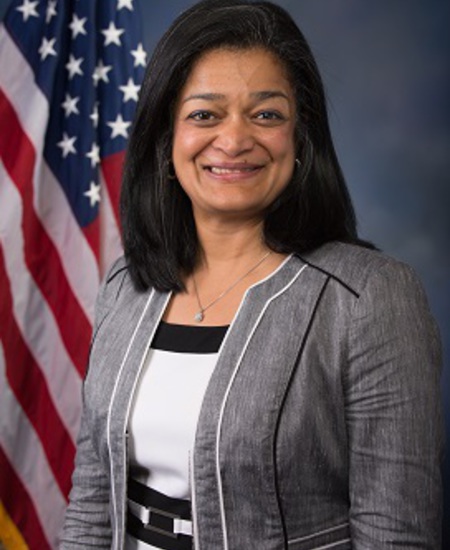
Rep. Pramila Jayapal
Sponsored bills
Maddy summaryHRES 1056 is a non-binding House resolution calling for the U.S. to formally end the Monroe Doctrine as official policy and develop a "New Good Neighbor" approach to relations with Latin American and Caribbean nations. It proposes specific policy shifts, including ending unilateral sanctions (like the Cuba embargo), reforming international financial institutions to support equitable development, and ending U.S. interference in regional judicial processes. The resolution directly affects U.S. foreign policy toward 34 countries in the region and aims to reshape diplomatic, economic, and security cooperation. As a resolution, it does not create new law but urges the State Department and Congress to adopt these changes.
Maddy summaryThis resolution (HRES 1049) is a non-binding House of Representatives congratulatory measure celebrating the Seattle Seahawks' victory in Super Bowl LX and honoring their fan base, known as the "12th Man." It specifically acknowledges the team's second Super Bowl title, key players like MVP Kenneth Walker III and record-setting kicker Jason Myers, and the defensive performance. The resolution has no legal effect or policy changes - it serves solely as ceremonial recognition for the team and fans, with no direct impact on individuals or legislation.
Maddy summaryHR 7480, the FAIR Act, sets pay adjustments for federal employees in 2027. It increases base pay by 3.1% for most federal workers under standard pay systems and for employees paid according to local civilian wages in high-cost areas. Additionally, it raises locality pay adjustments by 1% for 2027. The bill directly affects all federal employees covered by these pay systems through concrete, formula-based adjustments.
Maddy summaryThis federal bill (HR 7467) adds civil remedies for victims of specific federal crimes, primarily sexual abuse (18 U.S.C. §§ 2241-2243) and sex trafficking-related transportation crimes (18 U.S.C. §§ 2421-2423). It allows victims to sue perpetrators for damages and legal costs in federal court, with key changes to time limits: most cases must be filed within 10 years of the offense or until the victim turns 18 (if a minor), but no time limit applies to cases involving the specified sections. Civil lawsuits must pause during related criminal trials. The bill directly affects victims of these crimes, particularly minors, by expanding legal options for seeking compensation.
Maddy summaryThis bill amends disaster preparedness funding rules to better support companion animals during emergencies. It adds a new 90% federal funding option for specific pet-related preparedness activities, alongside the existing 50% option. States, localities, and tribes receiving disaster grants can now use funds for items like collapsible crates, mobile pet trailers, veterinary supplies, emergency generators, and animal response team training. The law directly affects government entities managing disaster response by expanding allowable uses of existing grant money for pet safety.
Maddy summaryHR 7363, the ICE Out of Our Faces Act, prohibits U.S. Customs and Border Protection (CBP) and U.S. Immigration and Customs Enforcement (ICE) officers from using facial recognition, voice recognition, or other biometric surveillance technology for immigration enforcement. It directly affects CBP and ICE officers, including those deputized under Section 287(g), by banning the acquisition, possession, or use of such technology within the U.S. The bill requires immediate deletion of all existing biometric data collected by these agencies within 30 days of enactment and makes illegally obtained data inadmissible in court. Individuals harmed by violations can sue the federal government for damages, while officers violating the law face retraining, suspension, or termination.
Maddy summaryHR 5658, the Child Care for Every Community Act, establishes a federal framework to create universal, high-quality child care and early learning programs available to all young children not yet required to attend school. The bill requires that covered children (children below compulsory school age) be entitled to participate in these programs, with no fees for low-income families and sliding-scale fees for others based on family income. Key provisions include requiring full-working-day, full-calendar-year care; setting national quality standards for staff qualifications and facilities; mandating comprehensive services including health, nutrition, and family support; and requiring coordination with schools to support children's transitions to kindergarten. The bill directly affects families seeking child care, child care providers, and local communities that would administer these programs through designated "prime sponsors."
Maddy summaryHR 6925, the Kennedy Center Protection Act, voids a December 2025 vote by the Kennedy Center's Board of Trustees that renamed the facility "The Donald J. Trump and John F. Kennedy Center for the Performing Arts." The bill mandates the immediate removal of all changed signage and restores the original name "John F. Kennedy Center for the Performing Arts" in all official references, documents, and records. It also permanently prohibits the Board from voting to rename the Center, amending existing law to restrict their authority in this regard. The bill requires the Board to report on any public or private funds used for the previous renaming effort within 30 days of enactment.
Maddy summaryThe Federal Property Integrity Act (HR 6926) prohibits federal agencies from naming, renaming, designating, or redesignating any federal building, land, or asset after the current President. This law directly affects the process of naming federal properties during a President's term in office. It would prevent the practice of honoring sitting Presidents with federal property names, such as naming a courthouse or park after the President while they are still in office. The bill does not apply to properties named before a President took office or to post-presidency naming.