

Safe Schools Improvement Act of 2021 This bill requires states to direct their local educational agencies (LEAs) to establish policies that prevent and prohibit bullying and harassment of elementary and secondary school students. In particular, these policies must prohibit bullying and harassment based on race, color, national origin, sex, sexual orientation, gender identity, disability, or religion. Further, LEAs must provide (1) students, parents, and educational professionals with annual notice of the conduct prohibited in their disciplinary policies; (2) students and parents with grievance procedures that target such conduct; and (3) the public with annual data on the incidence and frequency of that conduct at the school and LEA level. The Department of Education must conduct and report on an independent biennial evaluation of programs and policies to combat bullying and harassment in elementary and secondary schools. The National Center for Education Statistics must collect state data to determine the incidence and frequency of the conduct prohibited by LEA disciplinary policies.
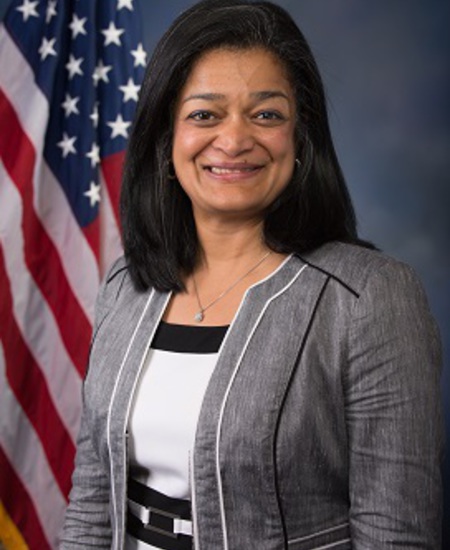
Rep. Pramila Jayapal
Sponsored bills
America's Red Rock Wilderness Act This bill designates specified lands in the following areas of Utah as components of the National Wilderness Preservation System: (1) Great Basin, (2) Grand Staircase-Escalante, (3) Moab-La Sal Canyons, (4) Henry Mountains, (5) Glen Canyon, (6) San Juan-Anasazi, (7) Canyonlands Basin, (8) San Rafael Swell, and (9) Book Cliffs and Uinta Basin. The bill sets forth administrative requirements for (1) the exchange of state-owned lands within such areas, (2) federal reservation of water rights, (3) measurement of setbacks for roads with adjacent wilderness, (4) authorized livestock grazing, and (5) withdrawal of such lands from disposition under certain public land laws.
Furthering Underutilized Technologies and Unleashing Responsible Expenditures for Western Water Infrastructure and Drought Resiliency Act or the FUTURE Western Water Infrastructure and Drought Resiliency Act This bill addresses water-related resources and infrastructure. Among other provisions, the bill reauthorizes through FY2026 the California Bay-Delta program, the Water Availability and Use Science Program, and a water desalination program; reauthorizes through FY2028 the Fisheries Restoration and Irrigation Mitigation program; creates various grants for water projects and expands the allowable uses of grants for water recycling and reuse projects; establishes a funding source for certain water resources development projects in western states; expands the tax exclusion for energy conservation subsidies provided by public utilities to include certain subsidies for water conservation or efficiency measures and stormwater management measures; establishes prizes for water technology applications; requires the U.S. Army Corps of Engineers to use specified funds for water control manual updates for forecast-informed water operations projects; and allows certain funding to be used for the remediation of land formerly used to cultivate marijuana. The Department of the Interior must, within 10 years, make certain streamgages operational. (Streamgages are fixed structures at streams, rivers, lakes, and reservoirs that measure water level and related streamflow.) The bill establishes programs related to ecosystem protection and restoration, including programs to (1) incentivize farmers to keep fields flooded during appropriate periods for waterbird habitat creation and maintenance, and (2) prepare drought plans to sustain critically important fisheries.
Medicare Dental, Vision, and Hearing Benefit Act of 2021 This bill provides for Medicare coverage of dental, vision, and hearing care. Coverage includes (1) routine dental cleanings and exams, basic and major dental services, emergency dental care, and dentures; (2) routine eye exams, eyeglasses, and contact lenses; and (3) routine hearing exams, hearing aids, and exams for hearing aids. With respect to such care, the bill establishes special payment rules, limitations, and coinsurance requirements.
Eliminating the HHS Discrimination Division Act of 2021 This bill eliminates the Conscience and Religious Freedom Division in the Office of Civil Rights of the Department of Health and Human Services (HHS) and prohibits the use of federal funds to establish or operate a similar entity with respect to HHS programs and activities.
Build Local, Hire Local Act This bill imposes various requirements on certain federally assisted infrastructure projects. The bill also creates infrastructure-related grant programs and establishes the Buy America Bureau. Such federally assisted infrastructure projects must (1) employ a certain percentage of local workers to the maximum extent practicable; and (2) prioritize hiring certain individuals, such as veterans and those facing barriers to employment. A certain percentage of funds for these projects must be used for contracts with small businesses that have fewer than 10 employees. When applying for a contract, grant, or loan related to a project, the applying entity must disclose whether there are any rulings, such as a civil judgment, finding that the entity has violated certain federal labor and occupational safety laws in the last three years. In addition, the Department of Transportation must award grants to entities in disadvantaged and underserved communities for infrastructure projects that create connected, economically prosperous, and environmentally healthy communities. Further, the Department of Labor must provide grants to workforce development boards and industry partnerships for job training programs to train certain groups, such as individuals with barriers to employment, for jobs in targeted infrastructure industries. The bill also establishes the Buy America Bureau within the Department of Commerce to oversee project compliance with existing laws that require the use of U.S.-made materials in certain federally funded projects.
Screening With Dignity Act This bill directs the Transportation Security Administration (TSA) to develop procedures to appropriately and respectfully screen self-identified transgender air passengers and passengers traveling with religious headwear or other articles of faith and begin training of all TSA Officers on such procedures. The TSA must implement protections for such passengers, including (1) prohibiting human viewing of passenger images and conducting pat downs by an officer of the gender requested by the passenger; and (2) ensuring secondary screening measures are no more intrusive than necessary to resolve an alarm or other concern raised by primary screening, including consideration of the sensitivity of the groin, chest, and other body areas and the sensitivity of religious articles of faith such as religious headwear. The TSA shall separately study and report on (1) the cost and feasibility of retrofitting advanced image technology screening equipment to distinguish between foreign objects and human body parts (including hair) in a manner that is gender neutral; and (2) the impact of imaging technology on transgender passengers, passengers whose religious faith requires them to travel with articles of faith, and passengers traveling with assistive devices. Additionally, the TSA must identify any policy, procedure, or training changes and complete any testing, certification, and assessment for qualifying additional technology to ensure that any advanced imaging utilized for passenger screening meets certain requirements, including not generating alarms based only on passengers' body parts (including hair), undergarments, or religious headwear.
Audit the Pentagon Act of 2021 This bill requires defense spending reductions during any fiscal year after FY2022 where the Comptroller of the Department of Defense (DOD) fails to certify that a department, agency, or other element of DOD has achieved an unqualified opinion on its full financial statements. The amount of any reductions must be deposited in the General Fund of the Department of the Treasury and must be available for deficit reduction. The bill excludes from any reductions accounts related to military personnel, reserve personnel, National Guard personnel, and the Defense Health Program. The President may waive a reduction if the President certifies that a reduction would negatively affect (1) national security or members of the Armed Forces who are deployed in combat zones, or (2) the Defense Health Program account.
This concurrent resolution expresses the sense of Congress that title IX of the Education Amendments of 1972 applies to the National Collegiate Athletics Association (NCAA) and that the NCAA should work to prevent sex-based discrimination in its programs and activities.
This resolution urges the President to facilitate private medical supply donations and to deliver urgently needed medical supplies, including oxygen generator plants, to India and countries neighboring India that are facing the spread of COVID-19.