

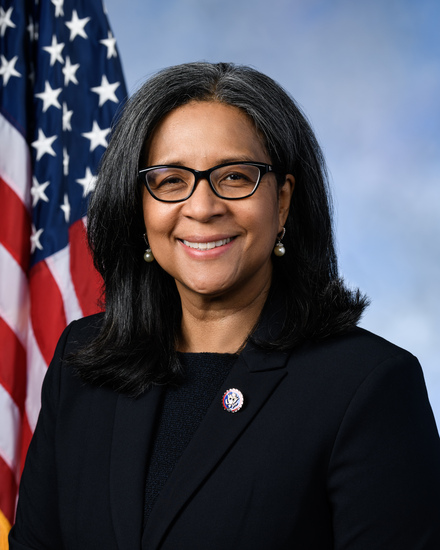
Photo of Marilyn Strickland
D United States House · District 10 · Washington On the 2026 ballot

Rep. Marilyn Strickland

Compare
Total votes
2,837
all sessions
Attendance
98%
62 missed
Near the chamber average
With party
98%
of cast votes
Near the chamber average
Bipartisan score
1%
crosses aisle rarely
Near the chamber average
Sponsored
1,357
bills & resolutions
Near the chamber average
Committees
6
assignments
1,357 bills and resolutions

Sponsored bills

Total
1,357
Primary
56
Co-sponsor
1,301
This page
1,357
matching current filters
Co-sponsor HR 240
Passed May 19, 2021 1 co-sponsor
Co-sponsor HR 204
Passed · Indiana House · Co-sponsor
STEM Opportunities Act

STEM Opportunities Act This bill provides for guidance, data collection, and grants for groups historically underrepresented in science, technology, engineering, and mathematics (STEM) education at institutions of higher education (IHEs) and at federal science agencies. Specifically, the bill requires the Office of Science and Technology Policy (OSTP) to provide specified guidance related to such groups to federal science agencies and IHEs. Each federal science agency must collect comprehensive demographic data on recipients of merit-reviewed research and development grants given to IHEs and federal laboratories supported by that agency. Each agency must also implement recommendations from the OSTP report titled Reducing the Impact of Bias in the STEM Workforce . In addition, each agency must carry out a pilot program and implement evidence-based policies and practices to minimize the effect of implicit bias in the grant review process. The National Science Foundation (NSF) must carry out and publish a survey to collect data on the demographics of STEM faculty, by broad fields of STEM, at different types of IHEs. The NSF must also carry out a variety of grant programs, including grants for increasing (1) the recruitment, retention, and advancement of individuals from underrepresented minority groups in STEM careers; (2) the recruitment and retention of minority students who are underrepresented in STEM fields; and (3) student participation in computer science and computational thinking education programs at tribal colleges and universities.

Passed May 19, 2021 1 co-sponsor
Co-sponsor HRES 404
In committee May 18, 2021 1 co-sponsor
Co-sponsor HRES 398
Passed · Indiana House · Co-sponsor
Recognizing the forthcoming centennial of the 1921 Tulsa Race Massacre.

This resolution expresses the sense of the House of Representatives that the United States can achieve a more perfect union by condemning the violence and destruction perpetrated against the African American community of Greenwood in Tulsa, Oklahoma. The resolution states that a more perfect union may be achieved through other means as well, including by promoting tolerance and unity, and it recognizes Congress's commitment to acknowledge and learn from the history of racism and racial violence in the United States in order to reverse the legacy of white supremacy and fight for racial justice.

Passed May 18, 2021 1 co-sponsor
Co-sponsor HR 3321
In committee · Indiana House · Co-sponsor
Credit for Caring Act of 2021

Credit for Caring Act of 2021 This bill allows an eligible caregiver a tax credit of up to $5,000 for 30% of the cost of long-term care expenses that exceed $2,000 in a taxable year. The bill defines eligible caregiver as an individual who has earned income for the taxable year in excess of $7,500 and pays or incurs expenses for providing care to a spouse or other dependent relative with long-term care needs.

In committee May 18, 2021 1 co-sponsor
Co-sponsor HR 3294
In committee · Indiana House · Co-sponsor
IGNITE HBCU Excellence Act

Institutional Grants for New Infrastructure, Technology, and Education for HBCU Excellence Act or the IGNITE HBCU Excellence Act This bill establishes a grant program to support long-term improvements of historically Black colleges and universities (HBCUs) and graduate programs at HBCUs. Specifically, the bill requires the Department of Education (ED) to award grants to HBCUs to improve campus facilities. A recipient must use grant funds for certain activities, such as constructing or renovating facilities, carrying out major repairs, and strengthening the safety and security of a campus. Any new construction, modernization, or renovation projects must meet building code and energy and water conservation requirements. Further, HBCUs must seek to procure contracts from certain small businesses, including those owned and controlled by veterans and service-disabled veterans. The bill prohibits the use of grant funds for specified activities, including for the payment of routine and predictable maintenance costs, minor repairs, and utility bills. The Government Accountability Office must study the implementation of the grant program. The bill also requires ED to repay the outstanding balance of principal, interest, fees, and costs and any related reimbursements for certain capital financing loans.

In committee May 18, 2021 1 co-sponsor
Co-sponsor HR 3271
In committee · Indiana House · Co-sponsor
Climate Change Health Protection and Promotion Act of 2021

Climate Change Health Protection and Promotion Act of 2021 This bill requires the Department of Health and Human Services (HHS) to take a series of actions to address the potential impacts of climate change on public health. Specifically, HHS must develop a strategic action plan and a climate and health program to ensure the public health and health care systems in the United States and other nations are prepared for, and can respond to, the impacts of climate change on health. HHS must revise the plan periodically to reflect new scientific developments and information. Additionally, HHS must establish a permanent science advisory board to provide (1) scientific and technical recommendations on the impacts of climate change on public health, and (2) advice for purposes of issuing the plan and conducting the program.

In committee May 18, 2021 1 co-sponsor
Co-sponsor HR 3289
In committee · Indiana House · Co-sponsor
Transportation Equity Act

Transportation Equity Act This bill directs the Department of Transportation (DOT) to reestablish the Transportation Equity Committee. The committee must provide independent advice and recommendations to DOT on transportation equity issues. The committee must also evaluate the work of DOT in connecting people to economic and related forms of opportunity and carrying out its strategic, research, technological, regulatory, community engagement, and economic policy activities related to transportation and opportunity. In addition, DOT must appoint a full-time federal employee to serve as coordinator and act as the designated federal officer for the committee.

In committee May 18, 2021 1 co-sponsor
Co-sponsor HR 1834
In committee · Indiana House · Co-sponsor
Hate Crimes Commission Act of 2021

Hate Crimes Commission Act of 2021 This bill establishes the United States Commission on Hate Crimes. The commission must investigate and report on whether hate crimes have increased; factors that contributed to an increase in hate crimes, if one is determined to exist; policies or actions by law enforcement agencies to reduce the commission of hate crimes; the impact of underreporting on hate crimes statistics and prevention; and successful community bias prevention responses.

In committee May 18, 2021 1 co-sponsor
Co-sponsor HR 1843
In committee · Indiana House · Co-sponsor
COVID–19 Hate Crimes Act

COVID - 19 Hate Crimes Act This bill requires a designated officer or employee of the Department of Justice (DOJ) to facilitate the expedited review of COVID-19 (i.e., coronavirus disease 2019) hate crimes and reports of COVID-19 hate crimes. It defines COVID-19 hate crime as a violent crime that is motivated by two things: (1) the actual or perceived characteristic (e.g., race or ethnicity) of any person, and (2) the actual or perceived relationship to the spread of COVID-19 of any person because of that characteristic. The bill requires DOJ to issue guidance for state and local law enforcement agencies on (1) the establishment of online hate crime reporting processes and the availability of online reporting in multiple languages, and (2) the expansion of culturally competent education campaigns. Additionally, DOJ and the Department of Health and Human Services must issue guidance on best practices for mitigating racially discriminatory language in describing the COVID-19 pandemic.

In committee May 18, 2021 1 co-sponsor
Showing 1,151 to 1,160 of 1,357 bills