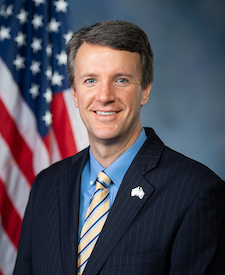
Photo of Ben Cline
R United States House · District 6 · Virginia On the 2026 ballot

Rep. Ben Cline

Compare
Total votes
2,837
all sessions
Attendance
99%
26 missed
Near the chamber average
With party
89%
of cast votes
Lower than 85% of chamber peers
Bipartisan score
6%
crosses aisle rarely
Higher than 84% of chamber peers
Sponsored
959
bills & resolutions
Near the chamber average
Committees
10
assignments
959 bills and resolutions

Sponsored bills

Total
959
Primary
51
Co-sponsor
908
This page
959
matching current filters
Co-sponsor HR 7385
Signed into law · Indiana House · Co-sponsor
To designate the facility of the United States Postal Service located at 29 Franklin Street in Petersburg, Virginia, as the "John Mercer Langston Post Office Building".

Maddy summaryThis bill renames the U.S. Postal Service facility at 29 Franklin Street in Petersburg, Virginia, as the "John Mercer Langston Post Office Building." It updates all official federal references (including laws, maps, and documents) to use this new name. The designation is ceremonial and affects only the building's official identification, with no changes to postal operations or services. This is a standard naming resolution with no substantive policy impact.

Signed into law Jan 4, 2025 1 co-sponsor
Co-sponsor HR 4563
In committee · Indiana House · Co-sponsor
ACE Act

Maddy summary# Summary of Proposed Legislation This comprehensive legislative proposal contains multiple sections addressing election integrity, campaign finance reform, cybersecurity, census operations, and related government functions. Key provisions include: 1. **Campaign Finance Reforms**: - Increased thresholds for political committee reporting requirements - Repeal of requirements for political committees to report donor identification - Exemption of uncompensated internet communications from contribution/expenditure treatment - Protection of donor privacy for tax-exempt organizations through the "Speech Privacy Act of 2023" 2. **Election Security**: - Establishment of a process for testing and monitoring cybersecurity vulnerabilities in election equipment - Requirements for the Secretary of Homeland Security to notify state officials about election cybersecurity incidents - Exclusive authority for the Election Assistance Commission regarding guidelines for voting system certification 3. **Census and Redistricting**: - Establishment of a permanent Census Monitoring Board with bipartisan composition to review census operations - Clarification of state authority over congressional redistricting maps - Provisions regarding the Speaker of the House's authority to join civil actions related to apportionment 4. **Other Key Provisions**: - Termination of the Disinformation Governance Board and prohibition on funding similar entities - Amendments to the Federal Election Campaign Act to increase reporting thresholds and exempt certain communications - Various technical corrections to existing campaign finance law The legislation appears to focus on enhancing election security, reducing regulatory burdens on political organizations, protecting donor privacy, and strengthening oversight of census operations while maintaining constitutional boundaries between federal and state authority.


In committee Jan 3, 2025 1 co-sponsor
Co-sponsor HR 53
In committee · Indiana House · Co-sponsor
Responsible Borrower Protection Act of 2025

Maddy summaryThis bill blocks the Federal Housing Finance Agency (FHFA) and mortgage enterprises (like Fannie Mae and Freddie Mac) from implementing specific mortgage fee changes announced in January 2023. It specifically revokes the FHFA's updated single-family mortgage pricing framework and related guidance documents. The bill does not affect the existing practice of risk-based pricing for mortgage credit fees, which remains permitted. It directly impacts mortgage lenders and borrowers by halting the 2023 fee changes without altering current risk-based fee structures.

In committee Jan 3, 2025 1 co-sponsor
Co-sponsor HR 24
In committee · Indiana House · Co-sponsor
Federal Reserve Transparency Act of 2025

Maddy summaryHR 24, the Federal Reserve Transparency Act of 2025, mandates a comprehensive audit of the Federal Reserve Board and Federal Reserve banks by the Government Accountability Office (GAO) within 12 months of enactment. The bill requires the GAO to submit a detailed report to Congress within 90 days of completing the audit, including findings, conclusions, and recommendations for legislative or administrative action. This audit replaces current limitations on reviewing Federal Reserve operations, particularly regarding entities like special purpose vehicles not previously subject to standard audits. The bill directly affects the Federal Reserve System by increasing congressional oversight of its financial activities and reporting mechanisms.

In committee Jan 3, 2025 1 co-sponsor
Co-sponsor HR 116
In committee · Indiana House · Co-sponsor
Stopping Border Surges Act

Stopping Border Surges Act This bill modifies immigration law provisions relating to unaccompanied alien minors and to asylum seekers. The bill requires the Department of Homeland Security (DHS) to repatriate certain unaccompanied, inadmissible alien children, generally those not at risk of being trafficking victims nor having a fear of persecution. Currently, only inadmissible unaccompanied aliens from neighboring countries are subject to repatriation, and DHS has discretion whether to repatriate. When the Department of Health and Human Services releases an unaccompanied child to an individual, it shall provide DHS with certain information about that individual, including Social Security number and immigration status. The bill requires a stricter standard to find a credible fear of persecution and imposes additional rules on credible fear interviews. If an alien is granted asylum because of fear of persecution in a country, the alien shall be deemed to have renounced asylum status by returning to that country, if there has been no change in the country's conditions. The bill also (1) expands the definition of what constitutes a frivolous asylum application, (2) imposes additional limitations on eligibility for asylum, (3) shortens the deadline for applying for asylum, and (4) extends the time period an alien seeking asylum must wait before receiving employment authorization. Any individual who knowingly and willfully makes materially false statements or uses fraudulent documents in asylum-related proceedings shall be fined or imprisoned up to 10 years, or both.

In committee Jan 3, 2025 1 co-sponsor
Co-sponsor HR 162
In committee · Indiana House · Co-sponsor
First Amendment Accountability Act

Maddy summaryHR 162, the First Amendment Accountability Act, creates a legal right for individuals to sue federal employees who violate their First Amendment rights (such as free speech or assembly) while acting under government authority. It directly affects citizens whose rights are infringed and federal employees (excluding the President/Vice President) who may face lawsuits. The bill allows victims to seek redress through court action, with courts having discretion to award attorney fees to the winning party. It explicitly excludes lawsuits against the federal government or employer for conduct within the scope of employment.

In committee Jan 3, 2025 1 co-sponsor
Co-sponsor HR 70
In committee · Indiana House · Co-sponsor
No SmartPay for Anti-2A Companies Act

Maddy summaryThis bill prohibits the federal government from awarding new contracts under the SmartPay Program (used for government payment systems) to payment processors that handle transactions for gun retailers. It specifically bans contracts for systems using processors that have designated merchant codes for gun retailers, affecting federal agencies and payment processors participating in the SmartPay Program. The restriction applies only to new contracts awarded after the bill's enactment, leaving existing contracts unaffected.

In committee Jan 3, 2025 1 co-sponsor
Co-sponsor HR 163
In committee · Indiana House · Co-sponsor
Finish the Wall Act

Maddy summaryHR 163, the "Finish the Wall Act," mandates the immediate resumption of border wall construction along the U.S.-Mexico border within 24 hours of enactment. It requires the Department of Homeland Security to use all existing funds appropriated since 2016 for this purpose, prohibits canceling pre-January 2021 contracts, and sets a deadline of September 30, 2026, to complete the wall system. The bill directly affects the Department of Homeland Security, contractors with prior wall contracts, and border facilities, which must also comply with DNA collection requirements under federal law. It focuses on concrete policy actions - resuming construction, using existing funds, and meeting a specific timeline - without addressing broader policy impacts.

In committee Jan 3, 2025 1 co-sponsor
Co-sponsor HR 45
In committee · Indiana House · Co-sponsor
FIND Act

Maddy summaryHR 45 (FIND Act) requires federal government contractors to certify they do not discriminate against firearm businesses (including manufacturers, dealers, and trade associations) in their policies or practices. The bill mandates that contractors and subcontractors (for contracts over 10% of the prime contract value) certify they have no discriminatory policies and will not adopt them during the contract term. Violations could lead to contract termination and potential debarment. This applies to all federal procurement contracts awarded after the bill's enactment, excluding sole-source contracts. The law aims to ensure firearm businesses are treated equally in government contracting without restricting legitimate business criteria like creditworthiness or legal compliance.

In committee Jan 3, 2025 1 co-sponsor
Co-sponsor HR 142
In committee · Indiana House · Co-sponsor
Regulations from the Executive in Need of Scrutiny Act of 2025

Maddy summaryThis bill requires Congress to approve major federal regulations before they take effect. It would mandate that agencies submit detailed reports including cost-benefit analyses, economic impact assessments, and other information to Congress before implementing significant regulations. Major rules - defined as those with at least $100 million annual economic impact or significant effects on costs, competition, or employment - would need a joint resolution of approval from Congress within 70 session days. Nonmajor rules would follow a less stringent disapproval process. The bill aims to increase legislative oversight of the regulatory process, requiring Congress to formally review and approve rules that significantly impact the economy or public regulations.

In committee Jan 3, 2025 1 co-sponsor
Showing 301 to 310 of 959 bills
Previous 1 … 30 31 32 … 96 Next