

Maddy summaryThe CONNECT for Health Act of 2025 expands Medicare telehealth coverage by removing geographic restrictions that limited where patients could receive care, expanding the types of health care providers who can offer telehealth services, and eliminating the requirement for an in-person visit before receiving telemental health services. The bill includes specific provisions to support telehealth use for Native American health facilities, rural health clinics, and Federally Qualified Health Centers. It requires the Centers for Medicare & Medicaid Services to collect and publish data on telehealth usage and impacts, and to develop resources to improve accessibility for people with disabilities and limited English proficiency. Program integrity measures are added to monitor telehealth billing practices and prevent fraud while maintaining coverage for telehealth services during public health emergencies.
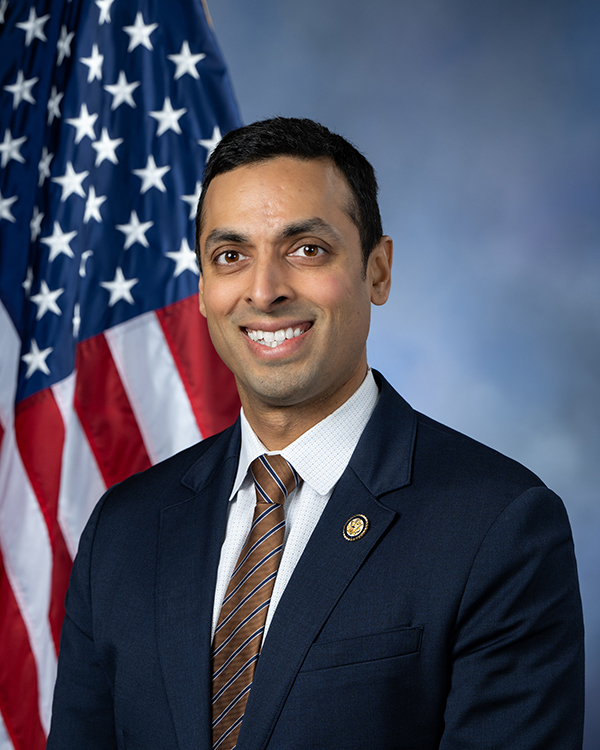
Rep. Suhas Subramanyam
Sponsored bills
Maddy summaryHR 4180, "Canyon’s Law," prohibits the use of M-44 devices - predator control tools containing highly toxic sodium cyanide - on public lands managed by federal agencies like the National Park Service, Fish and Wildlife Service, and Forest Service. The bill requires all federal, state, and county agencies to remove existing M-44 devices from public lands within 30 days of enactment. It directly affects agencies and land managers who previously deployed these devices, which have caused human poisonings (including incidents involving children), killed over 50 family dogs, and harmed endangered species. The law aims to eliminate the risk of accidental exposure and non-target wildlife deaths by banning the devices' use on public lands.
Maddy summaryHR 4153, the STRONG Act, increases maximum loan limits for two key Small Business Administration (SBA) programs. It raises the cap for standard 7(a) loans from $3.75 million to $7.5 million (and the threshold for higher amounts from $5 million to $10 million), and doubles the cap for development company loans from $5 million to $10 million (for both standard and higher thresholds). These changes directly affect small businesses seeking SBA financing by allowing them to access larger loans for growth, expansion, or recovery. The bill modifies specific provisions in the Small Business Act and Small Business Investment Act to expand access to capital.
Maddy summaryThis bill makes technical corrections to the Camp Lejeune Justice Act of 2022 to streamline claims for individuals harmed by water contamination at Camp Lejeune. It clarifies the evidence required (30+ days at the base plus a link between contaminants and health harm), specifies that cases must be handled in North Carolina courts (with limited transfer options), and sets attorney fee caps (20% before suit, 25% after). These changes directly affect veterans and civilians who lived at Camp Lejeune and filed claims under the 2022 law. The bill does not create new eligibility but aims to improve the legal process for existing cases.
Maddy summaryThe Women's Health Protection Act of 2025 would protect access to abortion services across the United States by prohibiting states from imposing restrictions that are more burdensome than those on comparable medical procedures. The bill directly affects people seeking abortion care and health care providers by banning restrictions such as mandatory in-person visits, requirements for specific tests, limitations on telemedicine, and rules based on a patient's reason for seeking abortion. It prohibits state laws that single out abortion for unnecessary restrictions while allowing post-viability abortions when necessary to protect a patient's life or health. The bill preempts conflicting state laws and provides enforcement mechanisms through private lawsuits and actions by the Attorney General.
Maddy summaryThe Caring for Survivors Act of 2025 increases monthly dependency and indemnity compensation for surviving spouses of veterans. It changes the calculation method from a fixed $1,154 to 55% of a specific veteran compensation rate, effective six months after enactment. The bill also reduces the required continuous disability rating period for survivors from 10 years to 5 years, and provides a proportional payment for cases where the rating period is shorter than 10 years. Surviving spouses of veterans who died before January 1, 1993, receive the greater of their current benefit or the new calculation. This directly affects surviving spouses eligible for benefits under Title 38, U.S. Code, particularly those with veterans who died prior to 1993.
Maddy summaryHRES 512 is a symbolic resolution expressing the House of Representatives' support for designating Sunday, June 15, 2025, as "Father's Day." It recognizes fathers' roles in families and society, citing statistics about fatherhood and the benefits of involved fathering. The resolution urges support for existing policy proposals like universal paid family leave, affordable childcare, and a child tax credit - though it does not create new laws or funding. As a commemorative measure, it has no legal effect beyond formally acknowledging Father's Day.
Maddy summaryThe RISE Act (HR 3939) streamlines documentation for college students with disabilities by requiring institutions to accept multiple forms of proof, including past Individualized Education Programs (IEPs), Section 504 plans, or licensed professional evaluations, instead of demanding current documentation. It mandates that colleges establish transparent, accessible processes for determining accommodation eligibility and share these policies with students, parents, and faculty. The bill also requires institutions to report specific data on students with disabilities (like enrollment numbers and accommodations used) to federal databases, while authorizing $10 million for a national support center. These changes directly affect colleges receiving federal aid and students seeking disability accommodations in higher education.
Maddy summaryHR 3941 would repeal Section 5123 of Public Law 118-159, which is part of the Caesar Syria Civilian Protection Act of 2019. This bill specifically targets one provision within the larger 2023 law, removing that particular section from federal law. It does not affect the rest of the Caesar Act or its core sanctions framework. The bill's direct effect is solely on the repealed section of the existing law. This is a procedural change focused on eliminating a specific legal provision.
Maddy summaryThis bill codifies existing protections for designated roadless areas within the National Forest System by prohibiting new road construction, road reconstruction, and logging in these areas. It directly affects National Forest lands already identified as "inventoried roadless areas" under the current Roadless Rule, which covers roughly 58 million acres. The key mechanism requires the Secretary of Agriculture to enforce these prohibitions, maintaining current protections without expanding restrictions to other lands or altering existing multiple-use management. The bill does not create new protected areas but legally solidifies the existing regulatory framework to preserve ecological and recreational values.