

Maddy summaryHR 7335 establishes comprehensive humanitarian standards for individuals held in U.S. Immigration and Customs Enforcement (ICE) and U.S. Customs and Border Protection (CBP) custody. The bill requires facilities to provide immediate health screenings within 12 hours (6 hours for high-risk individuals like children, pregnant people, or those with medical conditions), ensure access to adequate water, sanitation, food (with 2,000+ calories daily for adults), and age-appropriate shelter. It mandates specific facility standards including separate housing for males and females, accessible accommodations for people with disabilities, daily outdoor access for those detained over 48 hours, and proper medical equipment and personnel on-site. The bill also requires regular inspections, staff training on humanitarian protocols, and public reporting of sexual abuse complaints. These standards directly affect all individuals detained by ICE or CBP, with special protections for vulnerable groups like children, pregnant people, and those with medical needs.
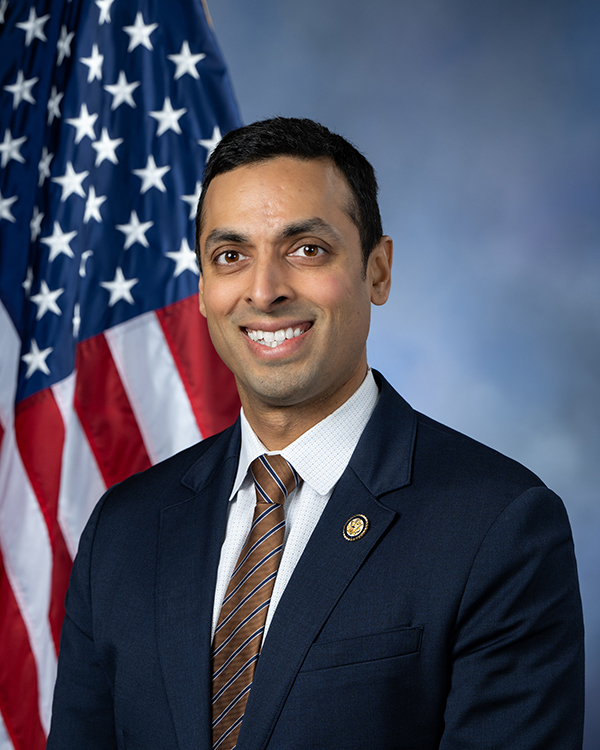
Rep. Suhas Subramanyam
Sponsored bills
Maddy summaryThis bill restructures the Federal Acquisition Security Council (FASC) to operate under the Executive Office of the President and establishes a Federal Acquisition Security Council Program Office within that office. It creates a process for the Council to issue "designated orders" that can exclude foreign entities posing national security risks from government contracts, with mechanisms for agencies to request temporary waivers under certain conditions. The Council must also report annually to Congress on security risks associated with covered sources of concern, directly affecting federal agencies and government contractors involved in procurement.
Maddy summaryHR 7265, the Vote by Mail Tracking Act, requires all government entities sending mail-in ballots for federal elections to use a standardized Postal Service barcode on ballot envelopes. This barcode enables tracking of each individual ballot, while also mandating specific envelope designs and machineability standards set by the Postal Service. The bill applies to all mail-in ballots for federal office elections starting in 2026, but excludes Federal write-in absentee ballots under the Uniformed and Overseas Citizens Absentee Voting Act. The Postmaster General must provide compliance guidance to government entities by June each year to implement the tracking system.
Maddy summaryThis bill modifies federal budget rules for unspent agency funds. It requires federal agencies to allocate 49% of unused funds to the next fiscal year, 49% toward paying the national debt, and 2% for retention bonuses (capped at 10% of an employee's base pay). Agencies must also limit future budget requests to the previous year's amount adjusted for inflation. The bill directly affects all executive branch agencies (excluding the Red Cross), altering how they manage leftover budget authority. It does not create new savings programs for individuals but changes government fiscal management procedures.
Maddy summaryHR 7322, the True Shutdown Fairness Act, requires federal agencies to pay regular wages to most employees and contractor workers during government shutdowns in fiscal year 2026, instead of furloughing them. It applies to all standard federal employees (excluding those on emergency duty) and contractor workers whose jobs would normally halt during a funding gap. Agencies must pay covered employees within 7 days of the bill's enactment for ongoing shutdowns, and contractors receive reimbursement for costs incurred keeping workers paid. The bill also prohibits agencies from implementing layoffs or placing employees on administrative leave for more than 10 days during a shutdown.
Maddy summaryThis bill (HR 7313) designates the U.S. Postal Service facility at 3135 1st Avenue North in St. Petersburg, Florida, as the "Poul Hornsleth Post Office." It updates all federal references - such as maps, documents, and regulations - to use the new name for this specific location. The bill has no policy impact beyond renaming the post office and does not affect any individuals or create new requirements. It is a procedural measure to honor Poul Hornsleth through official designation.
Maddy summaryHJRES 144 is a congressional disapproval resolution targeting a specific rule issued by the Department of Veterans Affairs (VA) on December 31, 2025, which addressed "Reproductive Health Services" (90 Fed. Reg. 61310). This resolution directs Congress to disapprove the VA rule under Chapter 8 of Title 5, U.S. Code, meaning the rule would have no legal effect if passed. The bill directly affects the VA's implementation of reproductive health services for veterans, as it seeks to nullify the agency's existing policy. This is a procedural measure, not a substantive policy change, aimed solely at blocking the VA's rule through congressional action.
Maddy summaryHCONRES 68 would require the President to remove U.S. military forces from Venezuela unless Congress has explicitly authorized their use through a declaration of war or a specific law. This applies to any U.S. Armed Forces currently stationed in Venezuela without such authorization. The resolution is based on the War Powers Resolution, which mandates congressional oversight of military deployments. It directs the immediate withdrawal of unapproved forces without adding new time limits or conditions.
Maddy summaryHR 7193, the Campaign and Election Accountability Act, prohibits U.S. individuals and organizations from knowingly helping foreign nationals make contributions or donations to U.S. election campaigns. The bill amends existing law to add a specific ban on assisting foreign nationals in violating the current prohibition against foreign contributions. This directly affects anyone who facilitates foreign election contributions, such as by transferring funds or providing campaign advice to foreign entities. The prohibition applies to contributions made on or after the bill's enactment date.
Maddy summaryHR 7100 establishes a Department of Justice Task Force on Anti-Sikh Hate and Discrimination to address systemic bias against Sikhs. The Task Force must draft a formal definition of anti-Sikh hate for DOJ use, develop educational programs for law enforcement and schools, and produce annual reports on hate crimes and trends. It requires quarterly collaboration with Sikh organizations and translation of materials into Punjabi. The bill directly affects Sikhs in the U.S. (who face disproportionate targeting as noted in FBI data) and mandates federal agencies to improve hate crime data collection and response. This is a policy-focused measure to standardize definitions, enhance reporting, and support community safety through DOJ action.