

American Workforce Empowerment Act This bill allows tax-preferred college savings plans (529 plans) to fund certain postsecondary certificate programs and apprenticeship programs.
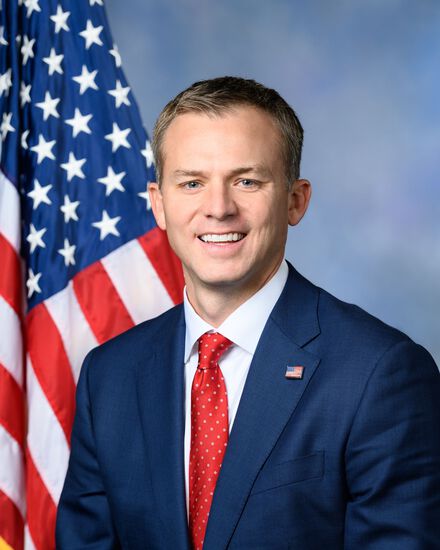
Rep. Blake D. Moore
Sponsored bills
Maddy summaryThis bill establishes nationwide recognition for valid concealed carry permits. It allows permit holders from any state to carry concealed handguns in states that either issue such permits or don't ban concealed carry, provided they carry a photo ID and their valid permit. Key provisions include making presentation of a valid permit and ID prima facie evidence of compliance, shifting the burden of proof to prosecutors if challenged, and requiring courts to award attorney fees to successful defendants. It does not override state laws prohibiting concealed carry on private property or government lands, nor does it affect restrictions on federal lands like national parks.
Maddy summaryHR 53 (FIND Act) requires federal contractors to certify they do not refuse to work with firearm manufacturers, dealers, ammunition sellers, or related safety device companies based on bias. It prohibits main contractors from awarding subcontracts exceeding 10% of a contract’s value to entities that fail to make this certification, and bans efforts to circumvent the rule through complex subcontract tiers. The law applies to all federal procurement contracts, directly affecting businesses bidding on government work. Violations risk contract termination and suspension from future government contracts.
Lodging Options Developed for Government Employees Act or the LODGE Act This bill expands the current authority of the Department of the Interior to enter into agreements with housing entities to provide rental housing for employees. The bill allows Interior to enter agreements with other federal agencies, state or local governments, tribal governments, or other public or private organizations for purposes of facilitating housing accommodation projects for rent to field employees and members of the public on public lands, including National Park System units; off public lands in the vicinity of system units; or on a combination of such lands. Interior may allow field employees and members of the public to occupy and lease project quarters. Field employees and members of the public shall be prohibited from subleasing housing units or quarters developed or leased in accordance with a housing partnership agreement under this bill, including all forms of short-term rentals. To the maximum extent practicable, priority for occupancy in project quarters shall be given to field employees. Interior may collect, or authorize entities who have entered into partnership housing agreements under this bill to collect, rents directly from field employees and members of the public occupying housing units or quarters. The bill modifies the lease-to-build program to allow Interior to lease federal land and interests in land to qualified persons for the construction of field employee quarters for any period not to exceed 60 years (under current law not to exceed 50 years).
Uyghur Forced Labor Prevention Act This bill imposes various restrictions related to China's Xinjiang Uyghur Autonomous Region, including by prohibiting certain imports from Xinjiang and imposing sanctions on those responsible for human rights violations there. Goods manufactured or produced in Xinjiang shall not be entitled to entry into the United States unless U.S. Customs and Border Protection (1) determines that the goods were not manufactured by convict labor, forced labor, or indentured labor under penal sanctions; and (2) reports such a determination to Congress and to the public. The President shall periodically report to Congress a list of foreign entities and individuals knowingly facilitating (1) the forced labor of Uyghurs, Kazakhs, Kyrgyz, and members of other Muslim minority groups in Xinjiang; and (2) efforts to contravene U.S. laws regarding the importation of forced labor goods from Xinjiang. The President shall impose property-blocking sanctions on the listed individuals and entities and impose visa-blocking sanctions on the listed individuals. Securities issuers required to file annual or quarterly reports with the Securities Exchange Commission shall disclose in such reports instances in which the issuer knowingly engaged in certain activities related to Xinjiang, such as working with an entity building detention facilities or surveillance systems there. After such a disclosure, the President shall determine whether to investigate if sanctions or criminal charges are warranted. The Forced Labor Enforcement Task Force and the Department of State shall report to Congress strategies to address forced labor in Xinjiang or any other part of China. The State Department shall also report to Congress a determination of whether the treatment of Muslim groups in Xinjiang constitutes crimes against humanity or genocide under U.S. law.
This act directs the Speaker of the House of Representatives and the President pro tempore of the Senate to arrange for the posthumous award of a Congressional Gold Medal to commemorate Glen Doherty, Tyrone Woods, J. Christopher Stevens, and Sean Smith, four Americans killed in the September 11, 2012, attack on the U.S. consulate in Benghazi, Libya. (Stevens was the U.S. Ambassador to Libya at the time, Smith was an officer in the Foreign Service, and Doherty and Woods were both government contractors and former Navy SEALs.) After the medal has been awarded, it shall be given to the Central Intelligence Agency Museum.
Cardiovascular Advances in Research and Opportunities Legacy Act This act addresses research, education, and awareness concerning valvular heart disease and its treatment. This disease is caused by damage to or disease affecting any valve that controls blood flow in the heart. The National Institutes of Health may conduct or support research on the disease in consultation with the National Heart, Lung, and Blood Institute (NHLBI). The NHLBI must also conduct a workshop on mitral valve prolapse, which occurs when the valve between the chambers of the left side of the heart seals improperly. The Department of Health and Human Services (HHS) must develop best practices to treat valvular heart disease. HHS may also carry out other projects to increase education and awareness of the disease.
Protecting Adopting Families from Audits Act This bill requires the Internal Revenue Service (IRS) to submit a written report to the congressional tax committees comparing the audit rate of individual taxpayers who claim the adoption tax credit to the audit rate of those taxpayers who do not claim such credit. The initial report must be submitted not later than the end of 2023 and then annually thereafter through 2036. The IRS must also submit a written report regarding its audit practices for individuals who claim refundable and nonrefundable tax credits.
Preventing Improper Payments Act This bill designates any program or activity making more than $100 million in payments in a fiscal year as susceptible to significant improper payments. Under current law, programs designated as susceptible to significant improper payments are subject to additional assessments and reporting requirements. The bill requires each agency to submit to Congress, as part of the annual financial report of the agency, a report on implementing financial and administrative controls and certain other practices with respect to fraud risk; identifying risks and vulnerabilities to fraud; and establishing strategies, procedures, and other steps to curb fraud.
Ski Hill Resources for Economic Development Act or the SHRED Act This bill establishes the Ski Area Fee Retention Account. A specified portion of rental charges for ski area permits on a Forest Service unit shall be deposited in such account. Amounts in the fund shall be available to the unit for expenditure without further appropriation for ski area administration, improvements, visitor services, and wildfire preparedness. Funds may be reallocated only if the amounts collected exceed the reasonable needs of the unit.