

Maddy summaryHRES 798 is a House resolution condemning support for Hamas, Hezbollah, and other terrorist organizations at colleges and universities. It states such support may create a hostile environment for Jewish students, faculty, and staff, citing incidents like blaming Israel for the October 7 Hamas attack. The resolution urges the Secretary of Education to direct the Office for Civil Rights to investigate and take action where appropriate. This non-binding resolution expresses the House's position but does not create new law or policy changes.
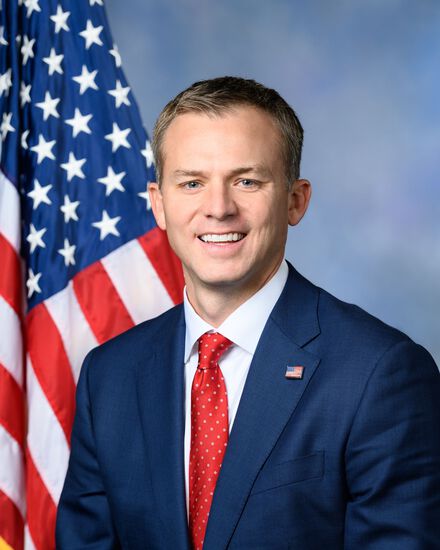
Rep. Blake D. Moore
Sponsored bills
Maddy summaryHR 6201, the Iranian Sanctions Enforcement Act of 2023, creates the Iran Sanctions Enforcement Fund to cover costs related to seizing and forfeiting property from Iran or its designated proxies (like Hezbollah or the Revolutionary Guard Corps) that violate U.S. sanctions. The fund, initially $150 million, pays for investigative costs, property management, informant rewards, and equipment for federal, state, and local agencies involved in enforcement. It also establishes an Export Enforcement Coordination Center within Homeland Security to improve interagency cooperation on enforcing export controls targeting Iran. The bill requires annual reports on fund usage and mandates repayment of the initial $150 million by 2034, unless waived for national security reasons.
Maddy summaryThis bill denies U.S. green energy tax credits to companies connected to specific countries. It targets companies created in, controlled by, or owned by entities linked to China, Russia, Iran, or North Korea. The law amends the tax code to exclude these "disqualified companies" from claiming credits under sections covering solar, wind, and other clean energy investments. This directly affects U.S. businesses with ties to those nations seeking federal tax benefits for green energy projects.
Maddy summaryHR 6128, the Outdoor Recreational Outfitting and Guiding Act, amends the Fair Labor Standards Act to create a new exemption for certain outdoor recreation employees. It exempts employees primarily working for businesses that provide outdoor outfitting or guiding services if the business operates for no more than seven months annually or has seasonal revenue patterns (average receipts for six months not exceeding 33 1/3% of receipts for the other six months). This change directly affects seasonal outdoor recreation businesses and their employees, allowing them to be excluded from standard overtime and minimum wage requirements under the FLSA. The bill does not alter other labor protections but specifically targets seasonal operations in this industry.
Maddy summaryHRES 771 is a non-binding resolution expressing the U.S. House of Representatives' support for Israel following Hamas' October 7, 2023, attack. It condemns Hamas' actions, affirms Israel's right to self-defense, and calls for the immediate release of hostages. The resolution also urges enforcement of existing laws restricting aid to terrorists and sanctions against Iran for supporting Hamas. It does not create new policies or allocate funds, as it is a symbolic statement of congressional support.
Maddy summaryHRES 768 is a symbolic House Resolution expressing congressional support for Israel following Hamas' October 7, 2023 attacks. It condemns Hamas' actions, reaffirms Israel's right to self-defense, and calls for the immediate release of hostages. The resolution references the U.S. commitment to Israel's security through existing military aid programs, including the 2016 U.S.-Israel Memorandum of Understanding, and emphasizes enforcement of laws like the Taylor Force Act to prevent U.S. aid from reaching terrorist groups. As a symbolic resolution, it does not create new policy but serves as a statement of congressional support for Israel.
Maddy summaryThis resolution designates the week of September 25-29, 2023, as "National Clean Energy Week" to recognize the growing role of clean energy in the U.S. economy. It expresses support for clean energy jobs and innovation, noting the sector employed about 8.1 million people in 2022. The resolution encourages federal, state, and local investment in affordable clean energy technologies and promotes "commonsense solutions" for energy needs. As a symbolic gesture, it has no legal force or funding implications - it simply urges recognition of clean energy's economic and environmental contributions.
Maddy summaryHR 5768, the University of Utah Research Park Act, transfers ownership of approximately 593 acres of land in Salt Lake City from the U.S. government to the University of Utah. The bill releases the government's reversionary interest (the right to reclaim the land) without requiring payment, specifically for land described by its 1968 patent and survey details. This directly affects the University of Utah, granting it full ownership of the land designated for its research park. The bill makes no new policy changes but finalizes a property transfer that has been pending since the land was originally patented.
Maddy summaryThis bill updates the Opportunity Zones program by requiring designated census tracts to meet specific poverty and income criteria, with a process to replace tracts that no longer qualify. It establishes mandatory annual reporting for Opportunity Zone funds and investors, collecting data on investments, employment, and community impact. The bill extends the tax deferral period for capital gains invested in Opportunity Zones from 2026 to 2028. Additionally, it creates a $1 billion State and Community Dynamism Fund to support investments in underserved communities, with specific requirements for how these funds can be used for affordable housing, small businesses, and community capacity building.
Maddy summaryThis bill amends the Internal Revenue Code to change how certain insurance companies account for debt instruments (like notes or bonds). It excludes these debts from being treated as "capital assets" for tax purposes, meaning gains or losses from selling them won't be taxed as capital gains. It applies only to specific insurance companies, excluding those with certain tax elections (like Section 831(b) companies) or foreign entities. The change affects tax calculations for these insurers but does not create new family-focused policies, despite the bill's misleading title. The amendment applies to dispositions after enactment, with transition rules for existing losses.