

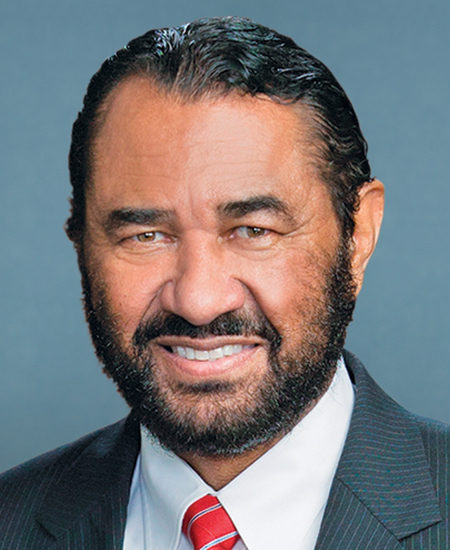
Tulsa-Greenwood Massacre Claims Accountability Act of 2021 This bill provides a cause of action for the victims of the 1921 race massacre that occurred in the Greenwood community of Tulsa, Oklahoma. Specifically, any person who acted under color of authority of the State of Oklahoma or the City of Tulsa to deprive a victim, on account of race, of any constitutional right secured to the victim at that time shall be liable to the victim or the victim's beneficiary or heir in a civil action for compensation.
Sponsored bills
Original National Domestic Violence Awareness Month Resolution of 2022 This resolution supports the goals and ideals of National Domestic Violence Awareness Month. Further, it expresses the sense of the House of Representatives that Congress should continue to raise awareness of and support programs to end domestic violence.
Endowment Transparency Act This bill requires certain actions regarding institutions of higher education (IHEs) and the management of their assets. Specifically, the bill requires the Department of Education to annually update the College Navigator website with information on the assets of IHEs, including information about investments with minority- or women-owned firms. The bill also requires the Minority Business Development Agency to (1) report on recommended changes for substantially increasing the use of minority- or women-owned firms in the investment and bond transactions of IHEs, and (2) convene a conference every five years.
Major Richard Star Act This bill provides that combat-disabled uniformed services retirees with fewer than 20 years of creditable service may concurrently receive, without reduction, veterans' disability compensation and retired pay or combat-related special compensation.
Keep Americans Safe Act This bill establishes a new criminal offense for the import, sale, manufacture, transfer, or possession of a large capacity ammunition feeding device (LCAFD). The bill does not prohibit certain conduct with respect to an LCAFD, including the following: importation, sale, manufacture, transfer, or possession related to certain law enforcement efforts, or authorized tests or experiments; importation, sale, transfer, or possession related to securing nuclear materials; and possession by a retired law enforcement officer. The bill permits continued possession of, but prohibits sale or transfer of, a grandfathered LCAFD. Newly manufactured LCAFDs must display serial number identification and the date of manufacture. Additionally, the bill allows a state or local government to use Edward Byrne Memorial Justice Assistance Grant Program funds to compensate individuals who surrender an LCAFD under a buy-back program.
Ralph David Abernathy, Sr. National Historic Site Act This bill establishes the Ralph David Abernathy, Sr. National Historic Site in Georgia as a unit of the National Park System. The site shall preserve, protect, and interpret the area where the Reverend Dr. Abernathy served as pastor during the height of the modern civil rights movement and his role as an internationally recognized civil rights leader.
This bill designates the facility of the United States Postal Service located at 3900 Crown Road Southwest in Atlanta, Georgia, as the John R. Lewis Post Office Building.
This bill provides for the posthumous commission of Milton Holland, who served as a sergeant major of the 5th Regiment of the United States Colored Infantry, as a captain in the regular Army.
This bill creates a safe harbor for certain perpetual trust funds. It excludes from the definition of investment property under arbitrage provisions any fund created and controlled by a state and established pursuant to its constitution or state law if on a specified date, substantially all of the assets of the fund consist of nonfinancial assets and the assets are used only to support specifically designated essential governmental functions.
Maximizing Outcomes through Better Investments in Lifesaving Equipment for (MOBILE) Health Care Act This bill allows a health center that currently receives funding through a Health Resources & Services Administration Health Center Program grant to use a New Access Point grant to set up a mobile unit regardless of whether the health center also establishes a permanent health care delivery site. New Access Point grants help health centers establish new delivery sites to provide comprehensive primary care to medically underserved populations. Under current law, health centers may only use the grants to set up a mobile unit if they also establish a permanent site.