

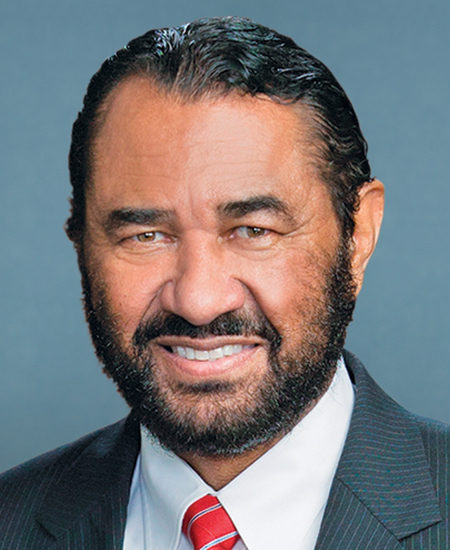
Photo of Al Green
D United States House · District 9 · Texas

Rep. Al Green

Compare
Total votes
2,837
all sessions
Attendance
99%
42 missed
Higher than 78% of chamber peers
With party
98%
of cast votes
Near the chamber average
Bipartisan score
1%
crosses aisle rarely
Near the chamber average
Sponsored
1,267
bills & resolutions
Near the chamber average
Committees
6
assignments
1,267 bills and resolutions

Sponsored bills

Total
1,267
Primary
152
Co-sponsor
1,115
This page
1,267
matching current filters
Primary HR 122
In committee · Indiana House · Lead sponsor
Original Living Wage Act

Maddy summaryHR 122, the Original Living Wage Act, amends the Fair Labor Standards Act to require the federal minimum wage to automatically adjust every four years based on a specific formula. The Secretary of Labor must set the wage so that a full-time worker earns an annual income 25.5% above the federal poverty threshold for a family of four (two adults, two children) in the contiguous U.S. This bill directly affects millions of low-wage workers covered by the federal minimum wage and their employers. The first adjustment would take effect September 1, 2023, with subsequent updates every four years, aiming to ensure minimum wage workers can afford basic needs like housing.

In committee Jan 9, 2023 0 co-sponsors
Primary HR 68
In committee · Indiana House · Lead sponsor
Housing Fairness Act of 2023

Veterans, Women, Families with Children, Race, and Persons with Disabilities Housing Fairness Act of 2023 or the Housing Fairness Act of 2023 This bill expands efforts to detect and address housing discrimination. Specifically, the Department of Housing and Urban Development (HUD) must conduct a nationwide testing program to (1) detect and document differences in the treatment of prospective renters, homebuyers, or mortgage borrowers; (2) measure patterns of adverse treatment because of the race, color, religion, sex, familial status, disability status, or national origin of a renter, homebuyer, or borrower; and (3) measure the prevalence of such discriminatory practices across housing and mortgage lending markets. The bill also reauthorizes through FY2027 the Fair Housing Initiatives Program, which supports organizations that provide direct assistance to individuals who have been victims of housing discrimination. Additionally, HUD must implement a grant program to assist public and private nonprofit organizations in (1) conducting comprehensive studies on the causes or effects of housing discrimination and segregation, and (2) implementing pilot projects that test solutions to help prevent or alleviate housing discrimination and segregation.

In committee Jan 9, 2023 0 co-sponsors
Primary HR 123
In committee · Indiana House · Lead sponsor
Alternative Data for Additional Credit FHA Pilot Program Reauthorization Act

Alternative Data for Additional Credit FHA Pilot Program Reauthorization Act This bill establishes a pilot program for an additional credit rating system for use by mortgage lenders. Specifically, the program must utilize one or more commercially available credit scoring models that apply additional credit information about borrowers who have insufficient credit histories for purposes of determining their creditworthiness for mortgages insured by the Federal Housing Administration.

In committee Jan 9, 2023 0 co-sponsors
Primary HR 126
In committee · Indiana House · Lead sponsor
Students Voicing Opinions in Today’s Elections (VOTE) Act

Students Voicing Opinions in Today's Elections (VOTE) Act This bill directs the Election Assistance Commission to carry out a pilot program providing funds, during FY2023, to local educational agencies (LEAs) for initiatives that provide 12th graders with voter registration information. LEAs must consult with their state and local election officials in developing the initiatives.

In committee Jan 9, 2023 0 co-sponsors
Primary HR 166
In committee · Indiana House · Lead sponsor
Fair Lending for All Act

Fair Lending for All Act This bill modifies provisions related to prohibited credit discrimination. The bill adds sexual orientation, gender identity, and an applicant's location based on zip code or census tract as classes protected against discrimination with respect to credit transactions. (Currently, discrimination is prohibited on the basis of race, color, religion, national origin, sex, marital status, age, or because an applicant receives public assistance.) The bill establishes criminal penalties for violations of prohibited credit discrimination. The Consumer Financial Protection Bureau is required to review loan applications for compliance with specified consumer laws and to establish an Office of Fair Lending Testing.

In committee Jan 9, 2023 0 co-sponsors
Co-sponsor HR 52
In committee · Indiana House · Co-sponsor
Kimberly Vaughan Firearm Safe Storage Act

Maddy summaryHR 52, the Kimberly Vaughan Firearm Safe Storage Act, promotes safe firearm storage through several concrete measures. It requires firearm manufacturers to include a "SAFE STORAGE SAVES LIVES" notice with each new handgun, rifle, or shotgun sold, directing buyers to the Attorney General’s public website with safe storage guidance. The bill also creates a federal grant program ($10 million annually) for states and tribes to develop public programs distributing safe storage devices (like locked containers or trigger locks), and establishes a tax credit for individuals purchasing such devices. These provisions directly affect firearm manufacturers, state/local governments, and the public seeking to secure firearms responsibly.

In committee Jan 9, 2023 1 co-sponsor
Co-sponsor HR 51
In committee · Indiana House · Co-sponsor
Washington, D.C. Admission Act

Maddy summaryHR 51, the Washington, D.C. Admission Act, would admit Washington, D.C. as the 51st state, named "Washington, Douglass Commonwealth," granting its residents full representation in Congress with two Senators and one Representative. The bill establishes procedures for admission, including elections for state officials, with the state initially having one Representative until the next congressional apportionment. It would create a "Capital" area (including the White House, Capitol, and other key federal buildings) that remains under federal jurisdiction as the seat of the U.S. government, while the rest of the District becomes the new state. The bill also includes provisions to ensure continuity of federal services, property management, and legal procedures during the transition to statehood.

In committee Jan 9, 2023 1 co-sponsor
Co-sponsor HR 40
In committee · Indiana House · Co-sponsor
Commission to Study and Develop Reparation Proposals for African Americans Act

Commission to Study and Develop Reparation Proposals for African Americans Act This bill establishes the Commission to Study and Develop Reparation Proposals for African Americans. The commission must (1) compile documentary evidence of slavery in the United States; (2) study the role of the federal and state governments in supporting the institution of slavery; (3) analyze discriminatory laws and policies against freed African slaves and their descendants; and (4) recommend ways the United States may recognize and remedy the effects of slavery and discrimination on African Americans, including through a formal apology and compensation (i.e., reparations). The commission consists of individuals from civil society and reparations organizations and individuals appointed by the President and congressional leadership; Members of Congress and governmental employees may not serve on the commission. The commission may hold hearings, subpoena witnesses and records, and contract with other entities to conduct its work. The commission must submit its final report within 18 months of its first meeting.

In committee Jan 9, 2023 1 co-sponsor
Co-sponsor HR 32
In committee · Indiana House · Co-sponsor
Keeping Texas School Construction Costs Down Act of 2023

Maddy summaryThis bill amends the federal tax code to create a "safe harbor" for certain Texas school trust funds. It specifies that these state-created funds - which hold nonfinancial assets (like land or buildings) and are used solely to support public schools or essential government functions - will not be classified as "investment property" under tax law. The provision applies to funds already meeting strict criteria as of 1986, ensuring their tax-exempt status remains intact. It directly affects existing Texas perpetual trust funds that support public elementary and secondary schools. The bill does not address new construction costs or funding mechanisms, but rather clarifies the tax treatment of pre-existing school funding structures.

In committee Jan 9, 2023 1 co-sponsor
Co-sponsor HR 31
In committee · Indiana House · Co-sponsor
COVER Now Act

Cover Outstanding Vulnerable Expansion-eligible Residents Now Act or the COVER Now Act This bill establishes a demonstration program to allow local governments to provide health benefits to the Medicaid expansion population in states that have not expanded Medicaid. Under the program, local governments may provide coverage for individuals who are newly eligible for Medicaid under the Patient Protection and Affordable Care Act (i.e., the Medicaid expansion population) for a maximum of 10 years, or until their respective states expand Medicaid. The bill provides a 100% federal matching rate for the first three years of program participation. The bill prohibits states from taking certain actions against participating localities, such as withholding funding, increasing taxes, or restricting provider participation. States that violate these requirements are subject to certain funding penalties.

In committee Jan 9, 2023 1 co-sponsor
Showing 851 to 860 of 1,267 bills
Previous 1 … 85 86 87 … 127 Next