

Securing and Enabling Commerce Using Remote and Electronic Notarization Act of 2022 or the SECURE Notarization Act of 2022 This bill allows a notary public commissioned under state law to remotely notarize electronic records and perform notarizations for remotely located individuals. The bill provides technical requirements for such notarizations, including the creation and retention of video and audio recordings and the use of communication technologies (i.e., video chat). Additionally, the bill requires U.S. courts and states to recognize notarizations—including remote notarizations of electronic records and notarizations of remotely-located individuals—that occur in or affect interstate commerce and are performed by a notary public commissioned under the laws of other states. The bill also allows a notary public to remotely notarize electronic records involving an individual located outside of the United States, subject to certain requirements.
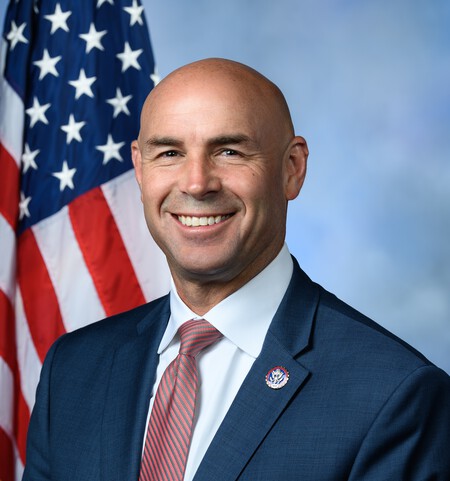
Rep. Jake Ellzey
Sponsored bills
Mathematical and Statistical Modeling Education Act This bill requires the National Science Foundation (NSF) to take certain actions to increase mathematical and statistical modeling education in public elementary and secondary schools. First, the NSF must provide competitive grants to institutions of higher education and nonprofit organizations for research and development to support high-quality mathematical modeling education (e.g., data science and computational thinking) in schools. In addition, the NSF must seek to enter into an agreement with the National Academies of Sciences, Engineering, and Medicine to study and report on mathematical and statistical modeling education in schools.
Scope 3 Act This bill prohibits any requirement that an issuer of securities must disclose the greenhouse gas emissions of its value chain (i.e., scope 3 emissions).
Federal Mask Mandate Limitations Act This bill requires prior congressional approval of any executive agency mandate that requires wearing masks or face coverings on commercial aircraft, trains, vessels, and public transportation. Before such a mandate may take effect, an agency must publish in the Federal Register and provide Congress and the Government Accountability Office (GAO) with scientific data, cost-benefit and economic impact analyses, and other information about the mandate's rationale. The GAO must, within 15 days, provide a report to Congress that assesses (1) the agency's compliance with the bill's provisions, and (2) the effect of the mask mandate on private-sector activity. Generally, the mandate shall not go into effect unless Congress approves it through a joint resolution; the bill sets procedures for the consideration of the joint resolution. However, the mandate may temporarily go into effect without congressional approval if the President determines the mandate is necessary to address (1) imminent health or safety threats or other emergencies, (2) the enforcement of criminal laws, or (3) national security.
Modernizing Department of Veterans Affairs Disability Benefit Questionnaires Act This bill requires that all disability benefit questionnaire data collected by persons other than employees of the Department of Veterans Affairs (VA) in the course of VA medical disability examinations must be transmitted to the VA in a machine-readable format.
Elizabeth Dole Home and Community Based Services for Veterans and Caregivers Act of 2022 or the Elizabeth Dole Home Care Act This bill addresses home care and caregiver programs for veterans.
Unborn Child Support Act This bill requires states to apply child support obligations to the time period during pregnancy. This requirement is applicable retroactively based on a court order at the request of the pregnant parent and a determination by a physician of the month during which the child was conceived. Existing state requirements are applicable to these obligations, such as proof of parenthood.
Support The Resiliency of Our Nation's Great Veterans Act of 2022 or the STRONG Veterans Act of 2022 This bill addresses mental health care provided by the Department of Veterans Affairs (VA), including by requiring the VA to update training for the VA workforce and Veterans Crisis Line staff, implement pilot programs, expand access to mental health care, conduct studies and research, and provide outreach to veterans regarding mental health resources. Among other requirements, the VA must ensure its medical centers have at least one full-time minority veteran coordinator and that such coordinators receive training on culturally appropriate mental health and suicide prevention services for American Indian and Alaska Native veterans; increase the number of full-time equivalent employees at Vet Centers and paid mental health trainees in the VA's workforce; expand specified scholarships and loan repayment programs for mental health providers and students; review and update the training for Veterans Crisis Line responders and social service assistants; designate a Buddy Check Week to organize outreach events and educate veterans on conducting peer wellness checks; update the Veterans Justice Outreach Program, including by conducting program outreach to justice-involved veterans; make permanent and expand the Peer Specialist Support program; expand eligibility for Vet Center services; offer mental health consultations to certain veterans; improve the assessment and treatment of veterans with sleep disorders; and perform various studies and research related to mental health issues and care. Additionally, the bill permanently authorizes and expands the Solid Start program.
Maddy summaryHR 8004, the America Works Act of 2022, reinstates work requirements for able-bodied adults without dependents in the Supplemental Nutrition Assistance Program (SNAP). It repeals a temporary pandemic-era suspension of these requirements and standardizes exemptions, allowing exemptions only for individuals under 18 or over 65, those medically certified as unfit for work, parents with children under 7, or pregnant women. The bill also reduces the exemption threshold from 12% to 3% for certain states. This directly affects SNAP recipients who are able-bodied adults without dependents in states where work requirements apply.
Citizen Ballot Protection Act This bill allows a state to include on its mail voter registration application form a requirement that the applicant provide proof of U.S. citizenship.