

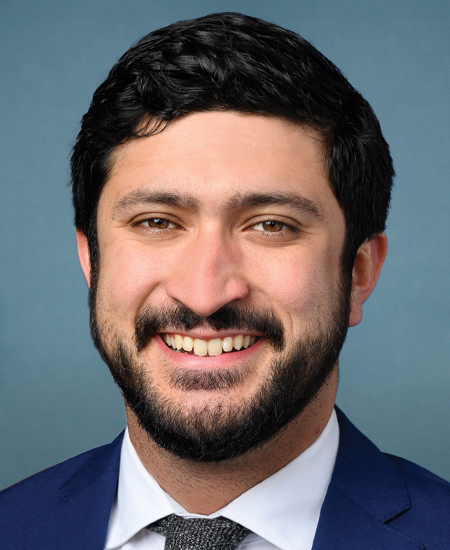
Photo of Greg Casar
D United States House · District 35 · Texas On the 2026 ballot

Rep. Greg Casar

Compare
Total votes
1,879
all sessions
Attendance
94%
118 missed
Lower than 96% of chamber peers
With party
94%
of cast votes
Near the chamber average
Bipartisan score
3%
crosses aisle rarely
Near the chamber average
Sponsored
733
bills & resolutions
Near the chamber average
Committees
7
assignments
733 bills and resolutions

Sponsored bills

Total
733
Primary
17
Co-sponsor
716
This page
733
matching current filters
Co-sponsor HRES 94
In committee · Indiana House · Co-sponsor
Expressing support for the Nation's local public K-12 schools and condemning any actions that would defund public education or weaken or dismantle the Department of Education.

This resolution supports federal investment in public K-12 schools, affirms that the Department of Education (ED) plays a vital role in the public education system, and states that public education funding should not be diverted (e.g., through the use of vouchers) to privately run K-12 schools.  The resolution also rejects any claim that the executive branch has the legal authority to (1) dismantle or relocate ED or any of its major offices; or (2) reduce federal funding for public education, block federal grants for education, or transfer funding burdens for education to state and local governments.

In committee Feb 4, 2025 1 co-sponsor
Co-sponsor HR 923
In committee · Indiana House · Co-sponsor
Stop Arming Cartels Act of 2025

Maddy summaryThe Stop Arming Cartels Act of 2025 prohibits civilian possession, sale, or transfer of rifles capable of firing .50 caliber ammunition, with exceptions for government use and rifles lawfully owned before the bill's enactment. It requires owners of such rifles to register them with the federal government within 12 months, without fees, and adds these rifles to the National Firearms Act registry. The bill also creates new federal firearm restrictions for significant foreign narcotics traffickers identified under the Foreign Narcotics Kingpin Designation Act and expands reporting requirements for rifle sales to include all rifles. This directly affects civilian rifle owners, sellers, and individuals designated as foreign narcotics traffickers.

In committee Feb 4, 2025 1 co-sponsor
Co-sponsor HR 930
In committee · Indiana House · Co-sponsor
Stop the Wait Act of 2025

Stop the Wait Act of 2025 This bill phases out the initial waiting period for Social Security Disability Insurance (SSDI) benefits and eliminates the waiting period for certain disabled individuals to become eligible for Medicare.  Under current law, individuals generally must wait five months after the onset of disability to begin receiving SSDI benefits. The bill would gradually reduce this waiting period before eliminating it entirely in the year 2030.  Further, the bill would eliminate the 24-month waiting period for certain disabled workers and other individuals to become eligible for Medicare. Under current law, individuals under the age of 65 may generally enroll in Medicare after they have been eligible for SSDI or Social Security child’s, widow’s, or widower’s benefits by reason of disability for 24 months. The bill would eliminate this waiting period for individuals for whom the annual cost of certain medical insurance would exceed a specified percentage of their household income (i.e., those who cannot afford minimum essential coverage). Medicare eligibility for these individuals must be available retroactively to the first month that an individual qualified for SSDI or Social Security child’s, widow’s, or widower’s benefits by reason of disability.

In committee Feb 4, 2025 1 co-sponsor
Co-sponsor HR 959
In committee · Indiana House · Co-sponsor
Combating International Islamophobia Act

Maddy summaryHR 959 creates a new Office within the U.S. Department of State to monitor and address Islamophobia abroad. The bill requires the State Department to include specific, detailed reports on Islamophobia in its annual human rights and religious freedom reports. These reports must describe incidents like violence against Muslims or mosques, government propaganda promoting hatred, and how foreign governments respond to such issues. The law directly affects how the U.S. government documents religious discrimination in foreign countries, mandating new reporting requirements for the State Department starting 180 days after enactment.

In committee Feb 4, 2025 1 co-sponsor
Co-sponsor HR 924
In committee · Indiana House · Co-sponsor
NO BAN Act

National Origin-Based Antidiscrimination for Nonimmigrants Act or the NO BAN Act This bill imposes limitations on the President's authority to suspend or restrict aliens from entering the United States. It also prohibits religious discrimination in various immigration-related decisions, such as whether to issue an immigrant or nonimmigrant visa, unless there is a statutory basis for such discrimination. The President may temporarily restrict the entry of any aliens or class of aliens after the Department of State determines that the restriction would address specific and credible facts that threaten U.S. interests such as public safety. The bill also imposes limitations on such restrictions, such as requiring the President, State Department, and the Department of Homeland Security (DHS) to (1) only issue a restriction when required to address a compelling government interest, and (2) narrowly tailor the suspension to use the least restrictive means to achieve such an interest. Before imposing a restriction, the State Department and DHS shall consult with Congress. The State Department and DHS shall report to Congress about the restriction within 48 hours of the restriction's imposition. If such a report is not made, the restriction shall immediately terminate. Individuals or entities present in the United States and unlawfully harmed by such a restriction may sue in federal court. The bill transfers the authority to suspend the entry of aliens traveling to the United States on a commercial airline that failed to comply with regulations related to detecting fraudulent travel documents from the Department of Justice to DHS.

In committee Feb 4, 2025 1 co-sponsor
Co-sponsor HR 944
In committee · Indiana House · Co-sponsor
Access to Counsel Act

Maddy summaryHR 944, the Access to Counsel Act, requires U.S. immigration officials to provide certain immigrants a meaningful opportunity to consult with legal counsel during key immigration processes. It directly affects U.S. nationals, lawful permanent residents returning from travel, visa holders, refugees, asylees, and parolees subject to secondary or deferred inspection at ports of entry. The bill mandates that officials ensure access to counsel (including via phone) within one hour of inspection starting, allow counsel to present evidence, and accommodate in-person meetings when possible. It also requires officials to provide counsel access before accepting Form I-407 abandonment forms from lawful permanent residents, unless waived in writing. The law takes effect 180 days after enactment and preserves existing rights to counsel under other immigration laws.

In committee Feb 4, 2025 1 co-sponsor
Co-sponsor HR 854
In committee · Indiana House · Co-sponsor
DERAIL Act

Maddy summaryHR 854, the DERAIL Act, requires the Transportation Secretary to update federal regulations defining "high-hazard flammable train" to include any train carrying flammable liquids or gases in tank cars. It also mandates that rail carriers report all toxic-by-inhalation materials on such trains to emergency responders within 24 hours after a derailment. The bill directly affects rail companies transporting hazardous materials and emergency agencies responding to train accidents. These changes aim to improve safety communication and response during incidents involving dangerous goods.

In committee Feb 1, 2025 1 co-sponsor
Co-sponsor HR 846
In committee · Indiana House · Co-sponsor
SAD Act

Stop Antiabortion Disinformation Act or the SAD Act This bill prohibits deceptive advertising for reproductive health services. Specifically, the bill makes it unlawful for a person (i.e., individual, partnership, corporation, association, or organization) to deceptively advertise the reproductive health services they offer, including by misrepresenting that the person (1) offers or provides contraception or abortion services (or referrals for such contraception or abortion services), or (2) employs or offers access to licensed medical personnel. The bill provides for enforcement by the Federal Trade Commission. In addition to any other penalty, violations are subject to a civil penalty that may not exceed the greater of $100,000 (adjusted annually for inflation) or 50% of the revenue earned during the preceding 12-month period by the ultimate parent entity of the person who violated the bill.

In committee Jan 31, 2025 1 co-sponsor
Co-sponsor HR 857
In committee · Indiana House · Co-sponsor
To designate the facility of the United States Postal Service located at 4400 East Paisano Drive in El Paso, Texas, as the "Enedina Sanchez Cordero Post Office Building".

Maddy summaryThis bill designates the U.S. Postal Service facility at 4400 East Paisano Drive in El Paso, Texas, as the "Enedina Sanchez Cordero Post Office Building" to honor her contributions. It requires all federal references in laws, maps, regulations, and documents to use the new name for the building. The change applies immediately to all official government records and communications. This is a ceremonial naming resolution with no new policy or funding provisions.

In committee Jan 31, 2025 1 co-sponsor
Co-sponsor HRES 70
In committee · Indiana House · Co-sponsor
Expressing the sense of the House of Representatives that Congress should take all appropriate measures to ensure that the United States Postal Service remains an independent establishment of the Federal Government and is not subject to privatization.

Maddy summaryThis resolution expresses the House of Representatives' position that Congress should take steps to prevent the privatization of the United States Postal Service (USPS), ensuring it remains a federal independent agency. It highlights USPS’s constitutional role, self-sustaining nature (relying on service revenue, not taxpayer funds), and critical functions - serving 168 million addresses daily, supporting rural communities, and underpinning e-commerce. The resolution opposes privatization, noting it would raise prices, reduce services, and harm the $1.9 trillion mailing industry. As a non-binding resolution, it reflects the House’s stance but does not create new law or policy.

In committee Jan 28, 2025 1 co-sponsor
Showing 321 to 330 of 733 bills
Previous 1 … 32 33 34 … 74 Next