

Spectrum Innovation Act of 2022 This bill addresses auctions of, and other matters related to, portions of the electromagnetic spectrum allocated for federal use. The bill also establishes grants for and otherwise modifies provisions concerning next generation 9-1-1 systems (i.e., interoperable Internet Protocol-based systems for receiving 9-1-1 calls). The bill extends to March 31, 2024, the authority of the Federal Communications Commission (FCC) to auction and license electromagnetic spectrum. (Under current law, the authority expires on September 30, 2022.) Additionally, the bill establishes a process for auctioning specified parts of the spectrum currently allocated for federal use. The Office of Management and Budget must transfer certain funding to federal entities for planning activities related to reallocating and auctioning spectrum while the National Telecommunications and Information Administration (NTIA) and the Executive Office of the President must oversee the planning. The Department of Commerce must, informed by the planning, identify the spectrum to auction. Further, the bill addresses shared use of spectrum bands by federal and nonfederal users. For example, the NTIA must implement an incumbent informing capability system to manage harmful interference when nonfederal users and incumbent federal entities share spectrum. The bill also establishes the Public Safety and Secure Networks Fund and directs a portion of spectrum auction proceeds to the fund for, among other purposes, reimbursing telecommunications providers for replacing equipment that poses risks to national security and safety.
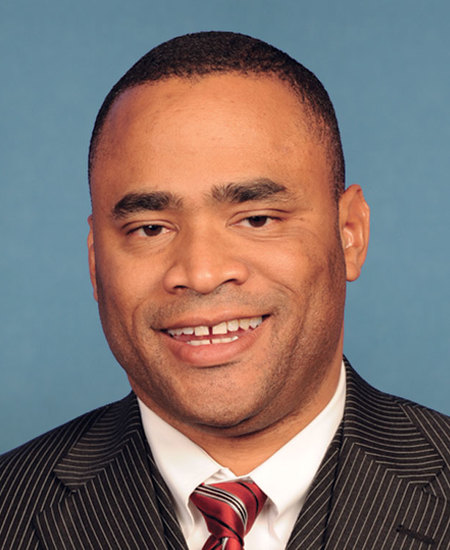
Rep. Marc A. Veasey
Sponsored bills
Original Slavery Remembrance Day Resolution of 2021 This resolution supports the designation of a Slavery Remembrance Day and condemns slavery and its progenies.
Designates the facility of the United States Postal Service located at 110 East Alexander Street in Three Rivers, Texas, as the "Private Felix Z. Longoria Veterans' Memorial Post Office."
American Families United Act This bill authorizes the Department of Homeland Security (DHS) or the Department of Justice (DOJ) to exercise discretion in certain immigration cases. The bill also removes certain requirements related to birthright citizenship. Under this bill, DOJ or DHS may, on a case-by-case basis, exercise discretion by declining to remove an alien or bar an alien from entering the United States to prevent hardship for the alien's U.S. citizen spouse, parent, or child. However, DOJ or DHS may not exercise this discretion if the alien is removable or inadmissible due to certain grounds, including specified crime- and security-related grounds. The bill also removes certain requirements related to birthright citizenship for a child born outside of the United States to one U.S. citizen parent and one alien parent. Specifically, the bill removes a provision that requires the U.S. citizen parent to be physically present in the United States for at least five years before the child's birth in order for the child to acquire U.S. citizenship at birth.
Maddy summaryThis resolution (HRES 1245) is a symbolic gesture expressing the House's support for designating November 22, 2022, as "Kimchi Day." It acknowledges kimchi's cultural significance in Korean cuisine (dating back over 2,000 years), its UNESCO recognition as intangible cultural heritage, and its health benefits as a probiotic food. The resolution does not create new laws or affect any individuals or policies; it simply formally supports the designation of a day to celebrate kimchi's cultural and culinary role. It was introduced by representatives with Korean-American connections and references kimchi's growing popularity in the U.S. as an example of multicultural exchange.
Right to Contraception Act This bill sets out statutory protections for an individual's right to access and a health care provider's right to provide contraception and related information. Contraception refers to an action taken to prevent pregnancy, including the use of contraceptives (i.e., a device or medication used to prevent pregnancy), fertility-awareness based methods, and sterilization procedures. Generally, the bill prohibits measures that single out and impede access to contraception and related information. However, a party may defend against a claim that a measure violates the bill's prohibitions by demonstrating, through clear and convincing evidence, that the measure significantly advances access to contraception and cannot be achieved through less restrictive means. The Department of Justice, individuals, or health care providers may bring a lawsuit to enforce this bill, and states are not immune from suits for violations.
This bill requires employers to provide construction employees with paid rest breaks and protects employees against related retaliatory actions. Specifically, the bill requires that construction employees receive at least one 15-minute paid rest break for every four hours of work. An employer may not take retaliatory personnel action or otherwise discriminate against a construction employee who (1) requests or takes paid rest breaks, or (2) files a related complaint with the Department of Labor. At the time of hiring an employee, an employer must provide notice of the right to paid rest breaks and protections against related retaliatory actions in the construction employee's primary language. Further, the employer must post this information at construction work sites in both English and Spanish.
Ensuring Women's Right to Reproductive Freedom Act This bill prohibits anyone acting under state law from interfering with a person's ability to access out-of-state abortion services. ( Abortion services includes the use of any drugs that are approved to terminate pregnancies and any health care services related to an abortion, whether or not provided at the same time or on the same day.) Specifically, the bill prohibits any person acting under state law from preventing, restricting, impeding, or retaliating against health care providers who provide legal abortion services to out-of-state residents, any person or entity who helps health care providers to provide such services, any person who travels to another state to obtain such services, any person or entity who helps another person travel to another state to obtain such services, or the movement in interstate commerce of drugs that are approved to terminate pregnancies. The Department of Justice may enforce this bill through civil actions; the bill also establishes a private right of action for violations.
This resolution calls on the government of Rwanda to immediately release Paul Rusesabagina on humanitarian grounds and permit him to return safely to the United States. The resolution calls on the government of Rwanda to ensure Paul Rusesabagina receives access to appropriate, qualified medical professionals and all medical care necessary to guarantee his physical integrity and psychological well-being. The resolution also urges the U.S. government in all interactions with the government of Rwanda to raise the case of Paul Rusesabagina and to press for his immediate release on humanitarian grounds. Finally, the resolution expresses support to the family of Paul Rusesabagina and their commitment to bringing him home.
Small Business Payment for Performance Act of 20 22 This bill allows a small business that is awarded a construction contract by a federal agency to request an equitable adjustment if the agency's contracting officer directs a change in the contract's performance without the agreement of the small business. The agency must provide the small business with an interim partial payment to cover additional costs resulting from such a change, and the small business must pay a first tier subcontractor or supplier the portion of the partial payment that is attributable to additional costs incurred due to the change.