

Life at Conception Act This bill declares that the right to life guaranteed by the Constitution is vested in each human being at all stages of life, including the moment of fertilization, cloning, or other moment at which an individual comes into being. Nothing in this bill shall be construed to authorize the prosecution of any woman for the death of her unborn child.
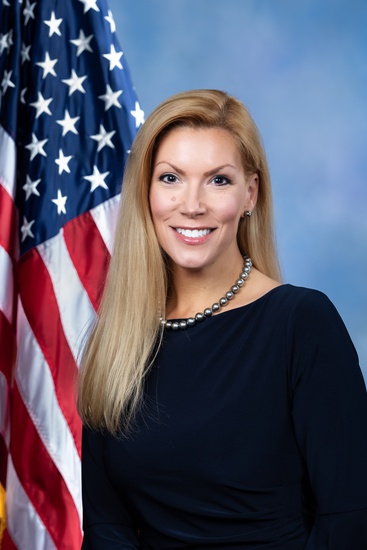
Rep. Beth Van Duyne
Sponsored bills
Maddy summaryThe GORAC Act requires the Comptroller General to hire an external auditor to review all federal programs over the past 20 years, identifying duplicative, wasteful, or outdated functions. The auditor must recommend consolidating agencies with the same purpose or eliminating programs that wasted funds through mismanagement, personal benefit, or completed objectives. The bill mandates that any savings from these changes fund domestic programs or reduce the national debt, while requiring agencies to relocate affected employees. Congress must act on the auditor's report within two years through a streamlined process that limits debate and amendments to the proposed legislation.
No User Fees for Gun Owners Act This bill prohibits a state or local government from imposing any insurance requirement, tax, user fee, or similar charge as a condition of the manufacture importation, acquisition, transfer, or continued ownership of a firearm or ammunition, with the exception of a proportionate sales tax. The bill imposes the same prohibition under the Internal Revenue Code for firearms, pistols, or revolvers, but allows for the assessment of a proportionate sales tax.
Authorization for the Use of Military Force to Combat, Attack, Resist, Target, Eliminate, and Limit Influence Resolution or the AUMF CARTEL Influence Resolution This joint resolution authorizes the President to use the Armed Forces against foreign nations, foreign organizations, or foreign persons affiliated with foreign organizations that the President determines are involved in trafficking fentanyl or fentanyl-related substances into the United States. The joint resolution also authorizes the use of force against those determined to have used force or violence in specified ways, such as engaging in violence or intimidation to control territory to be used for illicit means. The joint resolution deems nine named cartels as having met the criteria for the President to use force against them. Force authorized by this joint resolution may only be used against organizations and persons located outside of the United States. The authority expires five years after the date of this joint resolution's enactment.
American Workforce Empowerment Act This bill allows tax-preferred college savings plans (529 plans) to fund certain postsecondary certificate programs and apprenticeship programs.
Qualified Immunity Act of 2023 This bill provides statutory authority for qualified immunity for law enforcement officers in civil cases involving constitutional violations. Current law provides a statutory civil cause of action against state and local government actors (e.g., law enforcement officers) for violations of constitutional rights, also known as Section 1983 lawsuits. The Supreme Court has also found an implied cause of action against federal law enforcement officers in certain situations (e.g., Fourth Amendment violations), also known as Bivens lawsuits. However, under the judicial doctrine of qualified immunity, government officials performing discretionary duties are generally shielded from civil liability, unless their actions violate clearly established rights of which a reasonable person would have known. The bill provides statutory authority for these principles with respect to law enforcement officers. Specifically, under the bill, law enforcement officers are entitled to qualified immunity if (1) at the time of the alleged violation, the constitutional right at issue was not clearly established or the state of the law was not sufficiently clear for every reasonable officer to know that the conduct was unconstitutional; or (2) a court has held that the specific conduct at issue is constitutional. The bill applies to federal, state, and local law enforcement officers. It also specifies that law enforcement agencies and local governments may not be held liable if their officers are entitled to qualified immunity.
Maddy summaryThis bill requires colleges and universities receiving federal funding to ban TikTok (and related ByteDance apps) on all school-owned electronic devices - including computers, tablets, and smartphones - within 90 days of enactment. It prohibits federal funding for institutions that fail to implement such a ban, with an exception for research related to national security, law enforcement, or cybersecurity. The policy directly affects all public and private higher education institutions that accept federal funds, including grants and student aid programs. It does not restrict TikTok use on personal devices or apply to non-federal funding sources.
Maddy summaryThis concurrent resolution (HCONRES 4) expresses congressional support for U.S. law enforcement agencies and condemns efforts to defund or dismantle them. It does not create new funding or policy changes but formally rejects "misguided and dangerous efforts to defund and dismantle" police departments, citing officer safety concerns and rising fatalities. The resolution specifically references the 2021 increase in law enforcement deaths (458 officers killed) and opposes rhetoric that "vilifies" officers, while emphasizing their role in community safety and crisis response. It is a symbolic statement with no binding legal or financial impact.
Maddy summaryHJRES 8 proposes a constitutional amendment to permanently set the Supreme Court's size at nine justices. The bill would require any future changes to the Court's composition to follow this specific number, locking in the current structure. It does not alter the existing Court size (which has been nine since 1869) but aims to prevent future adjustments through legislative action. The amendment must be ratified by three-fourths of state legislatures within seven years to take effect. This is a procedural proposal focused on constitutional structure, not a direct policy affecting citizens or programs.
Maddy summaryHRES 8 is a formal resolution introduced by the U.S. House of Representatives in January 2023 to impeach Secretary of Homeland Security Alejandro Mayorkas. The resolution alleges three specific violations: (1) failing to maintain border security, citing record migrant encounters and fentanyl seizures under his leadership; (2) providing false testimony to Congress about border security; and (3) spreading false claims about Border Patrol agents whipping migrants during a 2021 incident. It claims these actions violated his constitutional duties and federal law. As an impeachment resolution, it does not enact policy but seeks to refer the case to the Senate for trial.