

Equity in Neuroscience and Alzheimer's Clinical Trials Act of 2021 or the ENACT Act of 2021 This bill sets out activities and requirements to increase the participation of underrepresented populations in research and clinical trials for Alzheimer's disease and related dementias. Specifically, the National Institute on Aging (NIA) must establish and provide technical assistance to Alzheimer's research centers located in areas with higher concentrations of minority groups. These centers must establish diagnostic and treatment clinics designed to serve minority, rural, and other underserved populations; operate clinical trials; and carry out public outreach to encourage members of minority populations to participate in clinical trials and research. Additionally, the NIA must disseminate information to members of minority populations about participating in clinical trials and take other actions to enhance diversity with respect to the Alzheimer's research that it conducts or supports. The bill also directs the NIA to increase diversity among Alzheimer's researchers by encouraging the participation of individuals who are from groups that are underrepresented in clinical, behavioral, and social sciences.
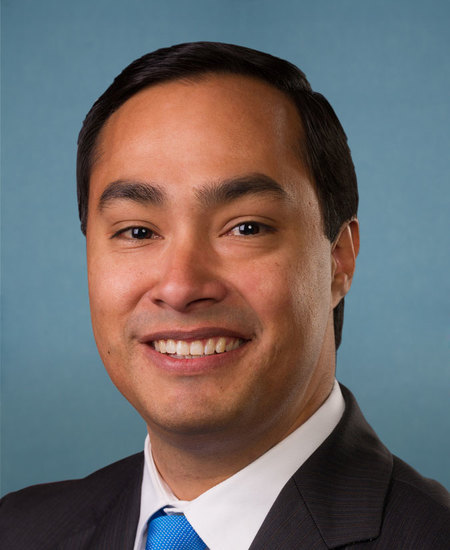
Rep. Joaquin Castro
Sponsored bills
Military Child Care Expansion Act of 2021 This bill modifies and implements policies to update child care facilities and administration at the Department of Defense (DOD). Specifically, the bill removes certain requirements for members of the Armed Forces to receive funding for an in-home child care provider under the DOD pilot program that provides financial assistance to such members who pay for in-home child care. The bill also allows DOD to expand the pilot program to additional locations (currently it is authorized for five). DOD must establish a 10-year pilot program to expand access to child care for members of the Armed Forces by entering into agreements with public or private child care facilities or development centers. Under the bill, DOD must determine the (1) root causes contributing to poor or failing facility conditions at its child development centers, and (2) total cost to improve the conditions of such centers. The Government Accountability Office must review the determinations and make recommendations on how to improve DOD child development center conditions. Lastly, DOD must utilize its existing authority to carry out minor military construction projects to construct child development centers.
Servicemember Parental Leave Equity Act This bill modifies Department of Defense parental leave provisions for members of the Armed Forces. Specifically, the bill increases parental leave for primary caregivers to 18 weeks (currently 12) following the birth of a child and to 12 weeks (currently 6) following the adoption of a child. The bill increases parental leave for a secondary caregiver from 21 days to 12 weeks in connection with the birth or adoption of a child. Primary or secondary caregivers of a long-term foster child are authorized to take up to 12 weeks of leave in connection with such placement. Parental leave for a primary or secondary caregiver for a birth, adoption, or foster child placement may be taken in more than one increment. For primary caregivers, the leave must be utilized within one year of the event. The bill authorizes up to 12 weeks of leave to certain service members who would have been secondary caregivers but for a miscarriage, stillbirth, or infant death. The following activities required of an active-duty member within a 12-month postpartum period must have the approval of a health care provider and be at the election of the member or in the interest of national security: (1) an order of temporary duty overnight travel or to participate in physically demanding field training exercises, (2) meeting of body composition standards, or (3) passing a physical fitness test. The bill also reduces the service commitment required for participation in the Career Intermission Program.
This concurrent resolution (1) affirms, on the 400th anniversary of the arrival of the first slave ship, that the nation owes a debt of remembrance not only to those who lived through the injustices of slavery but also to their descendants; and (2) urges the establishment of a U.S. Commission on Truth, Racial Healing, and Transformation to properly acknowledge, memorialize, and be a catalyst for progress, including toward permanently eliminating persistent racial inequities.
This resolution condemns and denounces all forms of anti-Asian sentiment, including those related to COVID-19 (i.e., coronavirus disease 2019), and calls on federal law enforcement officials, working with state and local agencies, to take specified steps. The resolution calls on federal officials to expeditiously investigate and document all credible reports of hate crimes, harassment, bullying, and threats against the Asian American and Pacific Islander communities; the Attorney General to work with state and local agencies and Asian American and Pacific Islander community-based organizations to prevent discrimination and to expand culturally competent and linguistically appropriate education campaigns on public reporting of hate crimes; and the Department of Health and Human Services to issue guidance describing best practices to mitigate racially discriminatory language in describing the pandemic. The resolution recommits the United States to serving as a world leader in building more inclusive, diverse, and tolerant societies by (1) prioritizing language access and inclusivity in communication practices, and (2) combating misinformation and discrimination that put Asian Americans and Pacific Islanders at risk.
Accessible, Affordable Internet for All Act This bill reauthorizes through FY2026, revises, and establishes grants and activities to promote access to broadband internet and other telecommunication services. The bill addresses digital equity and inclusion through grants and by requiring studies on barriers to adoption of broadband services and related matters. The bill addresses broadband affordability and access. It (1) reauthorizes and expands various programs that subsidize or otherwise support broadband services for eligible households, schools and libraries, and tribal lands and populations; and (2) establishes a program for expanding broadband service for underserved areas and community support organizations (e.g., schools and religious organizations). Additionally, the Federal Communications Commission (FCC) must award grants and take other actions to expand programs that verify an individual's eligibility for subsidized services. The bill addresses broadband data collection, disclosure, and sharing. The FCC must (1) issue rules regarding the collection of pricing data and labels that disclose information about broadband plans to consumers, and (2) collaborate and share data with federal agencies and other stakeholders. The bill makes financing (e.g., low-interest loans) available to communities and public-private partnerships for broadband infrastructure investments. Additionally, the Department of Transportation must require states to install conduits for broadband cables as part of certain highway projects. The bill also sets up a task force on nationwide dig once requirements (i.e., policies or practices to minimize excavations of highway rights-of-way when installing telecommunications infrastructure). Further, the bill preempts state laws that prohibit certain telecommunications service providers (e.g., public providers) from providing high-speed broadband services.
Saudi Arabia Accountability for Gross Violations of Human Rights Act This bill imposes visa-blocking sanctions on specified foreign persons determined to have played a role in the killing of Jamal Khashoggi, and it requires the Department of State to report on incidents of arbitrary detention, violence, and state-sanctioned harassment by Saudi Arabia against U.S. citizens and their family members. The bill also requires the State Department to make publicly available a report that describes whether and how a concurrence with Saudi Arabia for U.S. security assistance will avoid identifying the United States with governments that deny human rights and fundamental freedoms to their people.
Do No Harm Act This bill prohibits the application of the Religious Freedom Restoration Act of 1993 (RFRA) to specified federal laws or the implementation of such laws. Currently, RFRA prohibits the government from substantially burdening a person's exercise of religion even if the burden results from a rule of general applicability, except in furtherance of a compelling governmental interest when using the least restrictive means. Under the bill, RFRA is inapplicable to laws or the implementation of laws that protect against discrimination or the promotion of equal opportunity (e.g., the Civil Rights Act of 1964); require employers to provide wages, other compensation, or benefits, including leave; protect collective activity in the workplace; protect against child labor, abuse, or exploitation; or provide for access to, information about, referrals for, provision of, or coverage for, any health care item or service. The bill prevents RFRA from being used to deny (1) goods or services the government has contracted, granted, or made an agreement to provide to a beneficiary of or participant in a program or activity funded by such government contract, grant, agreement, or other award; or (2) a person's full and equal enjoyment of a government-provided good, service, benefit, facility, privilege, advantage, or accommodation. In order for a person to assert a RFRA claim or defense in a judicial proceeding, the government must be a party to the proceeding.
Democracy Is Strengthened by Casting Light On Spending in Elections Act of 2021 or the DISCLOSE Act of 2021 This bill addresses campaign finance, including by expanding the prohibition on campaign spending by foreign nationals, requiring additional disclosures of campaign expenditures, and requiring additional disclosures regarding certain political advertisements. First, the bill prohibits foreign nationals from participating in the decision-making process regarding an election expenditure. Additionally, the bill expands existing foreign money prohibitions to include disbursements for paid web-based or digital communications and federal judicial nomination communications. It also prohibits foreign nationals from contributing to campaigns related to ballot initiatives and referenda. The Federal Election Commission (FEC) must conduct an audit after each federal election cycle to determine the incidence of illicit foreign money. Next, the bill makes it unlawful to establish or use a corporation, company, or other entity with the intent to conceal an election contribution or donation by a foreign national. A violator is subject to criminal penalties—a fine, a prison term of up to five years, or both. Covered organizations (e.g., corporations, labor organizations, and political organizations) must, within 24 hours, file reports with the FEC to disclose campaign expenditures of more than $10,000 during an election cycle. Finally, the bill requires organizations to provide additional disclosures regarding political advertisements, including the donors who contributed the most money to that organization in the last year.
National Security Diversity and Inclusion Workforce Act of 2021 This bill requires each national security agency to report on its diversity and inclusion efforts. The bill defines diversity as diversity of persons based on gender, race, ethnicity, disability status, veteran status, sexual orientation, gender identity, national origin, and other demographic categories. It also requires each such agency to develop a system to collect and analyze applicant employment data to identify areas for improvement in attracting diverse talent, with emphasis on senior and management positions; conduct periodic interviews with a representative cross-section of the national security workforce to obtain workplace information; sponsor workforce members to participate in a Senior Executive Service candidate development program or similar program; implement performance and advancement requirements for the workforce; create opportunities for senior personnel to participate in outreach events and to discuss issues relating to diversity and inclusion; and expand training on bias in the workplace and flexible work policies. The bill encourages agencies to expand professional development and career advancement opportunities that support their missions and to seek a diverse and talented pool of employment applicants by reaching out to educational organizations and professional associations.