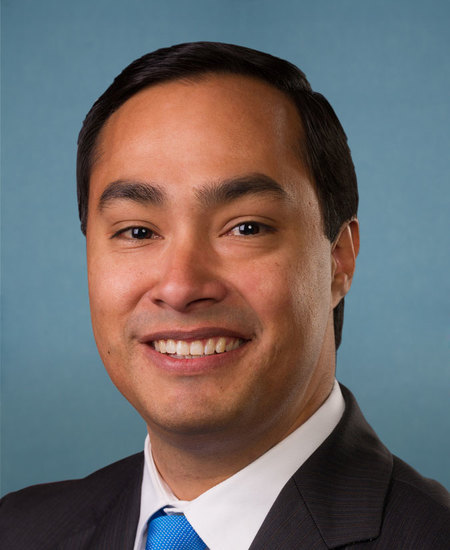
Photo of Joaquin Castro
D United States House · District 20 · Texas On the 2026 ballot

Rep. Joaquin Castro

Compare
Total votes
2,837
all sessions
Attendance
94%
160 missed
Near the chamber average
With party
98%
of cast votes
Near the chamber average
Bipartisan score
1%
crosses aisle rarely
Near the chamber average
Sponsored
960
bills & resolutions
Near the chamber average
Committees
7
assignments
960 bills and resolutions

Sponsored bills

Total
960
Primary
94
Co-sponsor
866
This page
960
matching current filters
Co-sponsor HR 396
In committee · Indiana House · Co-sponsor
Closing the Bump Stock Loophole Act of 2023

Maddy summaryHR 396, the Closing the Bump Stock Loophole Act of 2023, defines "bump stock" as any device or modification that increases the firing rate of a semi-automatic weapon to mimic a machine gun. The bill amends federal tax and firearms laws to classify bump stocks as prohibited devices under the National Firearms Act, requiring existing owners to register them within one year of enactment. It directly affects individuals who currently own bump stocks by mandating registration to avoid future possession prohibitions. The law takes effect immediately for new sales but provides a one-year grace period for existing owners to comply with registration requirements.

In committee Jan 17, 2023 1 co-sponsor
Co-sponsor HJRES 13
In committee · Indiana House · Co-sponsor
Proposing an amendment to the Constitution of the United States relating to the authority of Congress and the States to regulate contributions and expenditures intended to affect elections and to enact public financing systems for political campaigns.

This joint resolution proposes a constitutional amendment authorizing Congress and the states to (1) regulate and impose reasonable viewpoint-neutral limitations on the raising and spending of money by candidates and others to influence elections; and (2) regulate and enact public campaign financing systems, including those designed to restrict the influence of private wealth by offsetting the raising and spending of money by candidates and others with increased public funding. The amendment grants Congress and the states the power to implement and enforce this amendment by legislation. They are allowed to distinguish between natural persons and corporations or other artificial entities created by law, including by prohibiting such entities from spending money to influence elections.

In committee Jan 9, 2023 1 co-sponsor
Co-sponsor HR 51
In committee · Indiana House · Co-sponsor
Washington, D.C. Admission Act

Maddy summaryHR 51, the Washington, D.C. Admission Act, would admit Washington, D.C. as the 51st state, named "Washington, Douglass Commonwealth," granting its residents full representation in Congress with two Senators and one Representative. The bill establishes procedures for admission, including elections for state officials, with the state initially having one Representative until the next congressional apportionment. It would create a "Capital" area (including the White House, Capitol, and other key federal buildings) that remains under federal jurisdiction as the seat of the U.S. government, while the rest of the District becomes the new state. The bill also includes provisions to ensure continuity of federal services, property management, and legal procedures during the transition to statehood.

In committee Jan 9, 2023 1 co-sponsor
Co-sponsor HR 40
In committee · Indiana House · Co-sponsor
Commission to Study and Develop Reparation Proposals for African Americans Act

Commission to Study and Develop Reparation Proposals for African Americans Act This bill establishes the Commission to Study and Develop Reparation Proposals for African Americans. The commission must (1) compile documentary evidence of slavery in the United States; (2) study the role of the federal and state governments in supporting the institution of slavery; (3) analyze discriminatory laws and policies against freed African slaves and their descendants; and (4) recommend ways the United States may recognize and remedy the effects of slavery and discrimination on African Americans, including through a formal apology and compensation (i.e., reparations). The commission consists of individuals from civil society and reparations organizations and individuals appointed by the President and congressional leadership; Members of Congress and governmental employees may not serve on the commission. The commission may hold hearings, subpoena witnesses and records, and contract with other entities to conduct its work. The commission must submit its final report within 18 months of its first meeting.

In committee Jan 9, 2023 1 co-sponsor
Co-sponsor HR 32
In committee · Indiana House · Co-sponsor
Keeping Texas School Construction Costs Down Act of 2023

Maddy summaryThis bill amends the federal tax code to create a "safe harbor" for certain Texas school trust funds. It specifies that these state-created funds - which hold nonfinancial assets (like land or buildings) and are used solely to support public schools or essential government functions - will not be classified as "investment property" under tax law. The provision applies to funds already meeting strict criteria as of 1986, ensuring their tax-exempt status remains intact. It directly affects existing Texas perpetual trust funds that support public elementary and secondary schools. The bill does not address new construction costs or funding mechanisms, but rather clarifies the tax treatment of pre-existing school funding structures.

In committee Jan 9, 2023 1 co-sponsor
Co-sponsor HR 31
In committee · Indiana House · Co-sponsor
COVER Now Act

Cover Outstanding Vulnerable Expansion-eligible Residents Now Act or the COVER Now Act This bill establishes a demonstration program to allow local governments to provide health benefits to the Medicaid expansion population in states that have not expanded Medicaid. Under the program, local governments may provide coverage for individuals who are newly eligible for Medicaid under the Patient Protection and Affordable Care Act (i.e., the Medicaid expansion population) for a maximum of 10 years, or until their respective states expand Medicaid. The bill provides a 100% federal matching rate for the first three years of program participation. The bill prohibits states from taking certain actions against participating localities, such as withholding funding, increasing taxes, or restricting provider participation. States that violate these requirements are subject to certain funding penalties.

In committee Jan 9, 2023 1 co-sponsor
Co-sponsor HR 2021
In committee · Indiana House · Co-sponsor
Environmental Justice For All Act

Environmental Justice For All Act This bill establishes several environmental justice requirements, advisory bodies, and programs and modifies the scope of environmental review under the National Environmental Policy Act of 1969. The bill sets forth provisions to address the disproportionate adverse human health or environmental effects of federal laws or programs on communities of color, low-income communities, or tribal and indigenous communities. It also prohibits disparate impacts on the basis of race, color, or national origin as discrimination. Aggrieved persons may seek legal remedy when faced with such discrimination. In addition, the bill directs agencies to follow certain requirements concerning environmental justice. For example, agencies must prepare community impact reports that assess the potential impacts of their actions on environmental justice communities under certain circumstances. It also raises coal, oil, and gas royalty rates to create a funding source to support fossil fuel-dependent communities and displaced workers as they transition away from fossil fuel industries. Additionally, the bill creates a variety of advisory bodies and positions, such as the White House Environmental Justice Interagency Council. Among other things, the council must issue an environmental justice strategy. It also establishes requirements and programs concerning chemicals or toxic ingredients in certain products. For example, the bill (1) requires certain products (e.g., cosmetics) to include a list of ingredients or warnings; and (2) provides grants for research on designing safer alternatives to chemicals in certain consumer, cleaning, toy, or baby products that have an inherent toxicity or that are associated with chronic adverse health effects. Finally, it creates a variety of funding programs, such as a grant program to enhance access to park and recreational opportunities in urban areas.


In committee Dec 30, 2022 1 co-sponsor
Showing 601 to 610 of 960 bills
Previous 1 … 60 61 62 … 96 Next