

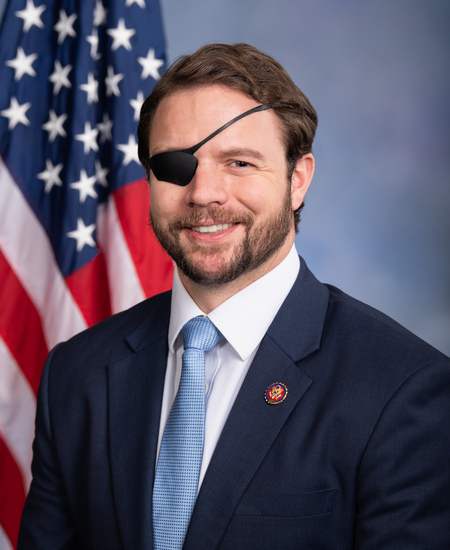
TBI and PTSD Treatment Act This bill requires the Department of Veterans Affairs to furnish hyperbaric oxygen therapy through a provider authorized by the Veterans Community Care Program to veterans who have a traumatic brain injury or post-traumatic stress disorder.
Sponsored bills
Security First Act This bill reauthorizes the Operation Stonegarden program from FY2024 through FY2027 and addresses other border security issues. (Operation Stonegarden provides grants to enhance the border security capabilities of state, local, and tribal governments.) From FY2024 through FY2027, the money from unreported monetary instruments seized from individuals crossing the U.S.-Mexico border and transferred into the Department of the Treasury general fund shall be made available without further appropriation to the Department of Homeland Security (DHS) to fund Operation Stonegarden. DHS must report to Congress on (1) DHS hiring practices from 2018 to 2021, and (2) whether certain Mexican drug cartels meet the criteria to be designated as foreign terrorist organizations. DHS must also periodically report to Congress about the technology needed to secure the U.S.-Mexico land border.
Maddy summaryHR 191 requires the Department of Homeland Security to publish monthly reports on the number of known or suspected terrorists encountered while attempting to enter the United States. The reports must include total numbers broken down by geographic region and entry method (land, air, or sea), and be posted on a public DHS website by the 15th of each month. This bill directly affects DHS operations and provides the public with transparency about border encounters involving individuals in the Terrorist Screening Database. It is a procedural requirement focused on data disclosure, not policy change.
Maddy summaryHR 29, the Border Safety and Security Act of 2023, grants the Secretary of Homeland Security authority to restrict entry at U.S. land or maritime borders for certain immigrants deemed "covered aliens" (those inadmissible under immigration law due to lack of proper documentation). The bill requires the Secretary to suspend entry if they cannot detain or process these individuals as required by existing immigration law. It also allows state attorneys general to sue the Secretary in federal court if they believe border policies harm their state's residents. The law defines "operational control" using terms from the Secure Fence Act of 2006. This bill directly affects immigrants seeking entry who fall under the specified inadmissibility category.
This resolution condemns Iranian state-sponsored terrorist attacks against U.S. citizens and officials and Iranian dissidents. The resolution also expresses support for the people of Iran who are legitimately defending their rights for freedom against repression and condemns the killing of Iranian protesters by the Iranian regime.
Maddy summaryHCONRES 13 is a concurrent resolution expressing Congress's support for maintaining the current policy that prohibits imposing new fees on local radio stations for playing music. It states that Congress should not impose any performance fee, tax, royalty, or charge on local radio stations for broadcasting sound recordings over the air, or on businesses like bars and restaurants that play music publicly. The resolution argues that such fees would harm local radio stations - critical sources for emergency information and community programming - and jeopardize the economic model that has supported both radio and the music industry for decades. This resolution does not create new law but formally opposes potential legislative changes to the existing fee structure.
Maddy summaryThis bill creates a new federal crime for assaulting law enforcement officers causing serious injury or death, with penalties up to 10 years in prison for serious injury and up to life for aggravated cases involving death, kidnapping, or attempted killing. It applies when offenses involve interstate travel, commerce, or target officers engaged in law enforcement duties. Federal prosecution requires Attorney General certification that state authorities cannot or will not handle the case, or that federal action is necessary for public safety. The law covers all law enforcement officers (state, local, and federal) who enforce criminal laws or detain individuals.
Maddy summaryHR 769 designates the National Museum of the Mighty Eighth Air Force in Pooler, Georgia (located at 175 Bourne Avenue) as the official National Museum of the Mighty Eighth Air Force of the United States. The bill clarifies that this museum will not be part of the National Park System and explicitly states it does not appropriate or authorize federal funds for the museum's operations. This is a procedural designation with no policy changes or funding implications.
Maddy summaryHR 712, the State Border Security Reimbursement Act of 2023, requires the federal government to reimburse states that spent over $2.5 billion on border security costs between 2013 and 2023. It directly affects states like Texas, which reported spending more than $3.2 billion on border security during that period, as documented in the bill's findings. The bill mandates that eligible states submit detailed expense reports within 180 days of enactment, and the federal government must reimburse these costs within one year. This policy aims to address states' financial burden from covering what Congress deems a federal responsibility, without creating new funding streams.
Maddy summaryHR 382, the "Pandemic is Over Act," terminates the federal public health emergency declaration for the COVID-19 pandemic. The bill ends the emergency status declared on January 31, 2020, effective upon the bill's enactment. This action directly ends the federal authority tied to the emergency, including related public health measures and funding mechanisms under the Public Health Service Act.