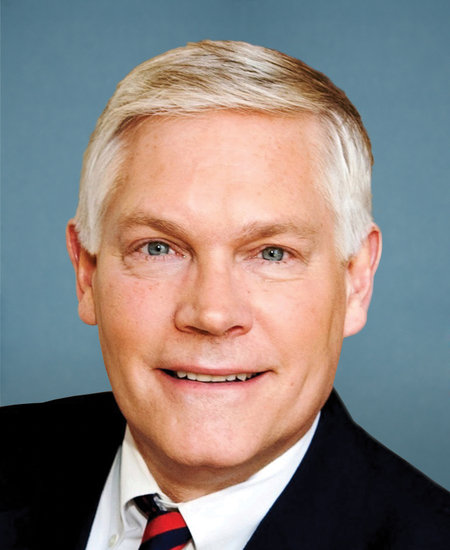
Photo of Pete Sessions
R United States House · District 17 · Texas On the 2026 ballot

Rep. Pete Sessions

Compare
Total votes
2,837
all sessions
Attendance
97%
77 missed
Higher than 89% of chamber peers
With party
95%
of cast votes
Higher than 83% of chamber peers
Bipartisan score
3%
crosses aisle rarely
Lower than 84% of chamber peers
Sponsored
924
bills & resolutions
Near the chamber average
Committees
6
assignments
924 bills and resolutions

Sponsored bills

Total
924
Primary
45
Co-sponsor
879
This page
924
matching current filters
Co-sponsor HR 426
In committee · Indiana House · Co-sponsor
Protection of Women and Girls in Sports Act of 2021

Protection of Women and Girls in Sports Act of 2021 This bill makes it a violation of federal law for a recipient of federal funds who operates, sponsors, or facilitates athletic programs or activities to permit a person whose sex is male to participate in an athletic program or activity that is designated for women or girls. The bill specifies that sex shall be recognized based solely on a person's reproductive biology and genetics at birth.

In committee Apr 26, 2022 1 co-sponsor
Co-sponsor HR 3076
Signed into law · Indiana House · Co-sponsor
Postal Service Reform Act of 2022

Postal Service Reform Act of 202 2 This bill addresses the finances and operations of the U.S. Postal Service (USPS). The bill requires the Office of Personnel Management (OPM) to establish the Postal Service Health Benefits Program within the Federal Employees Health Benefits Program under which OPM may contract with carriers to offer health benefits plans for USPS employees and retirees. The bill provides for coordinated enrollment of retirees under this program and Medicare. The bill repeals the requirement that the USPS annually prepay future retirement health benefits. Additionally, the USPS may establish a program to enter into agreements with an agency of any state government, local government, or tribal government, and with other government agencies, to provide certain nonpostal products and services that reasonably contribute to the costs of the USPS and meet other specified criteria. The USPS must develop and maintain a publicly available dashboard to track service performance and must report regularly on its operations and financial condition. The Postal Regulatory Commission must annually submit to the USPS a budget of its expenses. It must also conduct a study to identify the causes and effects of postal inefficiencies relating to flats (e.g., large envelopes). The USPS Office of Inspector General shall perform oversight of the Postal Regulatory Commission.


Signed into law Apr 6, 2022 1 co-sponsor
Co-sponsor HR 1916
Passed · Indiana House · Co-sponsor
Ensuring Lasting Smiles Act

Ensuring Lasting Smiles Act This bill requires private health insurance plans to cover diagnosis and treatment of congenital anomalies and birth defects, such as reconstructive services and items. Coverage must include services and items that functionally improve, repair, or restore any body part that is medically necessary for normal bodily functions or appearance, as determined by the treating physician. Coverage limits and cost-sharing requirements for such services and items may not be more restrictive than those applicable to all medical and surgical benefits under the plan.

Passed Apr 5, 2022 1 co-sponsor
Co-sponsor HR 7382
In committee · Indiana House · Co-sponsor
Supply Chain Disruptions Relief Act

Supply Chain Disruptions Relief Act This bill modifies the treatment of liquidations of new motor vehicle inventory as qualified LIFO (last in first out accounting method) inventory. It allows new motor vehicle dealers to elect to wait until the end of 2025 to replace their inventory for purposes of determining income attributable to the sale of such inventory during 2020 and 2021.

In committee Apr 4, 2022 1 co-sponsor
Co-sponsor HR 7359
In committee · Indiana House · Co-sponsor
Stop Fentanyl Border Crossings Act

Stop Fentanyl Border Crossings Act This bill authorizes the Department of Health and Human Services (HHS) to restrict migration and imports from foreign countries to prevent the introduction of illicit drugs into the United States. Current law authorizes HHS to restrict migration and imports from foreign countries to prevent the introduction of communicable diseases. Under this bill, HHS may also restrict migration and imports from a country if HHS determines that the existence of substantial illicit drug smuggling from that country poses a risk to public health.

In committee Apr 4, 2022 1 co-sponsor
Co-sponsor HR 7287
In committee · Indiana House · Co-sponsor
Anti-Border Corruption Improvement Act

Anti-Border Corruption Improvement Act This bill revises the waiver authority of the U.S. Customs and Border Protection (CBP) for polygraph examinations of applicants for law enforcement positions in the CBP. Any individual who receives such a waiver and holds a current background investigation may be subject to further background investigation. The CBP may administer a polygraph examination to an applicant for employment or an employee who is eligible for a waiver if information is discovered prior to the completion of a background investigation that makes necessary a final determination regarding suitability for employment or continued employment.

In committee Mar 31, 2022 1 co-sponsor
Co-sponsor HRES 1015
In committee · Indiana House · Co-sponsor
Recognizing the importance of stepped-up basis under section 1014 of the Internal Revenue Code of 1986 in preserving family-owned farms and small businesses.

This resolution supports the preservation of the stepped-up basis tax rule that allows recipients of inherited assets such as land, equipment, or buildings to adjust the cost basis of the assets to reflect their fair market value. The resolution opposes any efforts to impose new taxes on family farms or small businesses and recognizes the importance of generational transfers of farm and family-owned businesses.

In committee Mar 30, 2022 1 co-sponsor
Primary HR 7258
In committee · Indiana House · Lead sponsor
Health Care Equality and Modernization Act of 2022

Health Care Equality and Modernization Act of 2022 This bill repeals the requirement for large employers to offer affordable coverage to full time employees and makes other changes to the health insurance system. Specifically, health insurance is no longer required to cover preventive care at no cost or include the essential health benefits. Individuals enrolling in health insurance who have not maintained continuous coverage over the previous 12 months are charged an extra 20% on premiums for each consecutive year without coverage, unless the individual is subject to similar state incentives to maintain coverage. States may enroll uninsured residents in high deductible health plans. Individuals must be permitted to opt-out of this coverage. The Department of Health and Human Services (HHS) must develop a risk adjustment mechanism for health insurance in the individual market. For residents of a state to qualify for premium subsidies or the health insurance tax credit in this bill, the state must permit health insurance with an annual limit on benefits to be sold on its exchange. The bill establishes an advanceable, refundable health insurance tax credit for taxpayers enrolled in coverage that does not cover abortion except in certain circumstances. States may (1) apply to HHS to use unclaimed health insurance tax credits for indigent health care; and (2) enroll Medicaid-eligible individuals in health insurance that qualifies for the tax credit instead of in Medicaid, at the individual's option. The bill establishes Roth HSAs (health savings accounts) for paying certain medical expenses and health insurance premiums. The bill eliminates the tax deduction for medical expenses. Finally, the bill also changes federal Medicaid payments into block grants.

In committee Mar 29, 2022 0 co-sponsors
Co-sponsor HR 1667
Signed into law · Indiana House · Co-sponsor
Dr. Lorna Breen Health Care Provider Protection Act

Dr. Lorna Breen Health Care Provider Protection Act This bill establishes grants and requires other activities to improve mental and behavioral health among health care providers. Specifically, the Department of Health and Human Services (HHS) must award grants to hospitals, medical professional associations, and other health care entities for programs to promote mental health and resiliency among health care providers. In addition, HHS may award grants for relevant mental and behavioral health training for health care students, residents, or professionals. Additionally, HHS must conduct a campaign to (1) encourage health care providers to seek support and treatment for mental and behavioral health concerns, and (2) disseminate best practices to prevent suicide and improve mental health and resiliency among health care providers. HHS must also study and develop policy recommendations on improving mental and behavioral health among health care providers, removing barriers to accessing care and treatment, and identifying strategies to promote resiliency. Furthermore, the Government Accountability Office must report on the extent to which relevant federal grant programs address the prevalence and severity of mental health conditions and substance use disorders among health care providers.

Signed into law Mar 18, 2022 1 co-sponsor
Showing 731 to 740 of 924 bills
Previous 1 … 73 74 75 … 93 Next