

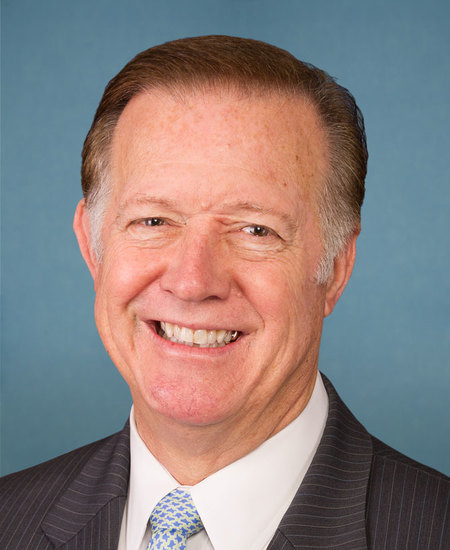
Photo of Randy K. Weber, Sr.
R United States House · District 14 · Texas On the 2026 ballot

Rep. Randy K. Weber, Sr.

Compare
Total votes
2,837
all sessions
Attendance
98%
68 missed
Near the chamber average
With party
92%
of cast votes
Near the chamber average
Bipartisan score
4%
crosses aisle rarely
Near the chamber average
Sponsored
1,847
bills & resolutions
Higher than 84% of chamber peers
Committees
6
assignments
1,847 bills and resolutions

Sponsored bills

Total
1,847
Primary
60
Co-sponsor
1,787
This page
1,847
matching current filters
Primary HRES 1273
In committee · Indiana House · Lead sponsor
Honoring mothers, and recognizing the significance of motherhood and the impact mothers have on raising the next generation, on the occasion of Mother's Day.

Maddy summaryThis resolution formally recognizes the importance of motherhood and honors mothers on Mother's Day. It explicitly supports policies that define mothers as women and opposes recent legislative efforts to remove the term "mother" from official House rules. The text also acknowledges various types of mothers, including stepmothers, adopted mothers, and single mothers, while rejecting alternative terms like "birthing person" or "gestational parent." Ultimately, the bill encourages the public to celebrate the sacrifices and contributions of mothers to the nation.

In committee May 11, 2026 0 co-sponsors
Co-sponsor HR 8730
In committee · Indiana House · Co-sponsor
Connected Vehicle Security Act of 2026

Maddy summaryThe Connected Vehicle Security Act of 2026 restricts the importation, sale, and manufacture of vehicles and related technology from specific countries, including China, Russia, Iran, and North Korea, to address national security concerns. The law defines prohibited items as connected vehicles, their software, and hardware components and sets different effective dates, with vehicle bans starting in 2027 and hardware restrictions beginning in 2030. A government official can grant exceptions for specific items after reviewing security risks and notifying Congress, while the agency must publish annual reports on enforcement actions and compliance.

In committee May 11, 2026 1 co-sponsor
Co-sponsor HR 2137
In committee · Indiana House · Co-sponsor
Review Every Veterans Claim Act of 2025

Maddy summaryHR 2137, the Review Every Veterans Claim Act of 2025, prevents the Department of Veterans Affairs (VA) from denying benefit claims solely because a veteran misses a required medical exam. It amends Section 5103A of Title 38, U.S. Code, to prohibit automatic denials for missed exams and requires the VA to consider other factors. This directly affects veterans filing claims for VA benefits who skip scheduled medical evaluations. The bill ensures veterans cannot be rejected for a claim based only on non-attendance, while allowing denials for other valid reasons.

In committee May 4, 2026 1 co-sponsor
Co-sponsor HR 1163
In committee · Indiana House · Co-sponsor
Prove It Act

Maddy summaryThis bill requires federal agencies to analyze indirect economic costs on small businesses when creating new rules, including costs affecting businesses that interact with regulated entities (like suppliers or partners). It creates a new process allowing small businesses to petition the Small Business Administration's Chief Counsel to review agency certifications claiming a rule won't significantly impact them. Agencies must then provide detailed cost analyses, publish guidance online for small business feedback, and face penalties if they fail to cooperate with reviews. The bill does not change existing regulations but adds new review steps for small business input.

In committee May 4, 2026 1 co-sponsor
Co-sponsor HR 8630
In committee · Indiana House · Co-sponsor
PEAT Act of 2026

Maddy summaryThe PEAT Act of 2026 amends federal regulations to clarify how certain biologic drugs are classified for approval purposes. Specifically, it prevents the Food and Drug Administration from denying approval to a biologic product simply because it contains a protein that does not have a clinical effect. This change ensures that the presence of inactive proteins does not automatically disqualify a drug from being treated as a biological product. The legislation directly impacts pharmaceutical companies developing complex biologics and the regulatory review process for these medicines. By removing this specific barrier, the bill aims to streamline the path to market for drugs that include non-active protein components.

In committee Apr 30, 2026 1 co-sponsor
Co-sponsor HR 8587
In committee · Indiana House · Co-sponsor
Safeguarding Honest Speech Act of 2026

Maddy summaryThe Safeguarding Honest Speech Act of 2026 prohibits federal agencies from using taxpayer money to enforce rules that require employees or contractors to use a person's preferred pronouns if they conflict with that person's biological sex or to use names other than legal names. The bill defines sex strictly based on biological characteristics, such as the reproductive system used for fertilization, to determine these requirements. It also establishes a process where affected workers can file complaints, receive a formal response within 30 days, and sue their agency for violations if the response is unsatisfactory. If a worker wins a lawsuit, the court can order the agency to stop the practice, pay damages up to $100,000, and cover legal fees.

In committee Apr 29, 2026 1 co-sponsor
Primary HR 8462
In committee · Indiana House · Lead sponsor
National Quantum Initiative Reauthorization Act

Maddy summaryThis bill, the National Quantum Initiative Reauthorization Act, extends and expands the existing National Quantum Initiative through December 2032. It broadens the initiative's focus from "science" to "science, engineering, and technology" across federal agencies like NIST, NSF, DOE, and NASA, emphasizing the development of quantum applications, commercialization, and a robust domestic quantum industry. Key

In committee Apr 29, 2026 0 co-sponsors
Co-sponsor HR 6373
In committee · Indiana House · Co-sponsor
Air Permitting Improvements to Protect National Security Act of 2025

Maddy summaryHR 6373 modifies the Clean Air Act to create new permitting flexibility for specific facilities. It allows the President to waive certain emission offset requirements for new or modified semiconductor manufacturing facilities or critical mineral facilities (like those processing lithium or cobalt) if deemed necessary for national security. States can also permit these facilities to use alternative offset methods - such as paying an emissions fee capped at 1.5 times local control costs - if all standard offsets are exhausted, with fees required to fund further emissions reductions in the area. The bill directly affects advanced manufacturing and critical mineral operations seeking streamlined permitting.

In committee Apr 28, 2026 1 co-sponsor
Co-sponsor HR 4214
In committee · Indiana House · Co-sponsor
Clean Air and Building Infrastructure Improvement Act

Maddy summaryHR 4214 requires the Environmental Protection Agency (EPA) to publish final implementing regulations and guidance for new or revised national air quality standards at the same time as the standards themselves. This affects developers seeking preconstruction permits for facilities like factories or power plants, as the new standards cannot be applied to permit reviews until the EPA provides this guidance. The bill also includes a specific provision delaying the application of the 2024 PM2.5 air quality standard to certain permit applications if they meet timing conditions related to the EPA's final designation of affected areas. It does not change the air quality standards or pollution limits themselves, but ensures permit applicants receive clear guidance alongside new rules. The bill focuses on procedural timing for EPA rulemaking to streamline the permitting process.

In committee Apr 28, 2026 1 co-sponsor
Co-sponsor HR 161
In committee · Indiana House · Co-sponsor
New Source Review Permitting Improvement Act

New Source Review Permitting Improvement Act This bill modifies terminology for purposes of the New Source Review (NSR) permitting program of the Environmental Protection Agency (EPA). In order for a change to a stationary source to be a modification (a change to a stationary source that increases the air pollutant emissions or results in new pollutants) for purposes of the NSR permitting program, the maximum hourly emission rate achievable by such source must be higher than the maximum hourly rate achievable by such source during any hour in the 10-year period preceding the change. A change at a stationary source is not considered to be a modification under the bill if it is designed to (1) reduce the amount of any air pollutant emitted; or (2) restore, maintain, or improve the reliability of operations at, or safety of, the source. However, such changes are not excepted if the EPA determines the increase in the maximum achievable hourly emission rate from such change would cause an adverse effect on human health or the environment. Construction , in connection with a major emitting facility (a type of stationary source), does not include a change at such a facility that does not result in a significant emissions increase or a significant net emissions increase. In relation to major emitting facilities in nonattainment areas, the terms modifications and modified do not include changes at such facilities that do not result in a significant emissions increase or a significant net emissions increase.

In committee Apr 28, 2026 1 co-sponsor
Showing 81 to 90 of 1,847 bills
Previous 1 … 8 9 10 … 185 Next