

Hearing Protection Act This bill removes silencers from the definition of firearms for purposes of the National Firearms Act. It also treats persons acquiring or possessing a firearm silencer as meeting any registration and licensing requirements of such Act. The Department of Justice must destroy certain records relating to the registration, transfer, or making of a silencer. The bill also revises the definitions of firearm silencer and firearm muffler under the federal criminal code and includes such items in the 10% excise tax category.
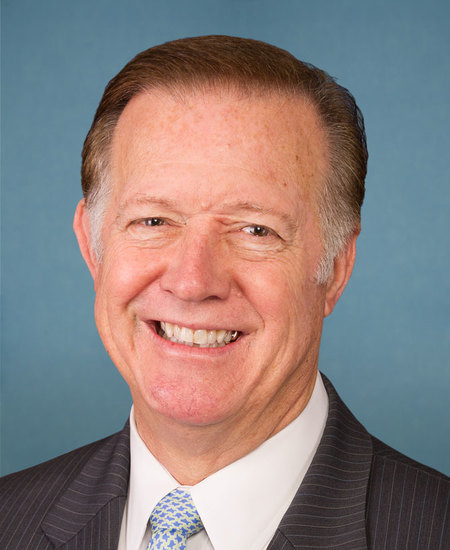
Rep. Randy K. Weber, Sr.
Sponsored bills
Mobilizing Against Sanctuary Cities Act This bill imposes penalties on certain state and local governments that do not assist federal immigration enforcement actions. Specifically, a state or local government shall be ineligible for federal financial assistance for at least one year if it restricts or prohibits an agency or official from (1) communicating with the responsible federal immigration agency regarding an individual's citizenship or immigration status, or (2) maintaining or exchanging information about an individual's status. Such governmental entities are sometimes referred to as sanctuary cities or jurisdictions. The bill restores assistance eligibility upon a Department of Justice (DOJ) determination that the jurisdiction no longer takes such actions. DOJ shall determine each year which state or local jurisdictions are not in compliance with immigration requirements and report such determination to Congress.
Concealed Carry Reciprocity Act This bill establishes a federal statutory framework to regulate the carry or possession of concealed firearms across state lines. Specifically, an individual who is eligible to carry a concealed firearm in one state may carry or possess a concealed handgun (other than a machine gun or destructive device) in another state that allows its residents to carry concealed firearms. It sets forth requirements for the lawful concealed carry across state lines. The bill preempts most state and local laws related to concealed carry and establishes a private right of action for a person adversely affected by interference with a concealed-carry right established by this bill.
This resolution calls on the President to abandon the One China policy in favor of one that recognizes Taiwan as an independent country that is not a part of China. The resolution also urges the President to bolster diplomatic and economic relations between the United States and Taiwan through specified means.
PPP Flexibility for Farmers and Ranchers Act This bill expands eligibility for agricultural producers under the Paycheck Protection Program, established to support small businesses in response to COVID-19 (i.e., coronavirus disease 2019), to include certain agricultural producers organized as partnerships. Currently, only certain agricultural producers that are sole proprietorships, independent contractors, or self-employed individuals may receive support under the program.
Safety and Opportunity for Girls Act of 2021 This bill addresses protections related to sex and sex-segregated spaces. Sex is defined as sex determined solely by a person's reproductive biology and genetics at birth. The bill prohibits construing the provisions of title IX of the Education Amendments of 1972 in a manner that would require forgoing the maintenance of sex-segregated spaces (such as bathrooms) and of sex-segregated athletic or academic programs by educational institutions.
Patient Access to Higher Quality Health Care Act of 2021 This bill repeals provisions under the Stark law (i.e., the Physician Self-Referral Law) that limit, for purposes of Medicare participation, self-referrals by newly constructed or expanded physician-owned hospitals.
Telehealth Modernization Act This bill modifies requirements relating to coverage of telehealth services under Medicare. Specifically, the bill extends certain flexibilities that were initially authorized during the public health emergency relating to COVID-19 (i.e., coronavirus disease 2019). Among other things, the bill allows (1) rural health clinics and federally qualified health centers to serve as the distant site (i.e., the location of the health care practitioner); (2) the home of a beneficiary to serve as the originating site (i.e., the location of the beneficiary) for all services (rather than for only certain services); and (3) all types of practitioners to furnish telehealth services, as determined by the Centers for Medicare & Medicaid Services.
This resolution supports the goals and ideals of National Engineers Week to increase understanding of, and interest in, engineering and technology careers. The resolution recognizes that engineering education is a critical component of STEM (science, technology, engineering, and mathematics) education.
This bill provides for the presentation of a Congressional Gold Medal to the Freedom Riders, in recognition of their contribution to civil rights by fighting for equality in interstate travel.