

Safeguarding Children's Privacy in Schools Act This bill revises the standards for parental consent with respect to the online collection, use, and disclosure of the personal information of a child. First, it revises the definition of verifiable parental consent to require websites and online services to obtain consent by a parent before collecting a child's personal information. Currently, websites and online services must make a reasonable effort to ensure that a parent authorizes the collection, use, and disclosure of such personal information before collecting it. The bill also prohibits elementary and secondary school employees from acting as the agent of a child enrolled in such school for the purpose of providing verifiable parental consent.
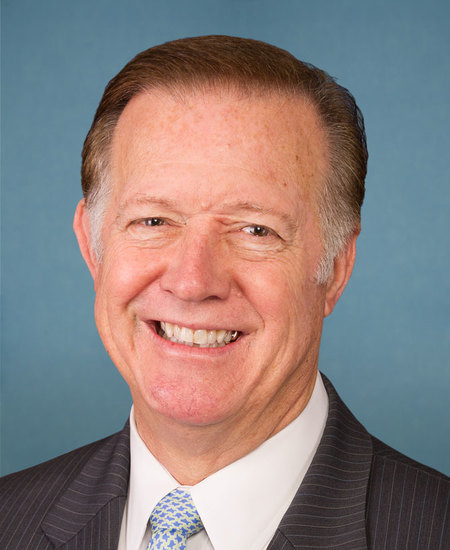
Rep. Randy K. Weber, Sr.
Sponsored bills
Free Veterans from Fees Act This bill waives the application fee for any special use permit solely for a veterans special event at war memorials on land administered by the National Park Service in the District of Columbia and its environs.
This joint resolution proposes an amendment to the Constitution requiring the Supreme Court to be composed of nine Justices consisting of one Chief Justice and eight Associate Justices.
This resolution recognizes and appreciates the dedication and devotion demonstrated by the men and women of law enforcement. It also condemns calls to defund, disband, dismantle, or abolish the police.
Maddy summaryHRES 272 is a symbolic House resolution introduced in March 2021 by several Republican representatives. It calls on the Department of Homeland Security to formally designate Antifa as a domestic terrorist organization under existing legal definitions (18 U.S.C. § 2331), citing alleged violent actions including attacks on federal officers, property damage during protests, and threats against law enforcement. The resolution specifically references incidents in Portland, Oregon, and Tacoma, Washington, as justification for its position. It does not create new law but urges federal action against domestic terrorism, condemning violent tactics while emphasizing peaceful First Amendment expression.
This resolution recognizes law enforcement agencies and officers for their tireless work to protect us and make our communities safer. It also condemns calls to defund, disband, dismantle, or abolish the police.
Safer Schools Act of 2021 This bill establishes a pilot program through which the Department of Justice must award grants to public elementary and secondary schools to conduct independent facility security risk assessments and make hard security improvements (e.g., video monitoring and alert notification equipment).
Maximum Pressure Act This bill expands sanctions and economic penalties on Iran. It also restricts the President from unilaterally lifting or waiving the sanctions or penalties and increases congressional oversight of them. Specifically, the bill requires the President to impose visa- and asset-blocking sanctions. Additionally, it modifies existing sanctions, including by (1) providing statutory authority for executive orders imposing sanctions; (2) applying sanctions to additional sectors of Iran's economy; and (3) broadening sanctionable conduct to cover, for example, assisting Iran with the acquisition of ballistic missiles and the complicity of Iranian officials in human rights violations in specified countries. The bill also requires reporting on licenses that authorize activities subject to sanctions. The bill prohibits U.S. representatives at the International Monetary Fund from voting to allow Iran's access to special drawing rights (a currency support tool) and places restrictions on financial transactions with Iran. The restrictions include requiring domestic financial institutions to implement special measures with respect to foreign financial institutions that conduct significant transactions connected to the Instrument in Support of Trade Exchanges (a European mechanism that bypasses U.S. sanctions when carrying out trade with Iran). The Department of State must maintain the Islamic Revolutionary Guard Corps' designation as a terrorist organization and must designate Ansharallah (or Houthis), which operates in Syria, as a foreign terrorist organization. The bill also requires reports on U.S. sanctions concerning Iran, the status of Iran's nuclear weapons program, and other matters.
Sunshine for Regulatory Decrees and Settlements Act of 2021 This bill establishes transparency and public accountability standards for federal agencies with respect to (1) certain civil actions seeking to compel agency action, and (2) related consent decrees and settlement agreements. For example, an agency must publish a complaint filed against it within 15 days. Additionally, settlement proceedings must be conducted through mediation or an alternative dispute resolution program of the court, and those proceedings must include intervening parties. The bill also creates a presumption in favor of a motion to intervene in settlement proceedings. Further, at least 60 days prior to entering a consent decree or settlement agreement, an agency must publish, and accept and respond to public comment on, the proposed agreement or decree. An agency also must provide the court with the administrative record, a summary of the public comments, and access to the record of any public hearings on the proposed decree or agreement. The Department of Justice, or the agency litigating a matter independently, must certify to the court its approval of certain terms included in an agreement or decree, including terms that convert a discretionary authority into a nondiscretionary duty. A court may not approve a consent decree or settlement agreement unless the agency has sufficient time and procedures to comply with federal administrative procedures, other rulemaking statutes, and applicable executive orders. Finally, courts must review a consent decree or settlement if an agency files a motion to modify the decree or agreement on the basis of changed facts or circumstances.
American Critical Mineral Independence Act of 2021 This bill provides support for a domestic supply of critical minerals, establishes deadlines to complete the environmental review of critical mineral projects on federal land, and sets forth related requirements to expedite the review of such projects under the National Environmental Policy Act of 1969 (NEPA). Specifically, the National Science Foundation must award grants to support research to advance critical mineral mining strategies and technologies. The Department of Energy must also provide grants to research, develop, and assess technologies and techniques to recover critical minerals from mine waste and metallurgical activities. If an environmental assessment or environmental impact statement is required for a critical mineral project, then all necessary federal review and permit considerations must be completed within 18 or 24 months, respectively. However, the review may exceed the time limit if the project sponsor agrees. The lead agency of the environmental review of such project must allow a state or another appropriate entity to assume certain federal responsibilities regarding the environmental review of the project upon the request of such entity. Further, the bill authorizes a lead agency to determine that the requirements of NEPA have been satisfied if a state or federal agency acting under state or federal law has addressed specified factors. If the lead agency does not make such a determination, then the agency must enter into an agreement with the project sponsor to set time limits for each part of the permitting process.