This resolution declares that space launch is a developmental activity, not a form of transportation, and finds that a process exists for investigating commercial space launch and reentry activities.
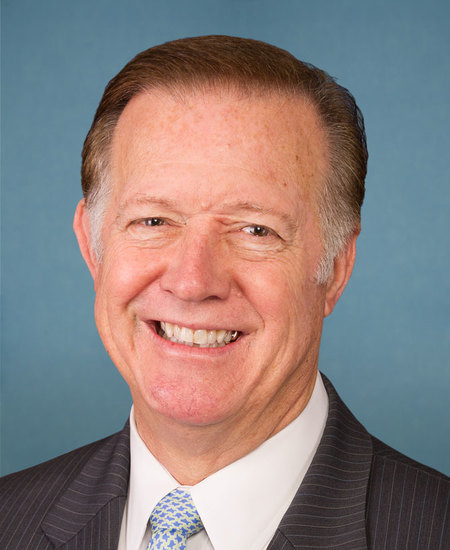
Rep. Randy K. Weber, Sr.
Sponsored bills
This resolution modifies requirements for written statements required of nongovernmental witnesses who appear before standing committees of the House of Representatives. Specifically, the resolution eliminates a requirement that a witness disclose whether they are a fiduciary of an organization or entity that has an interest in the subject matter of the hearing, in favor of a requirement that they disclose whether they are a fiduciary of an entity that has received payments from a specified foreign entity. The resolution also requires nongovernmental witnesses to disclose in their written statement certain contracts with specified foreign persons or entities. If the committee determines that a witness knowingly and willfully failed to truthfully comply with such disclosure requirements, the witness is prohibited from testifying before the committee for three years.
Housing Promotes Livelihood and Ultimate Success Act of 2021 or the Housing PLUS Act of 2021 This bill modifies the requirements under which the Department of Housing and Urban Development (HUD) must award grants under the Continuum of Care Program, which provides funding for nonprofit providers and state and local governments to quickly rehouse homeless individuals and families. Specifically, the bill bars HUD from prohibiting, limiting, or restricting Continuum of Care grants to recipients that (1) require program participants to receive supportive services, (2) require program participants to be sober or drug-free, or (3) are faith-based organizations. The bill also requires that 30% of Continuum of Care grant funds be set aside for eligible grant recipients that provide or offer access to wraparound services.
This bill prohibits the Small Business Administration from directly making a loan under the 7(a) Program, which authorizes loans and loan guaranties to small businesses that meet certain requirements.
Circumspectly Reducing Unintended Consequences Impairing Alliances and Leadership Act of 2021 or the CRUCIAL Act of 2021 This bill establishes requirements relating to the President's ability to impose sanctions on individuals or entities that engage in a significant transaction with the defense or intelligence sectors of Russia's government if the transaction involves a member of the Quadrilateral Security Dialogue. (The dialogue is a coalition comprised of the governments of the United States, Japan, India, and Australia.) Specifically, before imposing such sanctions for a transaction involving a member of the dialogue, the President must certify to Congress that the government in question is not participating in the dialogue on security matters that are critical to U.S. strategic interests.
Fairness for Federal Contractors Act of 2021 This bill prohibits executive agencies from requiring contractors to receive a COVID-19 vaccination. The bill also requires the Government Accountability Office to study the degree to which Executive Order 14042 (Ensuring Adequate COVID Safety Protocols for Federal Contractors) caused disruptions to federal contracts, supply chains, and transportation systems.
Science-Based Emissions Standards Act of 2021 This bill prohibits the Environmental Protection Agency (EPA) from finalizing any rule to amend the new source performance standards for stationary sources under the Clean Air Act to reduce methane emissions from new and modified oil and natural gas facilities until the Department of Energy takes specified actions. Specifically, the Department of Energy must first (1) complete and publish the results of the study titled Quantification of Methane Emissions from Marginal (Small Producing) Oil and Gas Wells, and (2) provide a period of at least 90 days for public comment on the application of the study's results. The EPA must take the results of the study into consideration when finalizing the rule.
Pregnancy Loss Mental Health Research Act of 2021 This bill expands research and related activities that address mental health complications following a pregnancy loss (i.e., miscarriage, stillbirth, or abortion). Specifically, the National Institutes of Health and the National Institute of Mental Health (NIMH) must expand and intensify research on mental health complications following pregnancy loss. In particular, NIMH must conduct a longitudinal study to determine the prevalence and other information about such mental health complications. Additionally, the Department of Health and Human Services must award grants to health providers, state or local governments, or other appropriate nonprofits to deliver services to individuals with mental health conditions following a pregnancy loss. Funding made available under this bill may not be provided to an entity (or an entity's affiliate, subsidiary, successor, or clinic) that performs abortions other than in the case of a pregnancy (1) that is the result of rape or incest; or (2) when the life of the woman is in danger due to a physical disorder, injury, or illness.

This joint resolution nullifies a Department of Labor emergency temporary standard for preventing the transmission of COVID-19 in employment settings. Under the standard issued on November 5, 2021, employers with 100 or more employees must require their onsite employees to either be fully vaccinated against COVID-19 or undergo weekly COVID-19 testing.
Supply Chain Emergency Response Act This bill directs the Maritime Administration to establish a program to provide grants to certain owners of cargo vessels to cover toll costs associated with rerouting cargo vessels from ports along the western seaboard of the United States through the Panama Canal to ports along the Gulf of Mexico and the eastern seaboard of the United States. To receive a grant, an owner of a cargo vessel shall submit documentation that such owner intends to reroute a cargo vessel and has the corresponding docking agreements. The bill allows states and localities to use COVID-19 relief funds for costs related to rerouting cargo vessels. Any marine terminal operator who is operating a port located along the western seaboard of the United States may not collect port fees from a recipient of a grant who has rerouted a cargo vessel from such port due to the inability of such port to receive such vessel. Any individual who is a member of the Chinese Communist Party or any company owned, in whole or in part, by the Chinese Communist Party may not receive a grant under this bill.