

Maddy summaryH.J. Res. 67 proposes a constitutional amendment requiring the federal government to balance its annual budget, meaning spending must not exceed revenue. It also caps annual federal spending at 18% of the previous year's gross domestic product (GDP). To override these limits, pass new taxes or tax increases, or raise the national debt limit, Congress would need a two-thirds vote in both the House and Senate. The amendment would take effect after ratification by three-fourths of state legislatures.
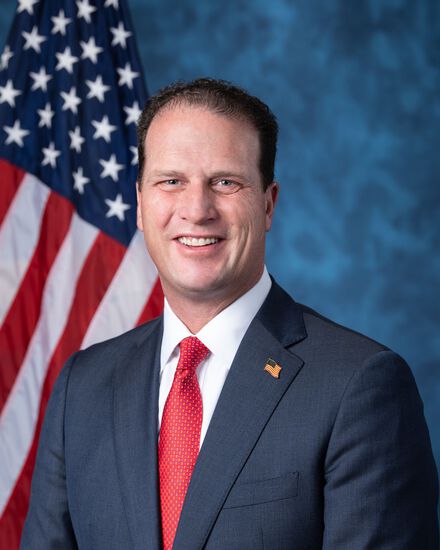
Rep. August Pfluger
Sponsored bills
Maddy summaryHJRES 29 is a procedural resolution seeking congressional disapproval of a U.S. Fish and Wildlife Service (FWS) rule that designated the northern lesser prairie-chicken population as "threatened" and the southern population as "endangered" under the Endangered Species Act. If passed, this resolution would prevent the FWS rule from taking effect, meaning the southern population would not be officially listed as endangered and the northern population would not be listed as threatened. The bill directly affects landowners, ranchers, and developers in states like Texas, Oklahoma, and New Mexico where the prairie-chicken habitat overlaps with agricultural or energy development. It uses the Congressional Review Act (Chapter 8 of Title 5, U.S. Code) to block implementation of the FWS rule without changing wildlife protection laws.
Maddy summaryHR 3792 extends U.S. security funding for Israel through 2028 (Section 3) and expands energy cooperation to include advanced nuclear technologies and carbon capture (Section 5). It requires annual reports on regional security partnerships involving Israel (Section 6) and ensures countries in the Abraham Accords can access U.S. development programs (Section 8). The bill also mandates reports on diplomatic efforts against ICC investigations targeting the U.S. and Israel (Section 10) and encourages people-to-people programs to strengthen the Abraham Accords (Sections 7, 9). These provisions directly affect Israel’s diplomatic engagement, security partnerships, and economic cooperation in the Middle East.
Maddy summaryThe HALT Fentanyl Act expands the definition of fentanyl-related substances in the Controlled Substances Act to include many structurally similar compounds, making it easier to regulate new fentanyl analogs without individual listing. It defines these substances based on specific chemical modifications to fentanyl, with limited exceptions for substances already controlled or listed elsewhere. The bill also streamlines research procedures for schedule I substances by creating expedited registration processes and allowing multiple studies under one registration, while requiring the Attorney General to publish a list of substances meeting the new definition.
Maddy summaryThis bill sets strict deadlines for the EPA to review state applications for primary control over Class VI wells (used for underground carbon storage). It requires the EPA to approve state programs automatically if no decision is made within 210 days (180 days for review plus 30 days), unless the EPA provides a detailed written explanation of delays. States must already have authority over other well types to qualify for automatic approval. The bill also prohibits the EPA from adding new conditions to state applications and mandates regular reporting on staffing needs for implementation. It applies to all new state submissions after enactment and resets timelines for pending applications.
Maddy summaryThis bill requires all non-profit organizations receiving federal funds to certify they comply with anti-human trafficking, anti-smuggling, and fraud laws, and have no convictions under immigration law (8 U.S.C. 1324). Nonprofits must submit this certification within 60-120 days of the law's enactment; failure to certify or violation of the law results in repayment of funds and potential loss of tax-exempt status. The Department of Homeland Security must create compliance guides and publish violation data, while the GAO will report annually on non-compliance. The law applies to all nonprofits with federal contracts, grants, or agreements, aiming to prevent federal funds from supporting entities involved in trafficking or smuggling.
Tribal Gaming Regulatory Compliance Act This bill allows the Ysleta del Sur Pueblo and Alabama-Coushatta tribes to conduct gaming activities on their land in Texas if certain conditions are met. Currently, the Ysleta del Sur Pueblo and Alabama-Coushatta Indian Tribes of Texas Restoration Act prohibits the tribes from conducting gaming activities on their land if those activities are prohibited by Texas law. The bill repeals those provisions and instead applies the Indian Gaming Regulatory Act (IGRA) to gaming activities on Indian lands of the tribes.
Maddy summaryThis bill requires that AM radio receivers be included as standard equipment in all new motor vehicles (such as cars and trucks) sold in the United States, with a rule to be issued by the Department of Transportation within one year. The rule must ensure AM radio is easily accessible on the dashboard and allows manufacturers to use digital AM radio technology instead of traditional AM. During the one-year period between the bill's enactment and the rule's effective date, manufacturers must clearly label vehicles without AM radio. The bill also directs a study to evaluate whether an alternative system could deliver emergency alerts as reliably as AM radio across the country, especially during crises.
Maddy summaryHR 3337, the Fuels Parity Act, removes a prohibition that previously excluded corn starch ethanol from being counted as "advanced biofuel" under the Clean Air Act. This change directly affects corn-based ethanol producers by allowing corn starch ethanol to qualify under renewable fuel standards. The bill also requires the EPA to update its methodology for calculating greenhouse gas emissions from corn-based ethanol and biomass-based diesel every five years, starting 90 days after enactment, with the first update mandating the use of the Argonne National Laboratory's GREET model. These provisions aim to standardize how emissions are assessed for these fuels under federal renewable fuel programs.
Maddy summaryHR 3455, the TSP Act, prohibits the Thrift Savings Fund (TSP) from investing in any "security of concern." This directly affects federal employees and retirees whose retirement savings are held in the TSP, as their accounts would no longer include certain investments tied to countries identified as national security threats. A "security of concern" includes stocks listed in a "country of concern" (per the Director of National Intelligence's annual report), companies incorporated in such countries, or firms generating over 50% of revenue there. The law bans all forms of these investments, including through mutual funds or synthetic instruments like equity swaps, without exception.