

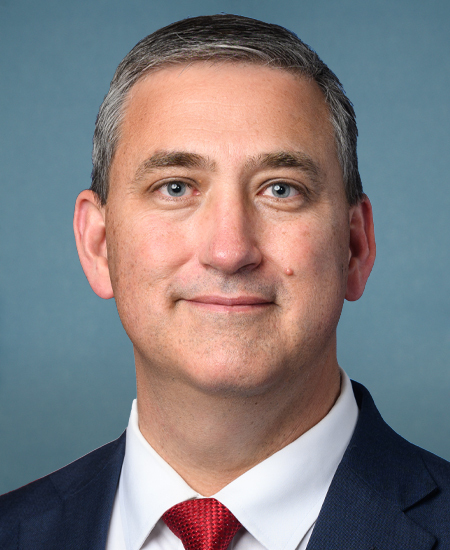
Photo of Nathaniel Moran
R United States House · District 1 · Texas On the 2026 ballot

Rep. Nathaniel Moran

Compare
Total votes
1,879
all sessions
Attendance
99%
19 missed
Near the chamber average
With party
95%
of cast votes
Higher than 97% of chamber peers
Bipartisan score
3%
crosses aisle rarely
Lower than 98% of chamber peers
Sponsored
523
bills & resolutions
Near the chamber average
Committees
5
assignments
523 bills and resolutions

Sponsored bills

Total
523
Primary
46
Co-sponsor
477
This page
523
matching current filters
Co-sponsor HR 2788
In committee · Indiana House · Co-sponsor
End DWI Act of 2025

Maddy summaryHR 2788, the End DWI Act of 2025, requires states to mandate ignition interlock devices for drivers convicted of driving while intoxicated (DWI) for a minimum of 180 days. States that fail to implement this requirement risk losing 3% of federal highway funds in 2027 and 5% annually thereafter. The bill directly affects states (by tying funding to policy compliance) and DWI offenders (who must use interlock devices to regain driving privileges). Key provisions include a national standard for interlock use, defined exceptions (like employer vehicles), and mechanisms for restoring withheld funds once states comply.

In committee Apr 9, 2025 1 co-sponsor
Co-sponsor HR 2102
In committee · Indiana House · Co-sponsor
Major Richard Star Act

Maddy summaryThis bill, HR 2102 (Major Richard Star Act), allows veterans with combat-related disabilities to receive both full military retired pay and veterans' disability compensation simultaneously, without the previous offset that reduced retired pay. It directly affects veterans already eligible for both benefits due to combat-related injuries, removing the requirement that their retired pay be reduced by the disability compensation amount. The key provision amends Title 10 and Title 38 to eliminate the offset rule (sections 5304 and 5305 of Title 38) for these veterans. The change applies to payments starting after the bill’s enactment date, effective for all qualifying veterans. This is a policy change to increase financial support for affected veterans, not a new benefit.

In committee Apr 4, 2025 1 co-sponsor
Co-sponsor HR 2570
In committee · Indiana House · Co-sponsor
Maximum Pressure Act

Maddy summaryThis bill codifies a "maximum pressure" policy toward Iran, requiring the U.S. to maintain all sanctions until Iran meets specific conditions related to its nuclear program, missile development, support for terrorism, and human rights violations. It expands sanctions on Iran's Revolutionary Guard Corps (IRGC) and entities supporting Iran's ballistic missile program, while prohibiting waivers of sanctions on these entities. The bill mandates regular reports to Congress on Iran's nuclear activities, support for terrorist groups like Hamas and Hezbollah, and human rights abuses within Iran. It also directs the use of frozen Iranian assets to support victims of state-sponsored terrorism and prevents the release of funds that could benefit Iran's terrorist proxies. The bill aims to maintain economic and diplomatic pressure on Iran until it changes its behavior across multiple fronts.

In committee Apr 1, 2025 1 co-sponsor
Co-sponsor HR 2547
In committee · Indiana House · Co-sponsor
Secure Family Futures Act of 2025

Maddy summaryThis bill, titled "Secure Family Futures Act of 2025" but actually focused on tax code changes, primarily affects a specific subset of insurance companies. It amends the Internal Revenue Code to exclude certain debts (like bonds or notes) held by these companies from being counted as capital assets (Section 2), and extends their capital loss carryover period to 10 years for losses from foreign expropriation or losses incurred by these companies (Section 3). The changes apply to debts acquired and losses arising after December 31, 2025. The bill's title is misleading, as it does not relate to family policy but is a technical tax amendment targeting defined insurance industry entities.

In committee Apr 1, 2025 1 co-sponsor
Co-sponsor HR 2548
In committee · Indiana House · Co-sponsor
Sanctioning Russia Act of 2025

Sanctioning Russia Act of 2025   This bill imposes penalties on certain persons (individuals and entities) if the President determines that the Russian government or a person acting at Russia's direction is involved with (1) refusing to negotiate a peace agreement with Ukraine; (2) violating a negotiated peace agreement; (3) initiating another invasion of Ukraine; or (4) overthrowing, dismantling, or seeking to subvert the Ukrainian government.   If the President makes such a determination, the bill requires certain actions including the President must impose visa- and property-blocking sanctions on specified persons such as the Russian president, certain Russian military commanders, and any foreign person that knowingly provides defense items to the Russian armed forces; the President must increase the rate of duty on all goods and services imported from Russia into the United States to at least 500% relative to the value of such goods and services; the President must increase the rate of duty on all goods and services imported into the United States from countries that knowingly engage in the exchange of Russian-origin uranium and petroleum products to at least 500% relative to the value of such goods and services; the Department of the Treasury must impose property-blocking sanctions on any financial institution organized under Russian law and owned wholly or partly by Russia, and any financial institution that engages in transactions with those entities; and the Department of Commerce must prohibit the export, reexport, or in-country transfer to or in Russia of any U.S.-produced energy or energy product.

In committee Apr 1, 2025 1 co-sponsor
Co-sponsor HR 2509
In committee · Indiana House · Co-sponsor
COMPLETE Care Act

Maddy summaryHR 2509, the COMPLETE Care Act, creates Medicare payment incentives for primary care providers who integrate specific behavioral health services into their practice. It directly affects Medicare providers offering services identified by HCPCS codes 99484, 99492, 99493, 99494, G2214, and G0323 (covering models like Collaborative Care and Primary Care Behavioral Health) during 2027-2029. The bill increases Medicare payments for these services to 125-175% of standard rates (phasing down from 175% in 2027 to 125% in 2029) and waives budget neutrality rules to fund these higher payments. Additionally, it requires the HHS Secretary to provide technical assistance to primary care practices adopting these models by 2026, with dedicated funding for 2025-2029.

In committee Mar 31, 2025 1 co-sponsor
Co-sponsor HR 2410
In committee · Indiana House · Co-sponsor
Revitalizing Downtowns and Main Streets Act

Maddy summaryHR 2410 creates a 20% federal tax credit for developers converting older non-residential buildings (at least 20 years old) into affordable housing. The credit applies to qualified conversion costs, requiring that 20% of units be rent-restricted for residents earning 80% or less of the area median income for 30 years. It establishes a $12 billion national credit limit, with $3 billion reserved for conversions in economically distressed areas, and mandates state-level allocation plans prioritizing projects near transit and employment. The bill directly affects developers seeking tax incentives for downtown revitalization, not tenants or local governments.

In committee Mar 27, 2025 1 co-sponsor
Primary HR 2456
In committee · Indiana House · Lead sponsor
Orderly Liquidation of the Department of Education Act

Maddy summaryThis bill would terminate the U.S. Department of Education by October 1, 2026, and transfer its education-related functions to other federal agencies. It would move K-12 education programs to the Office of Education within Health and Human Services, student loans to the Treasury Department, vocational education to the Labor Department, and civil rights enforcement to the Justice Department. The bill also specifies that certain education programs would be terminated after October 1, 2036, and includes provisions to ensure continuity of existing grants, contracts, and legal proceedings during the transition. It directly affects federal education programs, agencies handling education funding, and recipients of education-related grants and services.

In committee Mar 27, 2025 0 co-sponsors
Co-sponsor HR 2423
In committee · Indiana House · Co-sponsor
Unfair Tax Prevention Act

Maddy summaryHR 2423, the Unfair Tax Prevention Act, amends the U.S. tax code to modify how the base erosion tax applies to certain foreign-owned businesses. It directly affects foreign-controlled entities operating under specific foreign tax systems that impose taxes based on ownership chains, such as those linked to foreign corporations. Key provisions include treating these entities as "applicable taxpayers" for tax purposes, changing a deadline from December 31, 2025, to the bill's enactment date, and counting 50% of their cost of goods sold as a tax benefit while excluding certain other tax rules. The changes apply to taxable years beginning after the bill becomes law.

In committee Mar 27, 2025 1 co-sponsor
Co-sponsor HR 2397
In committee · Indiana House · Co-sponsor
Targeting TANF to Families in Need Act

Maddy summaryThe Targeting TANF to Families in Need Act would require states to use federal TANF funds exclusively for families with incomes below twice the federal poverty line. This amendment to the Social Security Act establishes a clear income threshold, meaning states must limit TANF assistance to households earning less than twice the official poverty guidelines (updated annually by the federal government). The policy change would take effect on October 1, 2026, directly affecting all families applying for TANF benefits and the states administering the program. It focuses on restricting eligibility to the most economically vulnerable households under the federal TANF framework.

In committee Mar 27, 2025 1 co-sponsor
Showing 181 to 190 of 523 bills
Previous 1 … 18 19 20 … 53 Next