

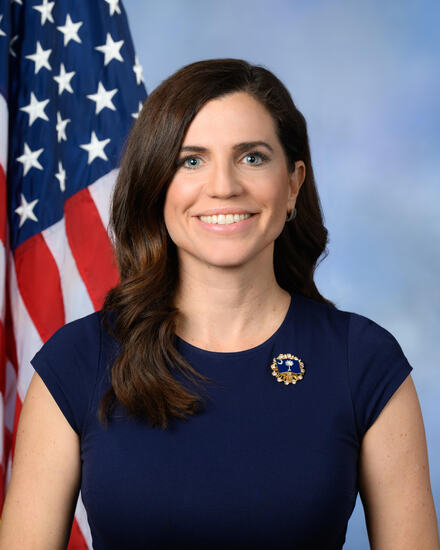
Photo of Nancy Mace
R United States House · District 1 · South Carolina

Rep. Nancy Mace

Compare
Total votes
2,837
all sessions
Attendance
94%
182 missed
Lower than 97% of chamber peers
With party
89%
of cast votes
Lower than 87% of chamber peers
Bipartisan score
6%
crosses aisle rarely
Higher than 86% of chamber peers
Sponsored
1,230
bills & resolutions
Near the chamber average
Committees
11
assignments
1,230 bills and resolutions

Sponsored bills

Total
1,230
Primary
200
Co-sponsor
1,030
This page
1,230
matching current filters
Co-sponsor HR 3469
In committee · Indiana House · Co-sponsor
Tax Relief for Victims of Crimes, Scams, and Disasters Act

Maddy summaryThis bill restores a tax deduction for personal losses caused by disasters, crimes, or scams (like stolen property or damage from hurricanes). It directly affects taxpayers who filed returns before 2025 but couldn’t claim this deduction due to a prior suspension. The bill reinstates the deduction and extends the deadline to file refund claims for these losses until the tax filing deadline for the year the bill becomes law. This allows eligible individuals to claim refunds they were previously barred from receiving.

In committee May 15, 2025 1 co-sponsor
Primary HR 3403
In committee · Indiana House · Lead sponsor
SEAT Act of 2025

Maddy summaryThe SEAT Act of 2025 requires third-party reservation platforms (like OpenTable or Yelp) to have a written agreement with restaurants before listing or selling reservations. It prohibits agreements that force restaurants to cover the platform’s legal liabilities (e.g., for errors or negligence). The Federal Trade Commission will enforce these rules as unfair business practices. This directly affects restaurants, food trucks, bars, and other food venues that use third-party reservation services nationwide.

In committee May 14, 2025 0 co-sponsors
Co-sponsor HR 3324
In committee · Indiana House · Co-sponsor
Safer Shrimp Imports Act

Maddy summaryHR 3324, the Safer Shrimp Imports Act, requires foreign countries exporting shrimp to the U.S. to meet specific food safety standards. It mandates that foreign governments enter agreements with the FDA within 180 days of the bill’s enactment, and shrimp from countries without such agreements or with inadequate food inspection systems will be refused entry one year after enactment. The law defines "equivalent" food inspection systems as those with sufficient staffing for uniform enforcement and regulations covering shrimp farming and transport conditions. This directly affects shrimp importers and foreign facilities manufacturing, processing, or holding shrimp for U.S. consumption.

In committee May 13, 2025 1 co-sponsor
Co-sponsor HR 3295
In committee · Indiana House · Co-sponsor
Federal Animal Research Accountability Act of 2025

Maddy summaryHR 3295, the Federal Animal Research Accountability Act of 2025, requires research institutions receiving National Institutes of Health (NIH) funding to submit detailed annual reports on animal use. These reports must categorize animals by species and specify: (1) animals used with no pain/distress, (2) animals with pain/distress using pain relief, (3) animals with pain/distress where pain relief would interfere with research, and (4) animals bred but not yet used. The NIH must make these reports publicly accessible online within three months of submission through a searchable database. The bill applies to all NIH-funded research entities and takes effect two years after enactment.

In committee May 8, 2025 1 co-sponsor
Primary HR 3246
In committee · Indiana House · Lead sponsor
Violet’s Law

Maddy summaryHR 3246, "Violet’s Law," amends the Animal Welfare Act to require federal research facilities to create plans for placing eligible animals (dogs, cats, nonhuman primates, guinea pigs, hamsters, or rabbits) no longer needed for research. It directs federal departments and agencies operating such facilities to develop standards within one year of enactment to facilitate adoption or placement with qualified organizations like animal rescue groups, sanctuaries, or shelters. Animals must be certified by a licensed veterinarian as free of infectious disease or physical issues endangering health before release. This applies directly to all U.S. federal agencies conducting animal research, mandating concrete steps to transition animals out of research settings into permanent care.

In committee May 7, 2025 0 co-sponsors
Co-sponsor HR 3199
In committee · Indiana House · Co-sponsor
Captive Primate Safety Act of 2025

Maddy summaryHR 3199, the Captive Primate Safety Act of 2025, bans the import, export, sale, breeding, and possession of certain nonhuman primates (including chimpanzees, gorillas, and lemurs) in interstate or foreign commerce. It directly affects pet owners, breeders, zoos, and wildlife facilities that currently handle these primates. The bill allows limited exceptions for existing owners who register their primates with the U.S. Fish and Wildlife Service within 180 days, agree to stop breeding/selling, and prevent public contact. It amends the Lacey Act to implement these restrictions, with enforcement beginning immediately regardless of regulatory timelines.

In committee May 5, 2025 1 co-sponsor
Co-sponsor HR 3144
In committee · Indiana House · Co-sponsor
Honoring our K9 Heroes Act

Maddy summaryThis bill creates a federal grant program to help cover medical costs for retired Federal working dogs (like police or military K9s). It authorizes $1 million annually (2026-2030) for eligible nonprofits with a two-year history of providing such care to dogs that have received official retirement letters and are now with their handlers. The grants allow these organizations to pay for veterinary expenses, directly supporting retired service dogs and their handlers. The program is administered through the Department of Homeland Security under existing grant authority.

In committee May 1, 2025 1 co-sponsor
Co-sponsor HR 3112
In committee · Indiana House · Co-sponsor
Better CARE for Animals Act of 2025

Maddy summaryHR 3112, the Better CARE for Animals Act of 2025, strengthens enforcement of the federal Animal Welfare Act by requiring dealers and exhibitors to hold valid licenses for animal sales or transport (Section 4). It expands enforcement authority by allowing the Attorney General to sue violators for up to $10,000 per day, seize animals, and seek injunctions (Section 20), while clarifying that courts can address violations of related rules and regulations. The bill directly affects animal dealers, exhibitors, the USDA, and the Department of Justice, creating clearer pathways for holding violators accountable. Key provisions include updating definitions, broadening inspection powers to cover all regulations, and directing penalty funds toward temporary animal care costs during legal proceedings.

In committee Apr 30, 2025 1 co-sponsor
Co-sponsor HR 3043
In committee · Indiana House · Co-sponsor
Accountability in Foreign Animal Research Act

Maddy summaryHR 3043 prohibits U.S. federal funding for biomedical research involving vertebrate animals conducted in or by entities located in China (including Hong Kong), Iran, North Korea, or Russia. It directly affects research institutions receiving grants or contracts from the Department of Health and Human Services (HHS) that would conduct such animal testing in those four countries. The bill bans HHS from directly conducting this research or funding it through grants, contracts, or other federal support. It also requires HHS to submit detailed reports to Congress within 60 days when adding new countries to the restricted list, as determined with input from State and Defense departments. This is a funding restriction, not a ban on all international research.

In committee Apr 28, 2025 1 co-sponsor
Co-sponsor HR 2930
In committee · Indiana House · Co-sponsor
PROTECT the Second Amendment Act

Maddy summaryHR 2930, the PROTECT the Second Amendment Act, prevents landlords and housing authorities from banning or imposing extra restrictions on lawfully possessed firearms in specific federally assisted housing. It directly affects tenants living in properties covered by HUD or USDA housing programs, including public housing, Section 8 voucher recipients, and other subsidized rental units. The bill explicitly allows residents to possess firearms within their own dwelling units or while moving through common areas to reach their unit, without additional prohibitions. This changes existing policies in these housing programs by mandating that firearm possession cannot be restricted solely based on housing type.

In committee Apr 17, 2025 1 co-sponsor
Showing 211 to 220 of 1,230 bills
Previous 1 … 21 22 23 … 123 Next