

Maddy summaryThe RRLEF Act of 2024 (HR 10384) requires law enforcement agencies seeking Edward Byrne Justice Assistance Grants to certify they do not transfer or purchase firearms from licensed dealers listed as "covered" by the ATF. A "covered" dealer is one with 25+ firearms traced to criminal use within three years in two of the past three years, per ATF data. The bill mandates the ATF publish this list annually and removes restrictions on public access to firearm tracing data. This directly affects local and state law enforcement agencies applying for Byrne grants, requiring them to avoid transactions with dealers on the public list.
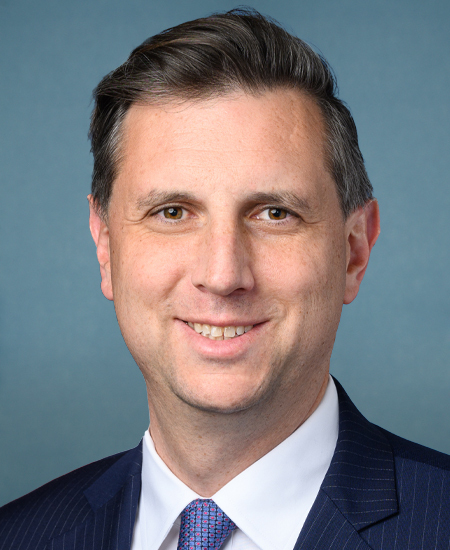
Rep. Seth Magaziner
Sponsored bills
Maddy summaryHR 7438 directs the U.S. Treasury to mint commemorative coins for the 2026 FIFA World Cup, including 100,000 $5 gold coins, 500,000 $1 silver coins, and 750,000 half-dollar coins. The coins will be sold to the public at face value plus surcharges ($35, $10, and $5 per coin, respectively), with all surcharge revenue paid to FWC2026 US, Inc. for U.S. soccer programs. These funds must support soccer initiatives, particularly in underserved communities and youth development, as specified in the bill. The coins are legal tender but will only be issued during 2026, with no net cost to the U.S. government.
Maddy summaryThis bill establishes the Southern New England Regional Commission (SERC) to support economic development across specific counties in Rhode Island, Connecticut, and Massachusetts. The commission will distribute federal grants starting in fiscal year 2025 to fund projects like transportation infrastructure, job training programs, healthcare access in distressed areas, renewable energy development, and maritime industry support. It directly affects local governments, tribes, and nonprofits in all Rhode Island counties, Connecticut’s Hartford, New Haven, Windham, Tolland, Middlesex, and New London counties, and Massachusetts’ Hampden, Plymouth, Barnstable, Essex, Worcester, and Bristol counties. The law creates a formal structure for regional collaboration on economic priorities without altering existing federal funding mechanisms.
Maddy summaryThe CASC Act establishes a National Climate Adaptation Science Center and nine Regional Climate Adaptation Science Centers to provide scientific expertise for managing natural resources, cultural resources, and ecosystem services in response to climate change. These centers will conduct research, provide education and training, and offer advisory services to Federal agencies, States, Indian Tribes, Tribal organizations, Native Hawaiian organizations, and other partners. The National Center will coordinate with regional centers, develop research priorities, and conduct five-year merit reviews to ensure high-quality climate adaptation science. The bill requires centers to work with diverse partners including Tribal Colleges and Universities, Historically Black Colleges and Universities, and minority-serving institutions to ensure inclusive climate adaptation science.
Maddy summaryHR 6751 authorizes the U.S. Mint to produce commemorative coins honoring Roberto Clemente, a Hall of Fame baseball player and humanitarian, including 50,000 $5 gold coins, 400,000 $1 silver coins, and 750,000 half-dollar coins. The coins must feature Clemente's image and inscriptions like "Roberto Clemente" and "2027," with all sales including a surcharge ($5-$35 per coin) paid to the Roberto Clemente Foundation. The foundation, which supports youth sports, education, and disaster relief programs, will use these funds for its mission, while the U.S. Treasury must recover all production costs. The coins will be sold exclusively in 2027, with no net cost to the government.
Maddy summaryHR 10273 directs the Secretary of Defense to study the health effects of indoor mold in military housing, specifically focusing on risks to service members, their families, and children living in covered housing (including unaccompanied and family housing). The study must examine harmful mold types, detection methods, health impacts like respiratory illnesses, and the effect on military readiness. Based on the study, the Department of Defense must develop model standards for preventing, detecting, and remediating mold, including new construction requirements to control moisture and ventilation. The bill also requires training military health professionals on mold-related illnesses and mandates public review of proposed standards.
Maddy summaryThis bill allows National Guard and Reserve members to count their active duty service toward student loan forgiveness requirements. Specifically, it deems months of qualifying military service (excluding deployments over 30 days) as equivalent to making monthly loan payments, calculated by dividing days served by 20 and rounding to the nearest whole month. Members must serve at least 10 days in a year to earn credit, and the bill removes the annual limit of 12 qualifying payments, allowing credit for more than 12 months if service qualifies. It directly affects Reserve component members of the Armed Forces who hold eligible federal student loans.
Maddy summaryThis bill requires the Secretary of Energy to determine if proposed natural gas exports to foreign countries are "consistent with the public interest" before approving them. To make this determination, the Secretary must evaluate three specific assessments: (1) climate impacts using full lifecycle emissions data and methane's 20-year warming potential, (2) economic effects on specific consumer groups like low-income households and manufacturers, and (3) environmental justice concerns affecting vulnerable communities. The Secretary must complete this review within one year of receiving the Federal Energy Regulatory Commission's environmental impact statement. The law also mandates public participation opportunities and treats export approvals as "major Federal actions" under environmental law.
Maddy summaryThe Zero-Emission Vessel Innovation Act establishes a $1 billion annual fund (2025-2034) to support research, development, and deployment of zero-emission vessels and their infrastructure, such as charging stations for electric ships or clean fuel systems. Eligible entities - including vessel operators, manufacturers, ports, and research institutions - can apply for grants, low-interest loans, or loan guarantees to cover costs for projects meeting specific priorities like reducing costs, improving environmental justice, and training workers. The program requires prioritizing projects with additional environmental benefits (e.g., reduced underwater noise) and mandates annual public reporting on funded projects. An advisory committee of industry, labor, and environmental experts will guide the program and assess progress toward clean shipping technology goals.
Maddy summaryHR 10165, the Security Clearance Review Act, requires the FBI Director to approve security clearances and access to classified information for political appointees working in the Executive Office of the President. It prohibits such appointees from holding clearances or accessing classified information without the FBI Director’s explicit authorization. If the FBI denies clearance, the Director must immediately notify the President and Congress. If the President overrides this denial, they must provide a written explanation to Congress within 30 days. The bill directly affects political appointees in the White House and establishes new oversight steps for security clearance decisions.