

Women's Health Protection Act of 2021 This bill prohibits governmental restrictions on the provision of, and access to, abortion services. Specifically, governments may not limit a provider's ability to prescribe certain drugs, offer abortion services via telemedicine, or immediately provide abortion services when the provider determines a delay risks the patient's health. Furthermore, governments may not require a provider to perform unnecessary medical procedures, provide medically inaccurate information, comply with credentialing or other conditions that do not apply to providers whose services are medically comparable to abortions, or carry out all services connected to an abortion. In addition, governments may not (1) require patients to make medically unnecessary in-person visits before receiving abortion services or disclose their reasons for obtaining such services, or (2) prohibit abortion services before fetal viability or after fetal viability when a provider determines the pregnancy risks the patient's life or health. The bill also prohibits other governmental measures that are similar to the bill's specified restrictions or that otherwise single out and impede access to abortion services, unless a government demonstrates that the measure significantly advances the safety of abortion services or health of patients and cannot be achieved through less restrictive means. The Department of Justice, individuals, or providers may bring a lawsuit to enforce this bill, and states are not immune from suits for violations. The bill applies to restrictions imposed both prior and subsequent to the bill's enactment.
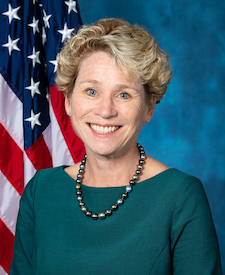
Rep. Chrissy Houlahan
Sponsored bills
This resolution supports the designation of a National FFA Week. It also (1) recognizes the important role of the National FFA Organization (Future Farmers of America) in developing the next generation of leaders who will change the world, and (2) celebrates 70 years of the National FFA Organization's membership magazine.
America's Call To Improve Opportunities Now for National Service Act or the ACTION for National Service Act This bill (1) converts the Corporation for National and Community Service into the AmeriCorps Administration and revises its membership, leadership, and authority; (2) reauthorizes programs carried out by the administration; (3) establishes a National Service Foundation to accept and administer gifts on behalf of the administration; (4) modifies the calculation of national service educational awards; and (5) otherwise modifies provisions related to national and volunteer service programs. Additionally, the bill creates an interagency Civilian Climate Corps, operated by the administration, to conduct service projects addressing climate change.
Maddy summaryHRES 939 is a symbolic House resolution expressing support for designating February 21-25, 2022, as "Public Schools Week." It does not create new policies, allocate funding, or impose requirements on schools or students. The resolution uses supportive language to acknowledge public education's role in democracy but has no legal effect. It was introduced by multiple representatives as a non-binding gesture of appreciation for public schools.
This resolution condemns the atrocities and possible crimes against humanity being perpetrated against women and girls in Ethiopia. It also supports the full investigation of atrocities against women and girls in Tigray, Amhara, Afar, and other parts of northern Ethiopia.
This resolution supports the goals and ideals of National Engineers Week to increase understanding of, and interest in, engineering and technology careers. The resolution recognizes that engineering education is a critical component of STEM (science, technology, engineering, and mathematics) education.
This resolution expresses that the House of Representatives (1) remains committed to nurturing the enduring ties between the people and the governments of the United States and Liberia; (2) encourages Liberia to redouble its efforts to counter corruption, advance the causes of human rights, and implement critical economic reforms necessary to accelerate sustainable economic growth and human capital development; (3) calls on the Departments of State and the Treasury to continue to impose targeted sanctions and other measures against those responsible for undermining the rule of law in Liberia and the faith and trust of the Liberian people; (4) recalls the significance of the bicentennial of the arrival of the first free Black American in Liberia; and (5) supports the continuing efforts and contributions of the Liberian diaspora in the United States.
Health Care for Burn Pit Veterans Act This bill updates policies and procedures related to Department of Veterans Affairs (VA) health care and benefits for veterans who have been exposed to toxic substances. Specifically, the bill extends the eligibility period for VA hospital care, medical services, and nursing home care for combat veterans who served after September 11, 2001, and were exposed to toxic substances, radiation, or other conditions, including those who did not enroll to receive VA care during the eligibility period. The VA must incorporate into its existing health care screening a screening to help determine potential exposures to toxic substances during military service. Among other requirements, the VA must also provide annual training to health care and benefits personnel with respect to veterans who were exposed to toxic substances; analyze total and respiratory disease mortality in veterans who served in specified locations on specified dates; conduct an epidemiological study on the health trends of veterans who served in the Armed Forces after September 11, 2001; conduct a study to determine trends in the rates of the incidence of cancer in veterans; publish a list of VA resources for veterans who were exposed to toxic substances, families and caregivers of such veterans, and survivors of such veterans who are receiving death benefits; and report on the data quality of the Individual Longitudinal Exposure Record and its usefulness in supporting veterans in receiving VA health care and benefits.
Global Respect Act This bill imposes visa-blocking sanctions on foreign persons responsible for or complicit in violating the human rights of individuals due to actual or perceived sexual orientation, gender identity, or sex characteristics. The President must report and periodically update a list of foreign persons responsible for such human rights violations and apply sanctions accordingly. The Department of State must designate at least one senior officer who shall be responsible for tracking violence and discrimination against individuals based on actual or perceived sexual orientation, gender identity, or sex characteristics in foreign countries.
Keeping School Meals Flexible Act This bill extends authority through June 30, 2023, for the Department of Agriculture (USDA) to waive certain requirements for the school meal programs to address COVID-19. The bill extends the authority for USDA to issue a single waiver of child nutrition program requirements to all states under the National School Lunch Program for purposes of providing meals and snacks with appropriate safety measures with respect to COVID-19; grant waivers of requirements to allow non-congregate feeding in the Child and Adult Care Food Program for purposes of providing meals and snacks with appropriate safety measures with respect to COVID-19; and grant waivers related to the nutritional content of meals served in child nutrition programs if it determines the waiver is necessary to provide meals and snacks, and there is a food supply chain disruption due to COVID-19.