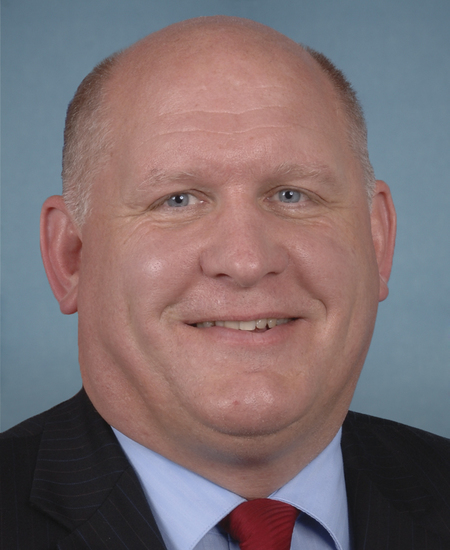
Photo of Glenn Thompson
R United States House · District 15 · Pennsylvania On the 2026 ballot

Rep. Glenn Thompson

Compare
Total votes
2,837
all sessions
Attendance
99%
37 missed
Near the chamber average
With party
93%
of cast votes
Near the chamber average
Bipartisan score
4%
crosses aisle rarely
Near the chamber average
Sponsored
963
bills & resolutions
Near the chamber average
Committees
4
assignments
963 bills and resolutions

Sponsored bills

Total
963
Primary
96
Co-sponsor
867
This page
963
matching current filters
Co-sponsor HRES 118
In committee · Indiana House · Co-sponsor
Expressing support for the Iranian people's desire for a democratic, secular, and nonnuclear Republic of Iran and condemning violations of human rights and state-sponsored terrorism by the Iranian Government.

This resolution condemns Iranian state-sponsored terrorist attacks against U.S. citizens and officials and Iranian dissidents and expresses support for the people of Iran who are engaged in legitimate and peaceful protests against the Iranian regime.

In committee Apr 2, 2021 1 co-sponsor
Co-sponsor HR 2294
In committee · Indiana House · Co-sponsor
Historic Tax Credit Growth and Opportunity Act of 2021

Historic Tax Credit Growth and Opportunity Act of 2021 This bill increases the rehabilitation tax credit and modifies certain requirements for the credit. The bill increases the rate of the credit for qualified rehabilitation expenditures in taxable years beginning after December 31, 2019, and before January 1, 2027, after which the rate reverts to 20%. The bill increases the rate of the credit to 30% for certain small projects whose qualified rehabilitation expenditures do not exceed $2.5 million. The bill also expands the types of buildings eligible for rehabilitation by decreasing the rehabilitation threshold from 100% to 50% of project expenses. It also eliminates the basis adjustment requirement for the credit and modifies rules relating to tax-exempt use property eligible for the credit.

In committee Apr 1, 2021 1 co-sponsor
Co-sponsor HR 2351
In committee · Indiana House · Co-sponsor
911 SAVES Act

Supporting Accurate Views of Emergency Services Act of 2021 or the 911 SAVES Act This bill requires the Office of Management and Budget, by 30 days after the bill's enactment, to categorize public safety telecommunicators as a protective service occupation under the Standard Occupational Classification System.

In committee Apr 1, 2021 1 co-sponsor
Co-sponsor HR 2213
In committee · Indiana House · Co-sponsor
Safe Routes Act of 2021

Safe Routes Act of 2021 This bill directs the Department of Transportation to waive vehicle weight limits for covered logging vehicles. The term covered logging vehicle means a vehicle that (1) is transporting raw or unfinished forest products, including logs, pulpwood, biomass, or wood chips; (2) is traveling a distance not greater than 150 air miles from origin to a storage or processing facility; and (3) meets state legal weight tolerances and vehicle configurations for transporting raw or unfinished forest products within the state boundaries in which the vehicle is operating.

In committee Mar 29, 2021 1 co-sponsor
Co-sponsor HR 1145
In committee · Indiana House · Co-sponsor
To direct the Secretary of State to develop a strategy to regain observer status for Taiwan in the World Health Organization, and for other purposes.

This bill directs the Department of State to include additional information in its annual reports concerning Taiwan's participation at the World Health Organization's World Health Assembly (WHA) as an observer. The report shall describe changes and improvements to the State Department's plan to support Taiwan's observer status at the WHA, following any meetings at which Taiwan did not participate under such status. (China has opposed Taiwan's participation in the WHA.)

In committee Mar 25, 2021 1 co-sponsor
Co-sponsor HR 2168
In committee · Indiana House · Co-sponsor
Expanded Telehealth Access Act

Expanded Telehealth Access Act This bill permanently allows audiologists, physical therapists, occupational therapists, speech-language pathologists, and other providers designated by the Centers for Medicare & Medicaid Services (CMS) to provide telehealth services under Medicare. Currently, the CMS is authorized to waive requirements for Medicare telehealth services during the public health emergency relating to COVID-19, and it has done so to allow all providers that are otherwise eligible to furnish in-person services under Medicare to also furnish telehealth services.

In committee Mar 24, 2021 1 co-sponsor
Co-sponsor HR 2163
In committee · Indiana House · Co-sponsor
Safe Step Act

Safe Step Act This bill requires a group health plan to establish an exception to medication step-therapy protocol in specified cases. A medication step-therapy protocol establishes a specific sequence in which prescription drugs are covered by a group health plan or a health insurance issuer.  A request for such an exception to the protocol must be granted if (1) an otherwise required treatment has been ineffective, (2) such treatment is expected to be ineffective and delaying effective treatment would lead to irreversible consequences, (3) such treatment will cause or is likely to cause an adverse reaction to the individual, (4) such treatment is expected to prevent the individual from performing daily activities or occupational responsibilities, (5) the individual is stable based on the prescription drugs already selected, or (6) there are other circumstances as determined by the Employee Benefits Security Administration. The bill requires a group health plan to implement and make readily available a clear process for an individual to request an exception to the protocol, including required information and criteria for granting an exception. The bill further specifies timelines under which plans must respond to such requests.

In committee Mar 23, 2021 1 co-sponsor
Co-sponsor HR 1220
In committee · Indiana House · Co-sponsor
Pennsylvania National Heritage Areas Reauthorization Act

Pennsylvania National Heritage Areas Reauthorization Act This bill reauthorizes in Pennsylvania through FY2036 the Rivers of Steel National Heritage Area, the Lackawanna Valley National Heritage Area, the Delaware and Lehigh National Heritage Corridor, the Schuylkill River Valley National Heritage Area, and the Oil Region National Heritage Area. The bill eliminates the limitation on the total amount that may be appropriated for the Rivers of Steel National Heritage Area, the Lackawanna Valley National Heritage Area, the Schuylkill River Valley National Heritage Area, and the Oil Region National Heritage Area.

In committee Mar 23, 2021 1 co-sponsor
Co-sponsor HR 1603
Passed · Indiana House · Co-sponsor
Farm Workforce Modernization Act of 2021

Farm Workforce Modernization Act of 2021 This bill contains provisions related to alien farmworkers, including provisions establishing a certified agricultural worker (CAW) status and changing the H-2A temporary worker program. The Department of Homeland Security (DHS) may grant CAW status to an applying alien who (1) performed at least 1,035 hours of agricultural labor during the two-year period prior to March 8, 2021; (2) on that date was inadmissible, deportable, or under a grant of deferred enforced departure or temporary protected status; and (3) has been continuously present in the United States from that date until receiving CAW status. The bill imposes additional crime-related inadmissibility grounds on CAW applicants and makes some other grounds inapplicable. CAW status shall be valid for 5.5 years and may be extended. DHS may grant dependent status to the spouse or children of a principal alien. An alien with a pending application may not be detained or removed by DHS and shall be authorized for employment until DHS makes a final decision on the application. A CAW alien (and dependents) may apply for lawful permanent resident status after meeting various requirements, including performing a certain amount of agricultural labor for a number of years. DHS shall create an electronic platform for (1) filing H-2A petitions, (2) facilitating the processing of H-2A cases, and (3) providing agencies a single tool for obtaining H-2A-related case information. The bill makes various changes to the H-2A program, such as (1) modifying the method for calculating and making adjustments to the H-2A worker minimum wage, (2) specifying how an employer may satisfy requirements that it attempted to recruit U.S. workers, (3) requiring H-2A employers to guarantee certain minimum work hours, (4) making the program available for agricultural work that is not temporary or seasonal, and (5) reserving a visa allocation for the dairy industry. DHS shall establish a pilot program allowing certain H-2A workers to apply for portable status, which gives the worker 60 days after leaving a position to secure new employment with a registered H-2A employer. DHS shall establish an electronic system patterned on the E-Verify Program for employers to verify an individual's identity and employment authorization. Employers hiring individuals for agricultural employment must use the system. This bill permanently establishes the Housing Preservation and Revitalization Program, which provides financing assistance for rural rental housing and off-farm labor housing and rental assistance for qualified tenants of such housing. It also authorizes the Department of Agriculture to provide various assistance, including funding for insuring loans and grants for new farmworker housing.


Passed Mar 22, 2021 1 co-sponsor
Co-sponsor HR 845
In committee · Indiana House · Co-sponsor
VA Billing Accountability Act

VA Billing Accountability Act This bill authorizes the Department of Veterans Affairs (VA) to waive the requirement that a veteran make co-payments for medications, hospital care, nursing home care, and medical services in certain situations. Specifically, a veteran may have such co-payments waived if (1) an error committed by the VA or a non-VA facility delayed co-payment notification to the veteran, and (2) the veteran received such notification later than 180 days (18 months in the case of a non-VA facility) after the date on which the veteran received the care or services. In requiring a veteran to make a co-payment for care or services provided at a VA or a non-VA medical facility, the VA shall notify the veteran not later than 180 days (18 months in the case of a non-VA facility) after the date on which the veteran received the care or services. If the VA does not provide notification by such date, it may not collect the payment, including through a third-party entity, unless the veteran is provided with (1) information about applying for a waiver and establishing a payment plan with the VA, and (2) an opportunity to make a waiver or establish a payment plan. Finally, the bill requires the VA to review and improve its co-payment billing internal controls and notification procedures.

In committee Mar 22, 2021 1 co-sponsor
Showing 901 to 910 of 963 bills
Previous 1 … 90 91 92 … 97 Next