Daniel Anderl Judicial Security and Privacy Act of 2021 This bill generally prohibits federal agencies and private businesses from publicly posting the personally identifiable information (e.g., home addresses) of federal judges and their immediate family members. It also (1) requires information to be removed upon written request from the federal judge concerned, (2) prohibits data brokers from purchasing or selling such information, and (3) establishes programs to protect such information at the state and local level and to enhance security for judges.
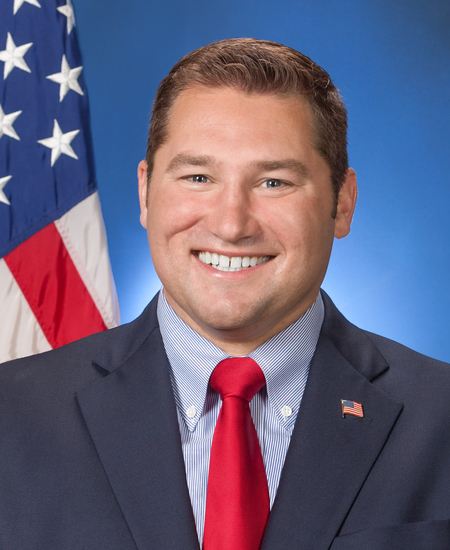
Rep. Guy Reschenthaler
Sponsored bills
No Frivolous Application for Short-Barreled Shotguns Act or the NFA SBS Act This bill removes certain short-barreled shotguns from the definition of firearms for purposes of the National Firearms Act. It also eliminates the prohibition on the sale or transportation of such shotguns in interstate commerce and treats persons who acquire or possess a short-barreled shotgun as meeting the registration or licensing requirements for such shotguns where such requirements are determined by reference to the National Firearms Act. The bill preempts state or local laws that impose a tax or recordkeeping requirements on short-barreled shotguns. The Department of Justice must destroy records relating to the registration of shotguns described by this bill within one year after the enactment of this bill.
H-2B Returning Worker Exception Act of 2021 This bill modifies the H-2B (temporary nonagricultural workers) nonimmigrant visa program, including by exempting certain workers from an annual numerical limit on such visas and requiring civil penalties for program violations. Under this bill, if a worker seeking a H-2B visa has been counted toward the 66,000 annual cap on such visas in one of the three preceding fiscal years, that worker shall not be counted against the cap again. Furthermore, the Department of Homeland Security (DHS) must impose a civil monetary penalty on an employer for (1) failing to meet requirements related to an H-2B visa petition, or (2) making a willful misrepresentation of material fact in such a petition. DHS must also ensure the establishment of an electronic platform (1) for employers to submit and request approval of an H-2B petition, and (2) to act as a single point of access for applicants and the relevant government agencies. The Department of Labor must maintain a publicly available online database of all job orders by H-2B employers. Furthermore, Labor may take certain actions to enforce program requirements, such as imposing penalties and seeking injunctions. The bill provides statutory authority for the current practice of limiting the program to workers who are nationals of countries approved by DHS. DHS may make exceptions to this limitation in individual cases if it is in the U.S. interest to do so. DHS shall select approved countries based on various factors, such as the rate of overstay by H-2B visa holders from each country.

Preventing Anti-Semitic Hate Crimes Act This bill requires a designated officer or employee of the Department of Justice (DOJ) to facilitate the expedited review of anti-Semitic hate crimes and reports of anti-Semitic hate crimes. Further, the bill requires DOJ to issue guidance for state, local, and tribal law enforcement agencies on expanding public education campaigns to raise awareness of anti-Semitic hate crimes. Finally, the bill increases the statutory maximum prison term for an individual who is convicted of a federal hate crime offense after a prior conviction for a hate crime offense under federal law or a hate crime felony under state law.
Illegal Immigration Penalty Enhancement Act of 2021 This bill establishes criminal penalties for certain aliens who reenter the United States after deportation. Specifically, an alien who does not have lawful immigration status and has reentered the United States after deportation shall be imprisoned for not less than five years in a federal correctional facility. If an alien is convicted of this offense and another offense, the alien must serve the sentences for the offenses consecutively.
Separation of Powers Restoration Act of 202 1 This bill modifies the scope of judicial review of agency actions to authorize courts reviewing agency actions to decide de novo (i.e., without giving deference to the agency's interpretation) all relevant questions of law, including the interpretation of (1) constitutional and statutory provisions, and (2) rules made by agencies. No law may exempt a civil action from the standard of review required by this bill except by specific reference to such provision.
No Stolen Trademarks Honored in America Act This bill modifies the bar against U.S. courts enforcing or validating trademarks that were confiscated by the Cuban government. The bill prohibits U.S. courts from enforcing or validating such confiscated trademarks if the mark had been used in connection with a confiscated business or asset. Currently, the prohibition applies only if the confiscated trademark is being asserted in the United States by a Cuban national. Under the bill, the prohibition shall not apply if the original trademark owner, or a successor, has expressly consented to the enforcement action. The prohibition shall apply only if the entity asserting the trademark rights knew or should have known, when it acquired the rights, that the mark was the same or substantially similar to one connected to a confiscated business or asset.
Securing America's Mineral Supply Chains Act of 2022 This bill addresses various matters related to mineral resources and ensuring adequate supply chains for them, with a particular focus on minerals that are critical to the U.S. economy and national security and critical energy resources. For example, the bill modifies various requirements related to permitting and other aspects of mining on federal land, including specific modifications related to critical energy resources; restricts mineral withdrawals on federal land and prohibits moratoria on or reversals of certain mineral leases, claims, or permits without congressional approval; establishes programs and requires activities to advance technologies for critical mineral production, carbon mineralization, and recovery of critical minerals from mine waste; provides support for workforce development related to mining; permits the inclusion of certain fuel minerals (e.g., uranium) on a list of minerals that are critical to the U.S. economy and national security; and requires efforts to diversify supply chains and promote domestic sources for critical energy resources.
Major Richard Star Act This bill provides that combat-disabled uniformed services retirees with fewer than 20 years of creditable service may concurrently receive, without reduction, veterans' disability compensation and retired pay or combat-related special compensation.
Combating the Persecution of Religious Groups in China Act This bill expresses the sense of Congress that the United States should promote religious freedom in China and makes statements of policy related to such freedom. In particular, the bill states that it is U.S. policy to consider senior Chinese government officials who are responsible for the persecution of Christians or other religious minorities in China to have committed (1) a gross violation of internationally recognized human rights for the purpose of imposing certain sanctions, and (2) a particularly severe violation of religious freedom for the purpose of determining whether such an individual is admissible into the United States.