

Maddy summaryHR 7634, the Plastic Pellet Free Waters Act, prohibits plastic pellets and pre-production plastic materials from being discharged into water through wastewater, spills, or runoff from specific facilities. It directly affects plastic polymer production facilities, plastic molding and forming facilities, and any point source (like packaging or transport operations) handling plastic pellets. The bill requires the EPA to issue a final rule within 60 days of enactment banning these discharges and updating all relevant wastewater, stormwater, and performance standards in permits and regulations. This creates a legal requirement for facilities to prevent plastic pellet pollution in waterways, targeting a major source of ocean plastic pollution.
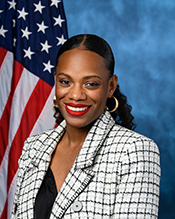
Rep. Summer L. Lee
Sponsored bills
Maddy summaryThis concurrent resolution (HCONRES 97) recognizes the gender wage gap, noting that women working full-time earn 84 cents for every dollar earned by men. It highlights racial disparities (e.g., Latinas earn 57 cents, Black women 69 cents) and the economic impact of the gap, including $965 billion in annual lost wages for women. As a symbolic resolution, it does not create new laws or policies but formally acknowledges the issue and reaffirms Congress’s commitment to addressing wage inequality.
Maddy summaryThis bill establishes the Dr. Percy and Dr. Anna Julian Home in Oak Park, Illinois, as a National Historic Site within the National Park System. It requires the Secretary of the Interior to finalize an agreement with the Julian Home for public access, interpretation, and maintenance before designation, and mandates a map of the site boundaries. The site aims to preserve and interpret the Julian family's achievements in chemistry and medicine, their history of overcoming racial discrimination, and their home's resilience against firebomb attempts. The National Park Service will manage the site under existing park system laws, with a management plan due within one year of funding. This designation directly affects the Julian Home property and future visitors, not policy or citizens.
Maddy summaryHRES 1068 is a symbolic House resolution condemning all forms of rape and sexual violence against women globally, both during conflicts and in peacetime. It specifically denounces the weaponization of sexual violence in recent conflicts (including Hamas attacks on Israel, Sudan, Ukraine, and others) and highlights ongoing issues in the U.S. and worldwide. The resolution calls for international action to hold perpetrators accountable and prioritize eliminating gender-based violence in conflict settings. As a non-binding statement, it does not create new laws or allocate funding but formally expresses congressional disapproval of sexual violence.
Maddy summaryHRES 1042 is a ceremonial resolution recognizing the historical significance of the Freedom House Ambulance Service, founded in Pittsburgh's Hill District in 1967. It acknowledges the service as the first U.S. ambulance program staffed by trained paramedics (beyond basic first aid), which pioneered national standards for prehospital emergency care - including life-saving techniques like field intubation and advanced trauma treatment. The resolution highlights how the service, established to provide job training and medical care in an underserved Black community, revolutionized emergency medical services nationwide before ending in 1975 due to political pressures. It does not create new laws or affect any policies - it solely commends the service's legacy and contributions to emergency medical care.
Maddy summaryThis bill establishes a federal task force to boost economic development and freight transportation along the Ohio, Allegheny, and Monongahela River corridors in Pennsylvania, West Virginia, Indiana, Illinois, Kentucky, Ohio, and Tennessee. The task force, composed of federal agencies, state representatives, and local stakeholders, will study waterway improvements, connect projects with funding, and submit annual reports on progress. It authorizes $5 million annually (2024-2034) to support these efforts, focusing on revitalizing communities impacted by deindustrialization and leveraging existing infrastructure investments.
Maddy summaryHR 6203 extends funding for the Emergency Food Assistance Program (EFAP) through fiscal year 2028, increasing annual commodity funding to $500 million per year for 2024-2028. It raises storage and distribution funding from $100 million to $200 million annually and creates new delivery options for geographically isolated states (Hawaii, Alaska, Puerto Rico, Northern Mariana Islands, U.S. Virgin Islands, and Guam), including allowing them to order through the Department of Defense Fresh Fruit and Vegetable Program. The bill also permits these states to use up to 20% of allocated funds to directly purchase locally grown food. Finally, it allows the Secretary to consider factors like product variety and transportation distance when awarding contracts for fresh produce packages, while maintaining nutritional goals.
This concurrent resolution honors the lives and work of Mary and John Meachum and recognizes the importance of the Mary Meachum Freedom Crossing, which is part of the National Underground Railroad Network to Freedom.
Maddy summaryThis bill designates the U.S. Postal Service facility at 28 East Airy Street in Norristown, Pennsylvania, as the "Charles L. Blockson Post Office Building." It directly affects the specific post office location and all official references to it. The key provision requires that all future government documents, maps, and records referencing this facility must use the new name. The bill makes no changes to postal services, operations, or affected individuals - only updating the facility's official designation. (Procedural naming bill; summary limited to 2 sentences as specified.)
Maddy summaryThis resolution proposes creating a Permanent Select Committee on Aging in the U.S. House of Representatives. The committee would study issues affecting older Americans - such as income security, healthcare, housing, and long-term care - without having the power to pass laws. It would review existing government and private programs, develop coordination strategies for aging-related services, and assess recommendations from the President or the White House Conference on Aging. The committee’s work would inform future policy discussions but would not directly change legislation.