

Maddy summaryThis bill (HR 9322) is a naming resolution that officially renames a U.S. Postal Service facility at 675 Wolf Ledges Parkway in Akron, Ohio, as the "Judge James R. Williams Post Office Building." It does not change any policies, services, or funding - it only updates the building's official name in all federal records, maps, and documents. The bill directly affects USPS administrative records and public references to the Akron facility. It was passed by Congress in December 2024 and signed into law on January 4, 2025.
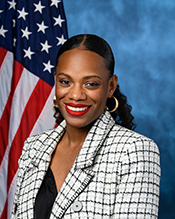
Rep. Summer L. Lee
Sponsored bills
Maddy summaryHR 7417 is a naming bill that would designate the United States Postal Service facility at 135 West Spring Street in Titusville, Pennsylvania as the "Edwin L. Drake Post Office Building." This bill does not change any laws or policies but simply provides a formal name for an existing post office location. The bill directly affects the USPS facility in Titusville by establishing its official name. This type of bill is purely ceremonial and affects no specific groups or policies beyond the naming of the building.
Maddy summaryHR 40 would establish a 15-member commission to study the legacy of slavery and systemic discrimination against African Americans in the United States, and develop proposals for reparations. The commission would examine historical and ongoing effects of slavery, discriminatory policies (including redlining and educational disparities), and recommend remedies through education and potential reparations. Composed of members appointed by the President, House Speaker, and Senate President pro tempore, the commission would have 18 months to submit a report to Congress, with $20 million authorized for its work. This legislation creates a study process but does not provide reparations directly.
Washington, D.C. Admission Act This bill provides for the establishment of the State of Washington, Douglass Commonwealth, and its admission into the United States. The state is composed of most of the territory of the District of Columbia (DC), excluding a specified area that encompasses the U.S. Capitol, the White House, the U.S. Supreme Court building, federal monuments, and federal office buildings adjacent to the National Mall and the U.S. Capitol. The excluded territory shall be known as the Capital and serve as the seat of the government of the United States, as provided for in Article I of the Constitution. The state may not impose taxes on federal property except as Congress permits. The bill provides for the DC Mayor to issue a proclamation for the first elections to Congress of two Senators and one Representative of the state. The bill eliminates the office of Delegate to the House of Representatives. The bill applies current DC laws to the state. DC judicial proceedings and contractual obligations shall continue under the state’s authority. The bill also provides for specified federal obligations to transfer to the state upon its certification that it has funds and laws in place to assume the obligations. These include maintaining a retirement fund for judges and operating public defender services. The bill establishes a commission that is generally comprised of members who are appointed by DC and federal government officials to advise on an orderly transition to statehood.
Maddy summaryThis bill (HR 4955) names a Department of Veterans Affairs community-based outpatient clinic in Monroeville, Pennsylvania, as the "Henry Parham VA Clinic." It directly affects the Monroeville VA clinic by changing its official name to honor Henry Parham, an African-American soldier who served in the segregated 320th Barrage Balloon Battalion during the D-Day invasion of Normandy in 1944. The bill makes no policy changes or funding adjustments - it only updates the clinic’s official designation and all references to it in government records to reflect this new name. The renaming commemorates Parham as the last surviving African-American combat veteran of the D-Day landings, who later volunteered at VA facilities in Pittsburgh.
Maddy summaryHR 10563 requires prime federal contractors to notify subcontractors about contract status within 30 days of a request, with a process for subcontractors to report delays to contracting officers. It mandates that agencies set small business utilization goals (minimum 50% for full contracts, 75% at contract stages) and withhold incentive fees if goals are unmet. The bill also directs agencies to host annual outreach events for veteran-owned, HUBZone, disadvantaged, and women-owned small businesses. Additionally, it orders studies on improving subcontractor complaint systems and using CPARS data to assess prime-subcontractor relationships.
Maddy summaryHR 10551, the HONORS Act, amends a section of U.S. military law to allow retired military members to serve at veterans' funerals under specific conditions. It directly affects veterans' families and military funeral honors teams by permitting retired members to participate when active-duty members aren't available nearby (within 50 miles) or when using retired members is fiscally necessary. The key provision requires the military secretary to determine availability or cost factors before permitting retired members, with family consent required. This change modifies existing eligibility rules without creating new funding or services.
Maddy summaryThe School Lunch Debt Cancellation Act of 2024 requires the Secretary of Agriculture to cancel all existing household debt for school meals under the National School Lunch Program and School Breakfast Program within 180 days of the bill’s enactment. This directly affects families who owe money for unpaid school lunches or breakfasts as of the bill’s effective date. The Secretary will use Commodity Credit Corporation funds to pay the cancelled debt amounts directly to local school districts, not to individual households. The law eliminates the financial obligation for these households without requiring new applications or eligibility reviews.
Maddy summaryThis bill creates a new federal grant program to expand STEM education opportunities for girls and underrepresented minorities in K-12 schools. Qualified local educational agencies (those serving schools with at least 40% of students eligible for free/reduced lunch) can apply for up to $250,000 annually per school year to fund specific activities like mentorship programs, teacher training on addressing bias, summer STEM camps, parent engagement, and field trips to STEM workplaces. The program is authorized for $10 million yearly from 2025-2028, requiring grantees to supplement existing funding and submit annual evaluations tracking student engagement and academic progress in STEM. It directly affects schools serving underrepresented student populations by providing targeted resources to increase their participation in STEM fields.
Maddy summaryThis bill requires all colleges receiving federal student aid (title IV programs) to conduct an annual survey measuring students' experiences with racial discrimination on campus. It mandates institutions to collect data on discrimination incidents, student preparedness for diverse environments, and satisfaction with how schools handle reports, then publish anonymized results publicly. Schools must also post clear anti-discrimination policies and complaint data, including how many reports they received from students and the Office for Civil Rights. The Department of Education will create a searchable online database of all submitted survey results, disaggregated by school and anonymized to protect student privacy.