Protect Democracy in Burma Act of 2021 This bill requires the Department of State to report to Congress on the military coup in Burma (Myanmar), including a description of U.S. efforts to (1) engage with the Association of Southeast Asian Nations to support a return to Burma's democratic transition and democratic values throughout Southeast Asia, and (2) influence the United Nations to hold accountable those responsible for the coup.
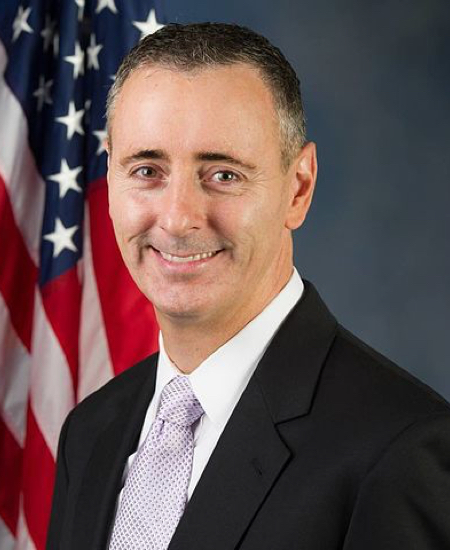
Rep. Brian K. Fitzpatrick
Sponsored bills
Puppies Assisting Wounded Servicemembers Act of 2021 or the PAWS Act of 2021 This bill requires the Department of Veterans Affairs (VA) to implement a grant program for the purpose of pairing service dogs with eligible veterans. Organizations that receive grants must provide veterinary health insurance coverage, hardware, and travel expenses for each service dog and veteran participating in the program. Eligible veterans are those who (1) are enrolled in the VA health care system, (2) have been evaluated and treated for post-traumatic stress disorder (PTSD) but remain diagnosed with PTSD, (3) may benefit from a service dog, and (4) agree to successfully complete training provided by an eligible organization. Veterans are required to see a VA health care provider at least once every six months to determine whether the veteran continues to benefit from a service dog. Eligible organizations are nonprofit organizations that provide service dogs to veterans with PTSD, meet publicly available standards set forth by the Association of Service Dog Providers for Military Veterans, have expertise in the needs of veterans with PTSD, agree to cover all costs in excess of the grant amount to guarantee the benefits of the program, agree to reaccept or replace a service dog provided to a veteran, and submit an application to the VA. Any improvement in PTSD symptoms as a result of the provision of a service dog shall not affect the veteran's eligibility for any other VA benefits. The Government Accountability Office must report on the grant program.
Improving Housing Outcomes for Veterans Act of 2021 This bill requires the Veterans Health Administration (VHA) to provide medical center staff and homelessness service providers of the Department of Veterans Affairs (VA) with information related to best practices for the collaboration on activities under the Department of Housing and Urban Development's Coordinated Entry program. The VA must also ensure that the information and related resources are accessible to VA medical center staff and homelessness service providers. Additionally, the bill requires the VHA to communicate with VA employees who have responsibilities related to homelessness assistance programs regarding (1) the measurement of performance by the VA's Homeless Program Office, and (2) how to obtain and provide feedback about the performance measures.
VA Billing Accountability Act This bill authorizes the Department of Veterans Affairs (VA) to waive the requirement that a veteran make co-payments for medications, hospital care, nursing home care, and medical services in certain situations. Specifically, a veteran may have such co-payments waived if (1) an error committed by the VA or a non-VA facility delayed co-payment notification to the veteran, and (2) the veteran received such notification later than 180 days (18 months in the case of a non-VA facility) after the date on which the veteran received the care or services. In requiring a veteran to make a co-payment for care or services provided at a VA or a non-VA medical facility, the VA shall notify the veteran not later than 180 days (18 months in the case of a non-VA facility) after the date on which the veteran received the care or services. If the VA does not provide notification by such date, it may not collect the payment, including through a third-party entity, unless the veteran is provided with (1) information about applying for a waiver and establishing a payment plan with the VA, and (2) an opportunity to make a waiver or establish a payment plan. Finally, the bill requires the VA to review and improve its co-payment billing internal controls and notification procedures.
Serve the People, Not the Swamp Act This bill establishes requirements for Members of Congress related to consideration of appropriations bills, lobbying activities, and retirement benefits. Specifically, the bill prohibits (1) the House of Representatives from adjourning for more than three calendar days in August until it has approved annual appropriations bills for the fiscal year beginning on October 1 of that year, and (2) Congress from adjourning for more than three calendar days between October 1 and the end of the congressional session until the annual appropriations bills are presented to the President. Neither chamber may recess or stand adjourned longer than 24 hours during any calendar year until Congress has agreed to a budget resolution for the fiscal year beginning on October 1 of such year that projects a balanced budget by the last fiscal year covered by the resolution. The bill establishes a five-year ban on (1) individuals appointed to executive schedule positions from engaging in lobbying activities in the executive branch, and (2) lobbying activities by Members of Congress. The Office of Government Ethics may waive lobbying restrictions for certain employees if it determines that the restrictions would create an undue hardship in obtaining qualified personnel for agency positions and granting such waiver would not create the potential for undue influence or unfair advantage. The bill excludes future Members of Congress from the Federal Employees Retirement System (FERS) and requires Members currently enrolled in FERS to opt in to continue their enrollment.
Luke and Alex School Safety Act of 2021 This bill requires the Department of Homeland Security (DHS) to establish a Federal Clearinghouse on School Safety Best Practices for use by state and local educational and law-enforcement agencies, institutions of higher education, health professionals, and the public. The bill requires DHS to collect clearinghouse data analytics, user feedback on the implementation of best practices and recommendations identified by the clearinghouse, and any evaluations conducted on these best practices and recommendations. In addition, DHS must coordinate with the Departments of Education, Health and Human Services, and Justice to assess and identify best practices and recommendations and establish an advisory board to provide feedback and propose additional recommendations. Further, the bill specifies the criteria for best practices and recommendations of the clearinghouse, including evidence that the best practice or recommendation has had a significant effect on improving the health, safety, and welfare of individuals in school settings. Finally, the bill provides for grant program review.

Research Advancing to Market Production for Innovators Act This bill provides commercialization services for federally funded small business research and development under the Small Business Innovation Research (SBIR) and Small Business Technology Transfer (STTR) programs. Specifically, the bill (1) expedites the application and award process for SBIR proposals and STTR solicitations, (2) requires determinations of commercialization potential for projects undertaken through SBIR and STTR awards, (3) provides continued flexibility of technical and business assistance for SBIR and STTR awardees, (4) instructs participating federal agencies to designate a technology commercialization official to help awardees commercialize, and (5) requires the Small Business Administration and the U.S. Patent Office to reach an interagency agreement to help SBIR and STTR awardees with intellectual property protection.
Just and Unifying Solutions To Invigorate Communities Everywhere Act of 2021 or the JUSTICE Act This bill addresses policies and issues regarding policing practices and law enforcement accountability. The bill funds state and local grants, incentivizes state and local reporting on the use of certain policing practices, creates new federal offenses for certain misconduct, and establishes best practices and training requirements. The bill funds state and local grants, including to support the use of body-worn cameras, to implement information sharing systems for disciplinary records of law enforcement officers, and to prohibit officers from engaging in sexual acts under color of the law. Further, it requires state and local governments that receive grants under the Edward Byrne Memorial Justice Assistance Grant program to report information related to use-of-force incidents and the use of no-knock warrants. At the federal level, the bill establishes new criminal offenses related to falsifying police reports and engaging in sexual acts under color of law. The bill directs the Department of Justice to develop training on de-escalation tactics, behavioral health crises, alternatives to the use of force, and the duty to intervene when another officer uses excessive force. Finally, the bill establishes and funds the National Criminal Justice Commission. Among other tasks, the commission must develop best practices for policing tactics and procedures.
This resolution supports the designation of National Rosie the Riveter Day and acknowledges the important role played by women during World War II.
This resolution condemns the military coup that took place in Burma (Myanmar) on February 1, 2021. It also calls on the Burmese military to (1) release all those detained arbitrarily in the coup, (2) restore all forms of communications, and (3) return to power all members of the civilian government.