

Continuous Improvement and Accountability in Organic Standards Act This bill requires the Department of Agriculture (USDA) to undertake rulemaking and other activities to implement certain recommendations of the National Organic Standards Board (a federal advisory board that considers and makes recommendations concerning the production, handling, and processing of organic products). Specifically, USDA must issue within a specified time line final rules for implementing recommendations approved (1) by the board between December 31, 2000, and the date of the bill's enactment; and (2) with at least two-thirds of the votes cast at a meeting where a quorum was present. If USDA determines issuing rules for such recommendations is not practicable, it must identify and report to Congress about the specific constraints that preclude rulemaking. In addition, the bill sets out a process and time line for USDA to implement through rulemaking future recommendations of the board that are approved by at least two-thirds of the votes cast at a meeting where a quorum was present. The bill also requires state officials or entities that certify organic farms or handling operations to report annually concerning the implementation of and compliance with any new rule or guidance.
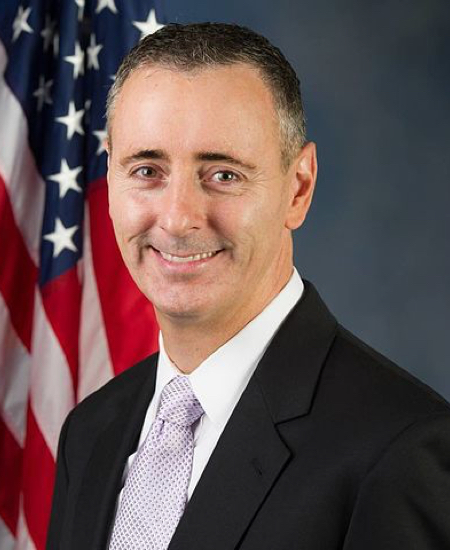
Rep. Brian K. Fitzpatrick
Sponsored bills
Puppy Protection Act of 2021 This bill requires the Department of Agriculture to expand standards that govern the humane handling, care, treatment, and transportation of animals to include new requirements for commercial dog dealers. Specifically, the standards must require dog dealers to provide to dogs adequate housing, exercise, and veterinary care; appropriate and nutritious food; continuous access to potable water; and meaningful socialization with humans and compatible dogs for at least 30 minutes each day. The standards must also include requirements for breeders to use safe breeding practices and make all reasonable efforts to find humane placement for retired breeding dogs.
Enhancing K-12 Cybersecurity Act This bill establishes resources and a program to address cybersecurity of elementary and secondary schools. First, the bill directs the Cybersecurity and Infrastructure Security Agency (CISA) to establish an information exchange to disseminate information, best practices, training, and resources to improve cybersecurity in elementary and secondary schools. In addition, CISA must establish a registry to track cyber incidents affecting information technology systems that are owned or managed by schools and educational agencies. Schools and educational agencies may voluntarily submit information to the registry. Finally, the bill requires CISA to establish a program to address cybersecurity threats to school information systems.
Traditional Cigar Manufacturing and Small Business Jobs Preservation Act of 2021 This bill exempts traditional large and premium cigars from Food and Drug Administration (FDA) regulation and FDA-assessed user fees.
No PFAS in Cosmetics Act This bill requires the Department of Health and Human Services to issue and finalize a rule to ban the use of intentionally added perfluoroalkyl or polyfluoroalkyl substances in cosmetics.
Campus Free Speech Restoration Act This bill addresses expressive activities (e.g., peacefully assembling, distributing literature, or carrying signs) on college campuses. First, the bill generally prohibits a public institution of higher education (IHE) that participates in federal student-aid programs from restricting noncommercial expressive activities on campus. Further, the bill prohibits a public IHE from receiving federal funds if the Department of Education determines that the public IHE (1) maintains a policy that infringes upon the expressive rights of students; or (2) maintains or enforces time, place, or manner restrictions on expressive activities, except in limited circumstances. In addition, the bill prohibits retaliation against an individual because the individual reported or complained about restrictions on expressive activities or participated in an investigation or hearing. The bill also requires a private IHE that receives federal funds to provide students with its policies related to expressive rights. The bill also establishes a framework for investigating complaints and for IHEs to regain eligibility for federal funds.
Clean Energy Production Parity Act This bill modifies the tax credit for investments in energy property to make qualified fuel cell property (certain fuel cell power plants) that uses an electromechanical process or includes a linear generator assembly eligible for the credit.
Senior Legal Hotline Act of 2021 This bill permits the Administration on Aging to award competitive grants to certain nonprofit organizations or partnerships to establish or maintain statewide senior legal hotlines to provide free services to older individuals.
Work Without Worry Act This bill modifies eligibility for Social Security Disability Insurance (SSDI) benefits for individuals who have a disability that began before age 22. Under current law, these individuals may obtain SSDI benefits based on the work record of a retired, disabled, or deceased parent. However, an individual with earnings after age 22 that exceed a specified monetary limit (i.e., constitute substantial gainful activity) permanently loses eligibility for such benefits. This bill allows individuals to retain eligibility for such benefits regardless of the amount of earnings after age 22. Additionally, individuals who apply for SSDI benefits on a parent's record and also independently qualify for Social Security benefits on their own record will receive the larger of the two benefit amounts.
Taiwan Peace and Stability Act This bill requires various reports to Congress related to Taiwan. The Department of State must report on (1) a strategy to advance Taiwan's meaningful participation in certain international organizations, and (2) a plan for strengthening Taiwan's community of civilian defense professionals. (China has taken actions to block Taiwan's participation in certain international organizations, such as opposing Taiwan's attendance at World Health Assembly meetings as an observer.) The U.S. Agency for International Development must report on cooperation with Taiwan on trilateral and multilateral development initiatives. The U.S. Trade Representative must report a legal template for establishing trade and investment agreements with Taiwan that is consistent with U.S.-Taiwan relations. The President must report a whole-of-government strategy to enhance deterrence over a military conflict between China and Taiwan. Among other matters, the strategy must include an examination of the present and future capabilities of the United States and Taiwan to respond to potential actions by China's military, such as a naval blockade. The Department of Defense must report on options for (1) supporting Taiwan's defense budgeting and procurement process in a way that is consistent with Taiwan's asymmetric defense strategy, and (2) strengthening Taiwan's implementation of its territorial defense force concept.